
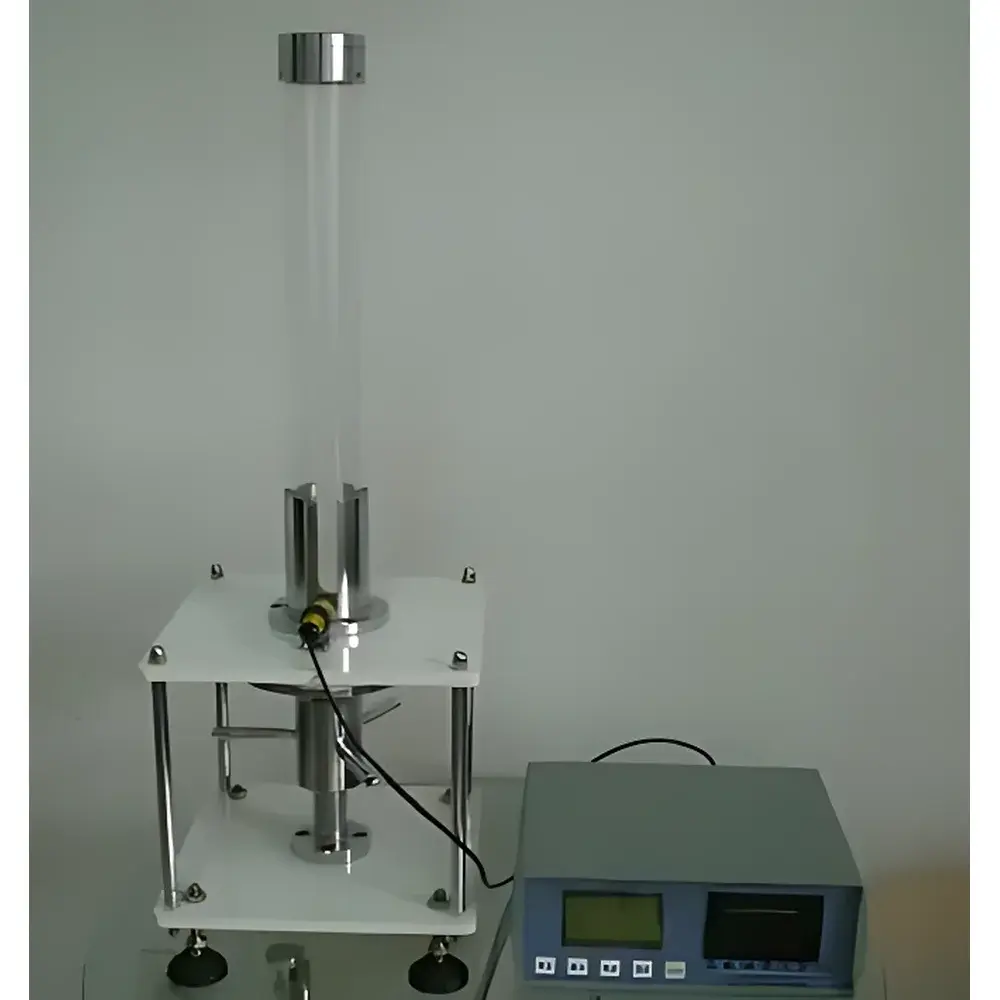
Beiguang Jingyi HMLQ-500 Falling Ball Resilience Tester
| Brand | Beiguang Jingyi / All Precision Instrument |
|---|---|
| Origin | Beijing, China |
| Manufacturer Type | OEM Manufacturer |
| Country of Origin | China |
| Model | HMLQ-500 |
| Price | Upon Request |
| Steel Ball Diameter | 16 mm |
| Drop Heights | 460 mm (GB/T 6670–2008), 500 mm (ASTM D3574) |
| Sample Dimensions | 100 mm × 100 mm × 50/100 mm |
| Rebound Rate Accuracy | <1% |
| Compliance Standards | GB/T 6670–2008, ISO 8307, ASTM D3574 |
| Control System | Microprocessor-based LCD interface with Chinese UI |
| Data Output | Integrated thermal mini-printer |
| Release Mechanisms | Dual-mode (manual + pneumatic/electromagnetic automatic) |
| Detection Method | High-speed precision photoelectric sensors |
| Height Adjustment | Motorized or precision mechanical fine-adjustment assembly |
| Leveling System | Integrated bubble-level and adjustable feet |
Overview
The Beiguang Jingyi HMLQ-500 Falling Ball Resilience Tester is a precision instrument engineered for the quantitative assessment of dynamic resilience in flexible polymeric foams—primarily soft polyurethane (PU) and viscoelastic sponge materials. It operates on the principle of free-fall impact mechanics: a standardized steel ball of defined mass and diameter is released from a calibrated height onto a horizontally positioned foam specimen; the maximum rebound height is optically captured, and the resilience value is calculated as the ratio (expressed in %) of rebound height to drop height. This method provides a repeatable, non-destructive, and internationally recognized metric for evaluating energy return characteristics critical to cushioning performance, comfort engineering, and long-term fatigue behavior in seating, bedding, packaging, and automotive interior applications.
Key Features
- Microprocessor-controlled test sequence with real-time digital display and on-board data logging
- Dual release modes: manually triggered release for operator verification and programmable automatic release for high-throughput testing under standardized conditions
- High-resolution photoelectric sensor array with sub-millimeter detection accuracy, ensuring consistent capture of peak rebound displacement
- Motorized or precision-machined height adjustment mechanism enabling rapid switching between GB/T 6670 (460 mm) and ASTM D3574 (500 mm) drop heights without recalibration
- Integrated horizontal leveling system with dual-axis bubble level and independent foot adjustment for geometric alignment per ISO 8307 requirements
- Steel ball trapping enclosure with shock-absorbing lining to prevent bounce interference and ensure operator safety during repetitive testing
- Thermal mini-printer for immediate hard-copy output of individual test records—including drop height, rebound height, calculated resilience %, date/time stamp, and sample ID
- Compliance-ready firmware architecture supporting audit trails and user-access logging (configurable for GLP/GMP environments)
Sample Compatibility & Compliance
The HMLQ-500 is validated for use with homogeneous, isotropic soft foam specimens measuring 100 mm × 100 mm × 50 mm or 100 mm (thickness options per standard requirements). Specimens must be conditioned at 23 ± 2°C and 50 ± 5% RH for ≥16 hours prior to testing, in accordance with ISO 293 and ASTM D638 conditioning protocols. The instrument fully conforms to the test methodology stipulated in three major international standards: GB/T 6670–2008 (Chinese National Standard), ISO 8307:2017 (Foam plastics — Determination of resilience by the falling ball method), and ASTM D3574–22 (Standard Test Methods for Flexible Cellular Materials — Slab, Bonded, and Molded Urethane Foams). It supports both Method A (single-drop measurement) and Method B (multi-drop statistical averaging) as defined in ASTM D3574 Section 12.
Software & Data Management
While the HMLQ-500 operates via embedded microcontroller firmware with no external PC dependency, its data architecture supports traceability and regulatory compliance. All test events—including operator ID (via manual entry), timestamp, environmental notes, raw sensor outputs, and final resilience calculations—are stored in non-volatile memory and printed locally. Optional RS-232 or USB-to-serial interface enables export of CSV-formatted datasets for integration into LIMS or QA documentation systems. Firmware supports configurable pass/fail thresholds, batch reporting, and average rebound rate computation across up to 10 consecutive drops—meeting minimum statistical robustness criteria outlined in ISO/IEC 17025 Clause 7.7 for testing laboratories.
Applications
This instrument serves quality control laboratories in foam manufacturing, automotive component suppliers, furniture OEMs, mattress producers, and contract testing facilities. Typical use cases include incoming raw material verification against supplier specifications; in-process monitoring of foam curing kinetics and formulation consistency; R&D evaluation of additive effects (e.g., flame retardants, fillers, crosslink density modifiers); and validation of aging or compression-set resistance after thermal/humidity cycling. Its results directly inform decisions related to product certification (e.g., CertiPUR-US®, OEKO-TEX® Standard 100), warranty claims analysis, and failure mode investigation in end-use applications involving dynamic loading.
FAQ
What standards does the HMLQ-500 comply with?
It complies with GB/T 6670–2008, ISO 8307:2017, and ASTM D3574–22 for falling-ball resilience testing of flexible polymeric foams.
Can the instrument test specimens thicker than 100 mm?
No—the test fixture geometry and sensor field-of-view are optimized for 50 mm and 100 mm thicknesses per standard-defined specimen dimensions.
Is calibration certification included with shipment?
A factory calibration report traceable to NIM (National Institute of Metrology, China) is provided; users are advised to perform annual verification using certified height gauges and reference steel balls.
Does the system support FDA 21 CFR Part 11 compliance?
The base configuration does not include electronic signature or audit trail features required for full Part 11 compliance; however, optional firmware upgrades with role-based access control and electronic logbook functionality are available upon request.
What maintenance is required for long-term accuracy?
Monthly inspection of sensor alignment, quarterly cleaning of optical pathways, biannual verification of release mechanism timing jitter (<±2 ms), and annual recalibration of height measurement subsystem are recommended per ISO/IEC 17025 preventive maintenance guidelines.



