
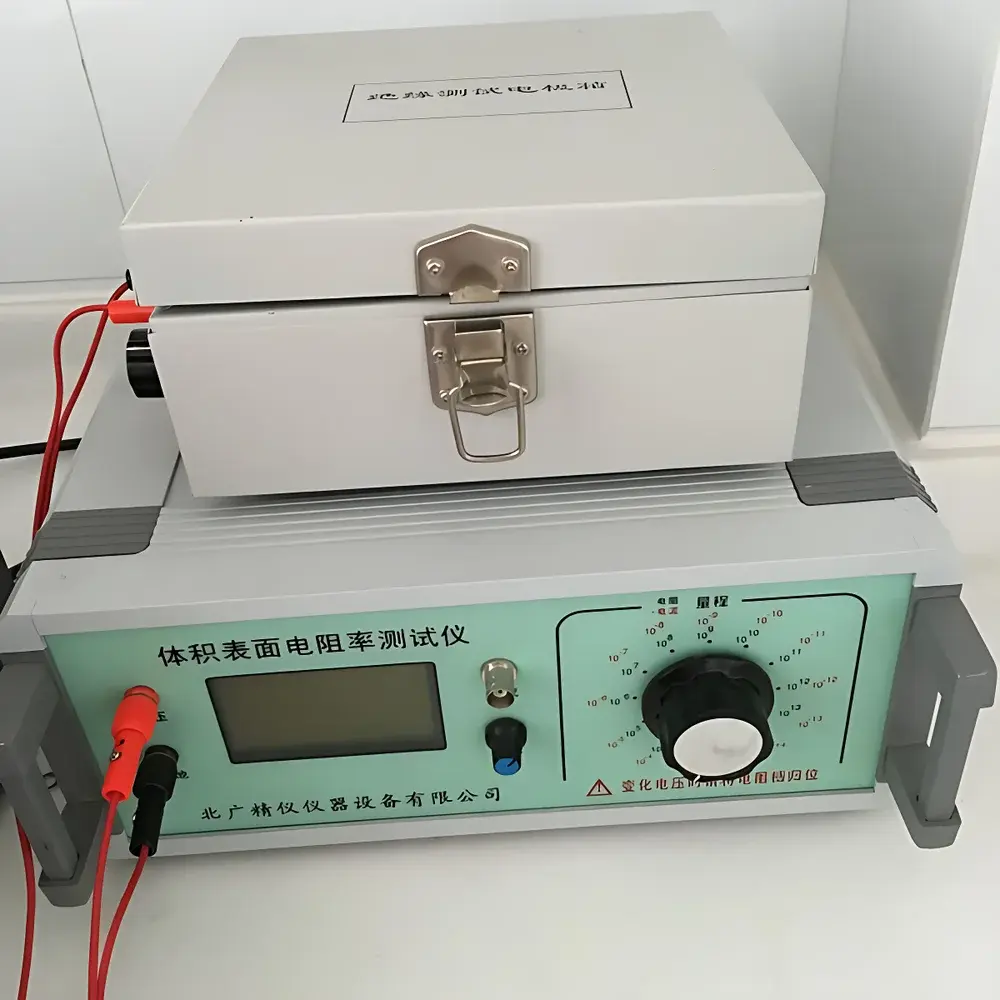
Beiguang BEST-121 Surface & Volume Resistivity Tester for Polymer Films and Rubber Materials
| Brand | Beiguang Precision Instrument |
|---|---|
| Origin | Beijing, China |
| Manufacturer Type | Direct Manufacturer |
| Country of Origin | China |
| Model Series | Beiguang BEST Series |
| Resistance Range | 1×10⁴ Ω to 1×10¹⁸ Ω |
| Current Range | 2×10⁻⁴ A to 1×10⁻¹⁶ A |
| Test Voltages | 10 V, 50 V, 100 V, 250 V, 500 V, 1000 V (selectable) |
| Accuracy | ±2% |
| Display | Dual 3.1/2-digit LED readouts (resistance & current) |
| Compliance | GB/T 1410–2006, ASTM D257–99 |
| Dimensions | 285 mm × 245 mm × 120 mm |
| Weight | 2.5 kg |
| Power Supply | AC 220 V, 50 Hz, ~5 W |
Overview
The Beiguang BEST-121 Surface & Volume Resistivity Tester is a precision digital high-resistance meter engineered for quantitative evaluation of electrical insulation and antistatic performance in polymeric thin films, elastomers, and solid dielectric materials. It operates on the fundamental principle of Ohm’s Law (R = V/I), but distinguishes itself from conventional electrometers by simultaneously measuring both applied DC test voltage and resulting current through a proprietary analog front-end and high-stability A/D conversion architecture. Unlike traditional analog or single-parameter high-resistance meters—whose scale nonlinearity and sensitivity to source drift compromise resolution at extreme resistance values—the BEST-121 employs dual-sensor acquisition and real-time computational division to deliver linear, stable, and traceable resistance values across its full 14-decade range (10⁴ Ω to 10¹⁸ Ω). This architecture ensures minimal dependence on power supply fluctuations, electrode polarization effects, or ambient humidity variations within specified operating limits (0–40 °C, <80% RH). Designed specifically for R&D laboratories, QC departments in polymer film manufacturing, and ESD control validation in electronics assembly facilities, the instrument supports standardized tri-electrode configuration per GB/T 1410 and ASTM D257, enabling independent determination of surface resistivity (ρₛ) and volume resistivity (ρᵥ) under controlled DC bias conditions.
Key Features
- Simultaneous dual-channel measurement of DC voltage and current with real-time digital resistance calculation
- Tri-electrode test fixture compatibility for compliant surface/volume resistivity separation per GB/T 1410–2006 and ASTM D257–99
- Six-step programmable test voltage selection (10 V to 1000 V DC), optimized for material-specific polarization response and leakage current minimization
- Dual 3.1/2-digit LED displays showing resistance (Ω) and current (A) concurrently—enabling direct dark-current assessment for photodetector characterization
- High-resolution current measurement down to 1×10⁻¹⁶ A, supporting low-conductivity polymer and ultra-high-purity insulator analysis
- Compact benchtop form factor (285 × 245 × 120 mm) with integrated shielding and low-noise grounding design to suppress electromagnetic interference
- Stable thermal management and low-power consumption (~5 W) for extended unattended operation during long-duration resistivity drift studies
Sample Compatibility & Compliance
The BEST-121 is validated for use with rigid and flexible dielectric substrates including PET, PI, PC, and PVC films; vulcanized rubber sheets; antistatic flooring composites; and molded thermoplastic components. Its tri-electrode system accommodates standard sample dimensions (e.g., 100 mm × 100 mm square or Ø100 mm circular specimens) per IEC 62631-3-1 and ASTM F150. All electrical safety and metrological performance comply with GB/T 1410–2006 (equivalent to IEC 60093) and ASTM D257–99 (reapproved 2020). The instrument’s calibration traceability aligns with national standards maintained by CNAS-accredited laboratories in China. While not FDA 21 CFR Part 11–compliant out-of-the-box, its deterministic measurement output and manual data logging support GLP/GMP documentation workflows when paired with controlled procedural records.
Software & Data Management
The BEST-121 operates as a standalone hardware platform without embedded firmware-based data storage or USB connectivity. Measurement values are displayed in real time and intended for manual transcription into laboratory notebooks or LIMS-compatible spreadsheets. For regulated environments requiring audit trails, users may integrate external digital multimeters with RS-232 or GPIB interfaces via third-party DAQ systems. All test parameters—including selected voltage, elapsed measurement time, and environmental conditions—are recorded manually per internal SOPs. The absence of onboard memory or network capability eliminates cybersecurity risks associated with connected instrumentation and simplifies validation for ISO/IEC 17025-accredited testing labs.
Applications
- Quantification of surface resistivity (ρₛ) of antistatic packaging films used in semiconductor handling and cleanroom transport
- Evaluation of volume resistivity (ρᵥ) in insulating layers of flexible printed circuits and dielectric substrates for OLED encapsulation
- Verification of ESD compliance for conductive footwear, workbench mats, and raised access floor systems per ANSI/ESD S20.20
- Quality control of extruded polymer films where moisture absorption or additive migration affects long-term resistivity stability
- Dark current profiling of photodiodes and organic photovoltaic (OPV) devices under variable bias conditions
- Material screening in academic research on carbon-black–filled elastomers, graphene-doped polyimides, and ionomer-based antistatic blends
FAQ
What standards does the BEST-121 comply with?
It fully supports GB/T 1410–2006 and ASTM D257–99 for surface and volume resistivity measurements using the three-terminal electrode method.
Can it measure both surface and volume resistivity on the same sample?
Yes—when used with a compliant tri-electrode fixture and appropriate sample geometry, it enables separate calculation of ρₛ and ρᵥ per standardized equations in GB/T 1410.
Is the instrument suitable for measuring ultra-low currents in photodetector characterization?
Yes—the current measurement range extends to 1×10⁻¹⁶ A with sub-femtoamp resolution, making it suitable for dark-current analysis of high-sensitivity optoelectronic devices.
Does it include automated data logging or PC interface?
No—it is a dedicated benchtop meter with dual LED readouts only. Data recording requires manual entry or integration with external DAQ systems.
What is the typical warm-up time before achieving specified accuracy?
Stabilization is achieved within 30 minutes after power-on under ambient temperature conditions; no pre-heating is required.




