
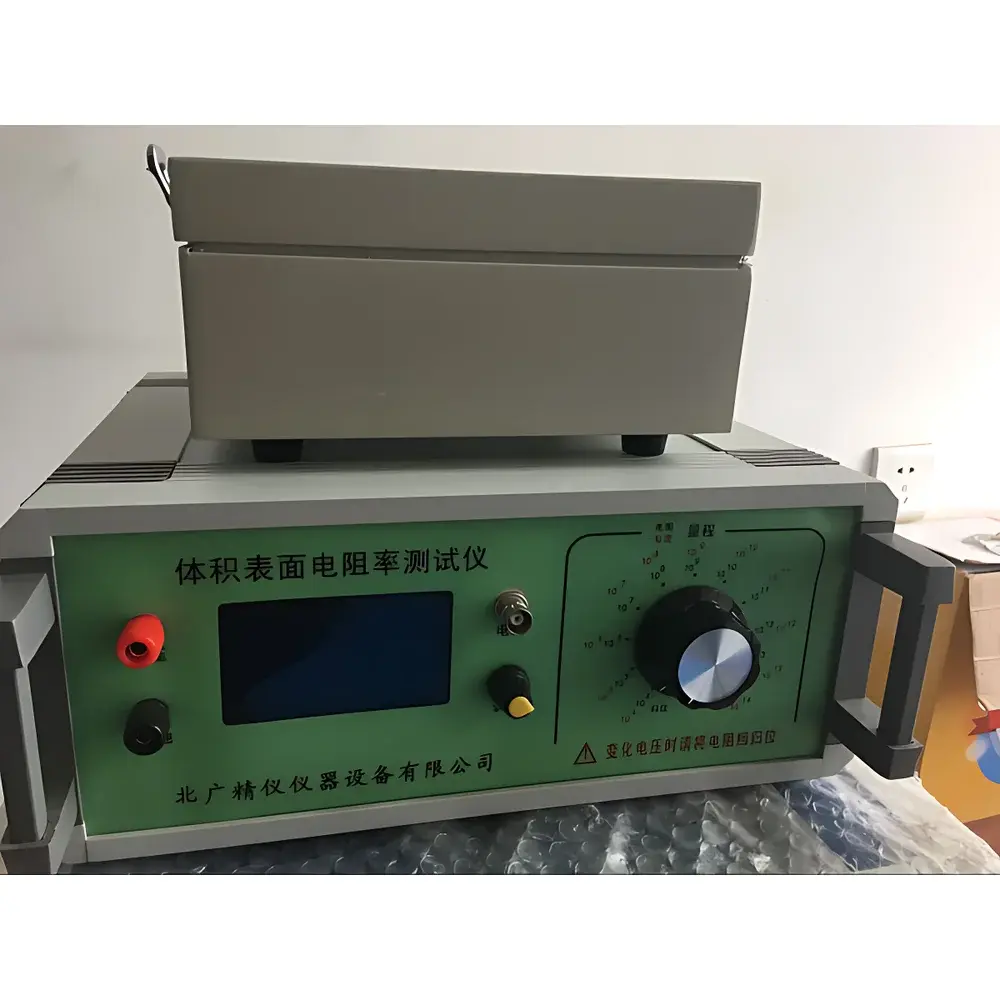
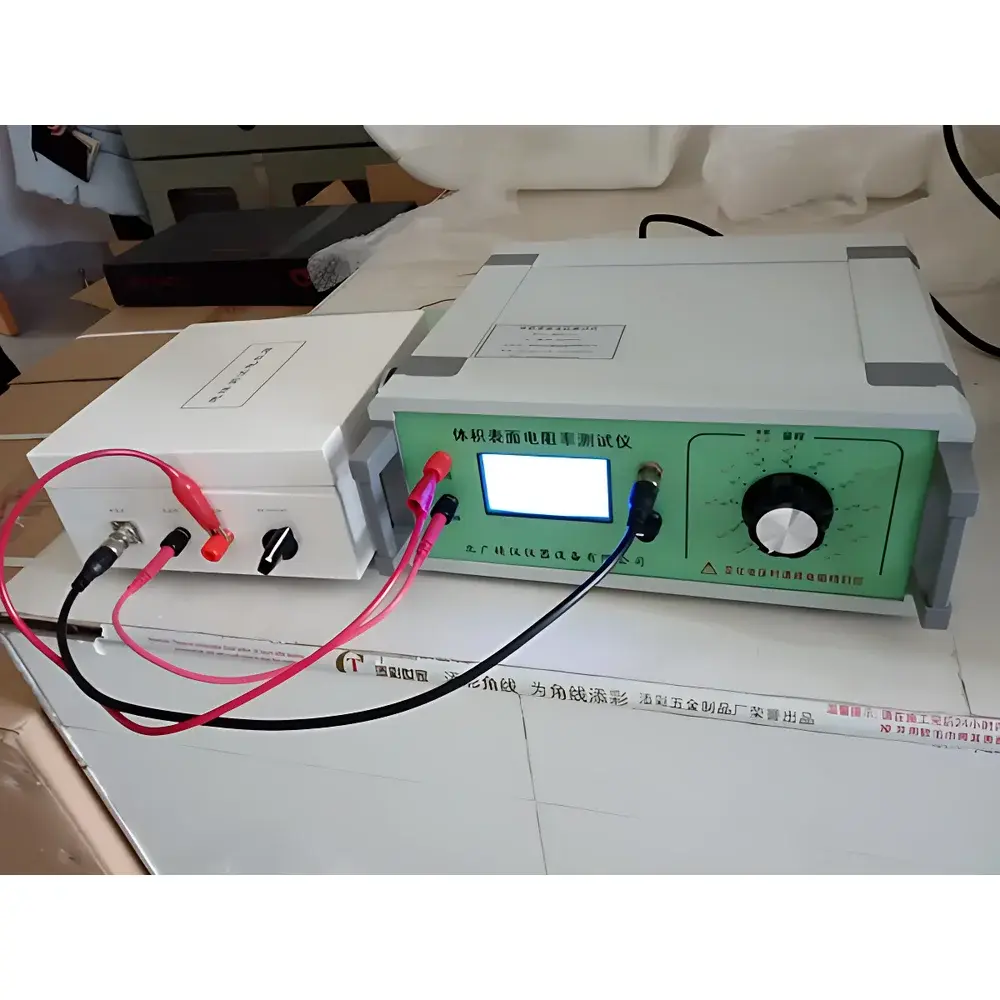
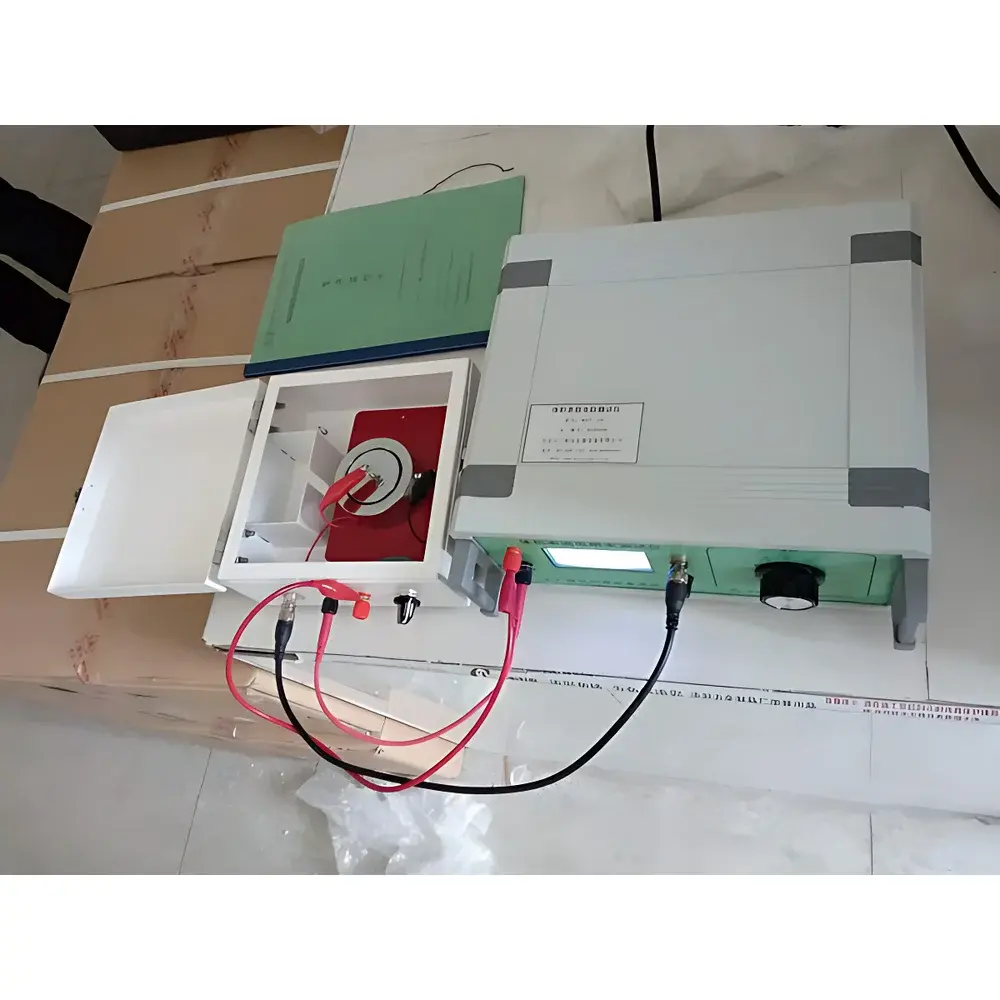
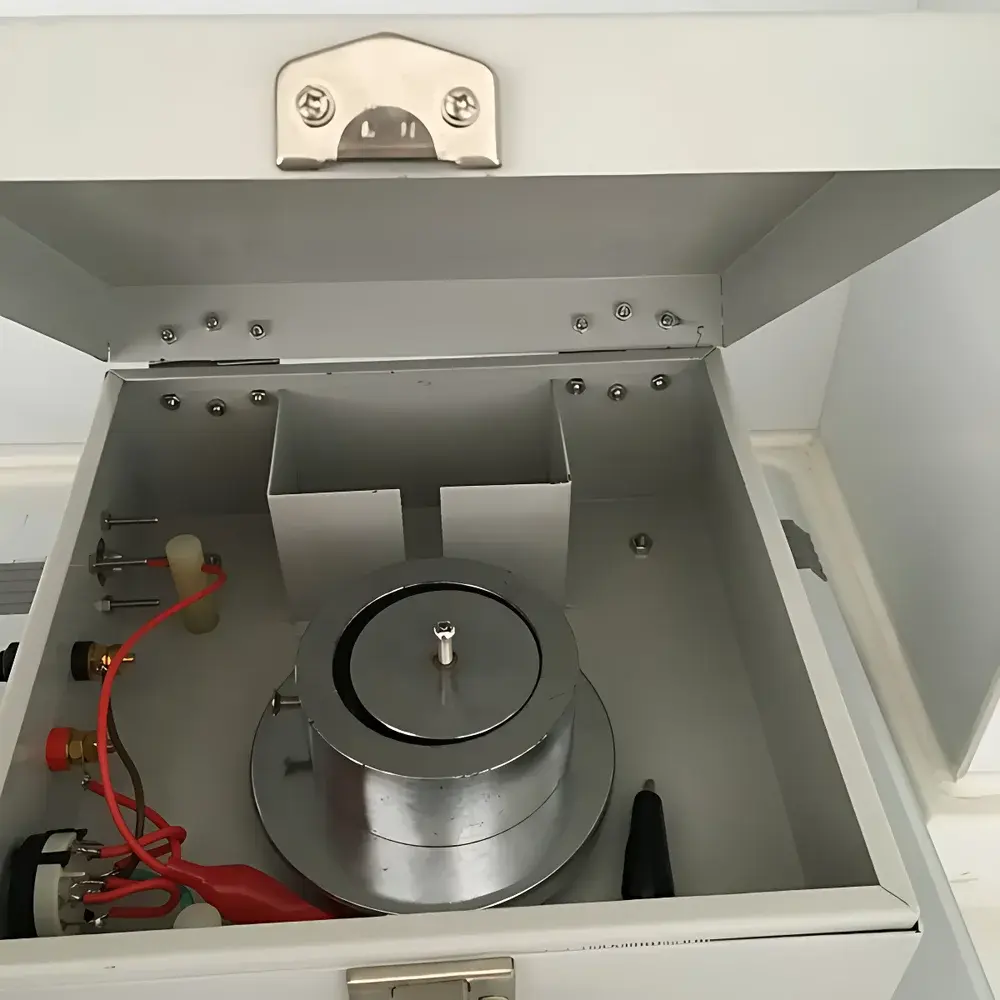
Beijing BEST-121 Volume & Surface Resistivity Tester for Vulcanized Rubber
| Brand | Beijing Best Precision Instrument Co., Ltd. |
|---|---|
| Model | BEST-121 |
| Origin | Beijing, China |
| Manufacturer Type | Direct Manufacturer |
| Power Supply | AC 220 V, 50 Hz, ~5 W |
| Dimensions | 285 mm × 245 mm × 120 mm |
| Weight | ~10 kg |
| Resistance Measurement Range | 1×10⁴ Ω to 1×10¹⁸ Ω (max. range up to 10¹⁴ Ω) |
| Current Measurement Range | 2×10⁻⁴ A to 1×10⁻¹⁶ A |
| Test Voltages | 10 V, 50 V, 100 V, 250 V, 500 V, 1000 V (user-selectable) |
| Basic Accuracy | ±1% to ±5% |
| Display | 32-bit LED LCD |
| Operating Environment | 0 °C to 40 °C, RH < 80% |
Overview
The Beijing BEST-121 Volume & Surface Resistivity Tester is a precision electrometric instrument engineered for the quantitative characterization of electrical insulation and conduction behavior in vulcanized rubber and other polymeric materials. It operates on the fundamental principle of Ohm’s Law (R = V/I), employing simultaneous high-accuracy digital measurement of applied DC test voltage and resulting leakage current—eliminating nonlinearity inherent in analog galvanometer-based high-resistance meters. Unlike conventional electrometers that fix voltage and infer resistance from current alone, the BEST-121 digitizes both V and I in real time via integrated high-stability analog-to-digital conversion and on-board arithmetic processing. This architecture ensures stable, linear, and repeatable resistivity readings across its full dynamic range—from 10⁴ Ω (conductive elastomers) to 10¹⁸ Ω (ultra-high-purity insulators)—without manual scaling or range-dependent correction factors. Designed specifically for rubber compounding laboratories, QC departments in tire and sealing component manufacturing, and R&D facilities evaluating antistatic additives or conductive fillers (e.g., carbon black, graphene, metal-coated fibers), the instrument delivers metrologically traceable data compliant with international standards for volume resistivity (ρᵥ) and surface resistivity (ρₛ) calculations per ASTM D257 and IEC 62631-3-1.
Key Features
- Simultaneous dual-parameter acquisition: Independent high-resolution measurement of test voltage (±0.5%) and leakage current (±1% typical) enables direct digital computation of resistance—minimizing drift, hysteresis, and scale nonlinearity.
- Six programmable DC test voltages (10 V, 50 V, 100 V, 250 V, 500 V, 1000 V) optimized for material classification: low-voltage settings for ESD-sensitive elastomers; 1000 V for bulk insulation validation in high-voltage cable sheathing compounds.
- 32-bit LED display with dual readout: Real-time simultaneous display of resistance (Ω) and current (A), eliminating operator interpretation errors and reducing measurement cycle time.
- Guarded three-terminal configuration (LINE, GUARD, EARTH): Integrated guard terminal suppresses surface leakage paths during surface resistivity testing—critical for accurate ρₛ evaluation on textured or contaminated rubber surfaces per GB/T 1410-2006 Annex B.
- Compact benchtop form factor (285 × 245 × 120 mm) with robust aluminum alloy chassis: Engineered for long-term stability under industrial lab conditions; low power consumption (~5 W) supports continuous operation without thermal drift.
- Compliance-ready design: Built-in hardware-level safety interlocks, insulated HV output terminals, and clearly marked grounding points meet Class I electrical safety requirements per IEC 61010-1.
Sample Compatibility & Compliance
The BEST-121 accommodates standard solid dielectric specimens per GB/T 1410-2006 and ASTM D257—including cured rubber slabs (2–10 mm thick), molded O-rings, extruded profiles, and laminated composites. Its electrode system supports both concentric ring (for surface resistivity) and parallel plate (for volume resistivity) configurations using optional ASTM D257-compliant electrodes (not included). The instrument is validated for use with elastomeric materials containing conductive fillers (e.g., acetylene black, nickel-coated graphite), antistatic agents (e.g., quaternary ammonium salts), and nanocomposites. It satisfies technical requirements of over 20 national and industry standards, including GB 18044-2008 (antistatic carpets), GB/T 22042-2008 (protective clothing), GB/T 18864-2002 (industrial antistatic rubber products), and GB 4385-1995 (ESD footwear). While not FDA 21 CFR Part 11 certified out-of-box, audit trails and user-access logs can be implemented via external PC interface for GLP/GMP-aligned workflows.
Software & Data Management
The BEST-121 operates as a standalone instrument with no embedded firmware-based data logging. However, its analog voltage and current outputs (0–2 V full-scale) are compatible with third-party DAQ systems (e.g., National Instruments USB-6009, Keysight 34972A) for automated acquisition, statistical analysis (Cp/Cpk), and report generation. Raw measurement values may be exported via RS-232 (optional module) to Excel-compatible CSV files. For regulated environments, users may integrate the device into validated LIMS or ELN platforms using custom Python or LabVIEW drivers—enabling electronic signatures, version-controlled SOPs, and 21 CFR Part 11–compliant audit trails when paired with appropriate access controls and backup protocols.
Applications
- Quality control of sulfur-cured EPDM, NBR, and silicone compounds for automotive gaskets, where volume resistivity must remain >10¹² Ω·m to prevent electrostatic discharge in fuel systems.
- Development of conductive rubber formulations for EMI shielding gaskets—verifying percolation thresholds and linearity of ρᵥ vs. carbon black loading.
- Surface resistivity mapping of conveyor belt compounds used in semiconductor cleanrooms (target: 10⁵–10⁹ Ω/sq per GB 50611-2010).
- Validation of antistatic properties in rubber-soled safety footwear per GB/T 20991-2007 and EN 61340-4-3.
- Research on humidity-dependent conduction mechanisms in halogenated butyl rubber—using variable-temperature environmental chambers coupled with BEST-121’s stable low-current measurement capability (down to 10⁻¹⁶ A).
FAQ
What is the difference between volume resistivity and surface resistivity?
Volume resistivity (ρᵥ, unit: Ω·m) quantifies bulk material resistance perpendicular to current flow, while surface resistivity (ρₛ, unit: Ω/sq) measures resistance along a material’s surface between two electrodes of equal length and separation—both defined per GB/T 1410-2006 and ASTM D257.
Can the BEST-121 measure resistivity of liquid rubber precursors?
No—the instrument is designed exclusively for solid, cured elastomers. Liquid or uncured compounds require specialized conductivity cells and impedance analyzers per GB 1672-8.
Is calibration traceable to national standards?
Yes—factory calibration uses NIST-traceable high-voltage dividers and picoammeter standards. Users should perform annual verification with certified reference resistors (e.g., IET Labs SR1012 series) per ISO/IEC 17025 guidelines.
How does the GUARD terminal improve measurement accuracy?
The GUARD terminal shunts surface leakage currents away from the measurement path, ensuring only bulk current contributes to the reading—essential for reliable ρₛ on hydrophobic rubber surfaces exposed to ambient humidity.
Does the instrument support automatic temperature compensation?
No—temperature dependence must be controlled externally (e.g., climate chamber) or corrected manually using material-specific TCR coefficients reported in literature.






