
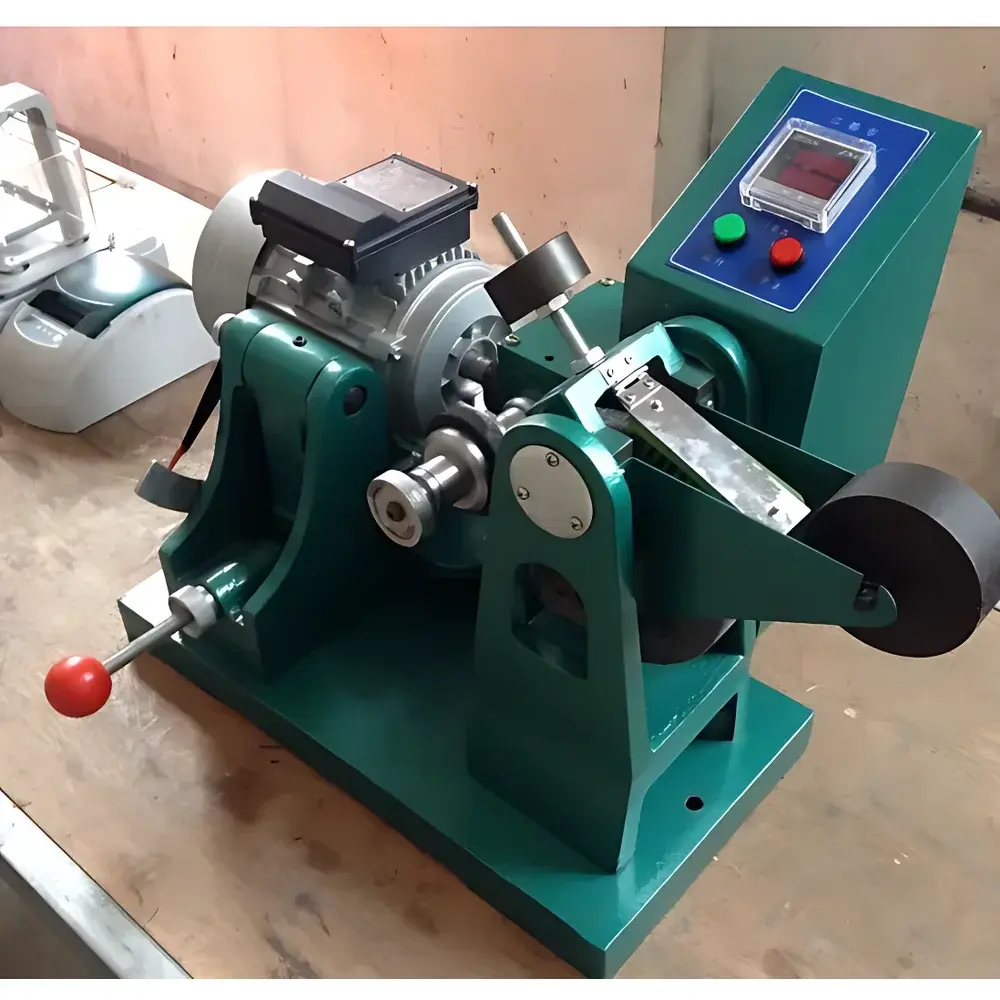
Akron Abrasion Tester BG-8205
| Brand | All Precision Instrument |
|---|---|
| Origin | Beijing, China |
| Manufacturer Type | Direct Manufacturer |
| Country of Origin | China |
| Model | BG-8205 |
| Power Supply | AC 220 V |
| Power Consumption | 250 W |
| Load on Specimen | 26.7 ± 0.2 N |
| Rubber Wheel Rotational Speed | 76 ± 2 rpm |
| Abrasive Wheel Rotational Speed | 34 ± 1 rpm |
| Adjustable Inclination Angle Between Wheels | 15° or 25° |
| Dimensions (L×W×H) | 600 × 480 × 400 mm |
| Net Weight | 60 kg |
Overview
The Akron Abrasion Tester BG-8205 is a precision-engineered instrument designed in strict accordance with ASTM D1630 and ISO 4649 standards for quantifying the abrasion resistance of vulcanized rubber compounds. It operates on the principle of controlled rotary abrasion, where a standardized rubber test specimen rotates against a calibrated abrasive grinding wheel under defined mechanical loading and angular geometry. The test simulates real-world wear conditions encountered in tires, conveyor belts, footwear soles, and industrial elastomeric components. By measuring the volume loss (in mm³) after a fixed number of revolutions—corresponding to a prescribed travel distance—the instrument delivers reproducible, traceable data essential for material qualification, formulation optimization, and quality control in rubber manufacturing and R&D laboratories.
Key Features
- Robust cast-iron frame with vibration-dampening base ensures mechanical stability during extended abrasion cycles
- Dual-speed independent drive system: precisely regulated rubber wheel (76 ± 2 rpm) and abrasive wheel (34 ± 1 rpm) motors enable consistent shear stress application
- Adjustable wheel inclination mechanism offering two standard angles—15° and 25°—to accommodate different test protocols and compound hardness ranges
- Calibrated dead-weight loading system applying a nominal 26.7 N (±0.2 N) vertical force to the specimen holder, compliant with ASTM D1630 tolerance requirements
- Integrated digital tachometer and load verification port for routine calibration validation and GLP-compliant maintenance logging
- CE-marked electrical enclosure with thermal overload protection and emergency stop circuit meeting IEC 61000-6-2/6-4 EMC and safety directives
Sample Compatibility & Compliance
The BG-8205 accepts standard ASTM D1630 test specimens: cylindrical rubber plugs (25.4 mm diameter × 6.35 mm thickness), die-cut discs, or molded slabs prepared per ISO 4649 procedures. Specimen mounting fixtures ensure concentric alignment and uniform contact pressure distribution across the abrasive interface. The instrument supports full compliance with ASTM D1630 (Standard Test Method for Rubber Property—Abrasion Resistance (Accelerated Abrader)), ISO 4649:2010 (Rubber, vulcanized or thermoplastic—Determination of abrasion resistance using a rotating cylindrical drum abrader), and GB/T 1689–2014 (Chinese national standard for rubber abrasion testing). Calibration certificates are traceable to NIM (National Institute of Metrology, China) standards, and periodic verification aligns with ISO/IEC 17025 laboratory accreditation requirements.
Software & Data Management
While the BG-8205 operates as a standalone mechanical tester, its design incorporates provisions for integration into digital QA/QC workflows. Optional analog output signals (0–10 V DC) for rotational speed and load status enable connection to external data loggers or SCADA systems. Test records—including run duration, total revolutions, ambient temperature/humidity (via optional sensor input), and operator ID—can be manually logged into LIMS-compatible spreadsheets adhering to 21 CFR Part 11 principles when paired with electronic signature-enabled documentation systems. The instrument’s mechanical repeatability (RSD ≤ 3.2% across five replicate runs on SRM reference rubber) satisfies internal audit requirements for method validation under ISO 9001 and IATF 16949 frameworks.
Applications
- Tire tread compound development and comparative wear ranking
- Quality assurance of rubber rollers used in printing, paper, and packaging machinery
- Evaluation of antiskid properties in polymer-modified asphalt binders (per ASTM D6928 adaptation)
- Screening of filler dispersion efficiency in carbon black- or silica-reinforced elastomers
- Validation of surface crosslink density effects on wear performance via post-cure aging studies
- Supporting ASTM D2228 round-robin interlaboratory studies for abrasion methodology harmonization
FAQ
What standards does the BG-8205 comply with?
ASTM D1630, ISO 4649:2010, and GB/T 1689–2014.
Is calibration certification included with shipment?
Yes—a factory calibration report traceable to NIM standards is provided; annual recalibration is recommended per ISO/IEC 17025 guidelines.
Can the instrument be used for non-rubber polymers?
It is validated for vulcanized rubber; use with thermoplastics or TPEs requires protocol adaptation and empirical correlation to established wear metrics.
What maintenance is required for long-term accuracy?
Monthly inspection of abrasive wheel wear profile, quarterly torque verification of loading mechanism, and biannual motor bearing lubrication per OEM service manual.
Does it support automated data export?
Not natively; however, analog outputs allow integration with third-party DAQ systems for time-stamped parameter capture.




