
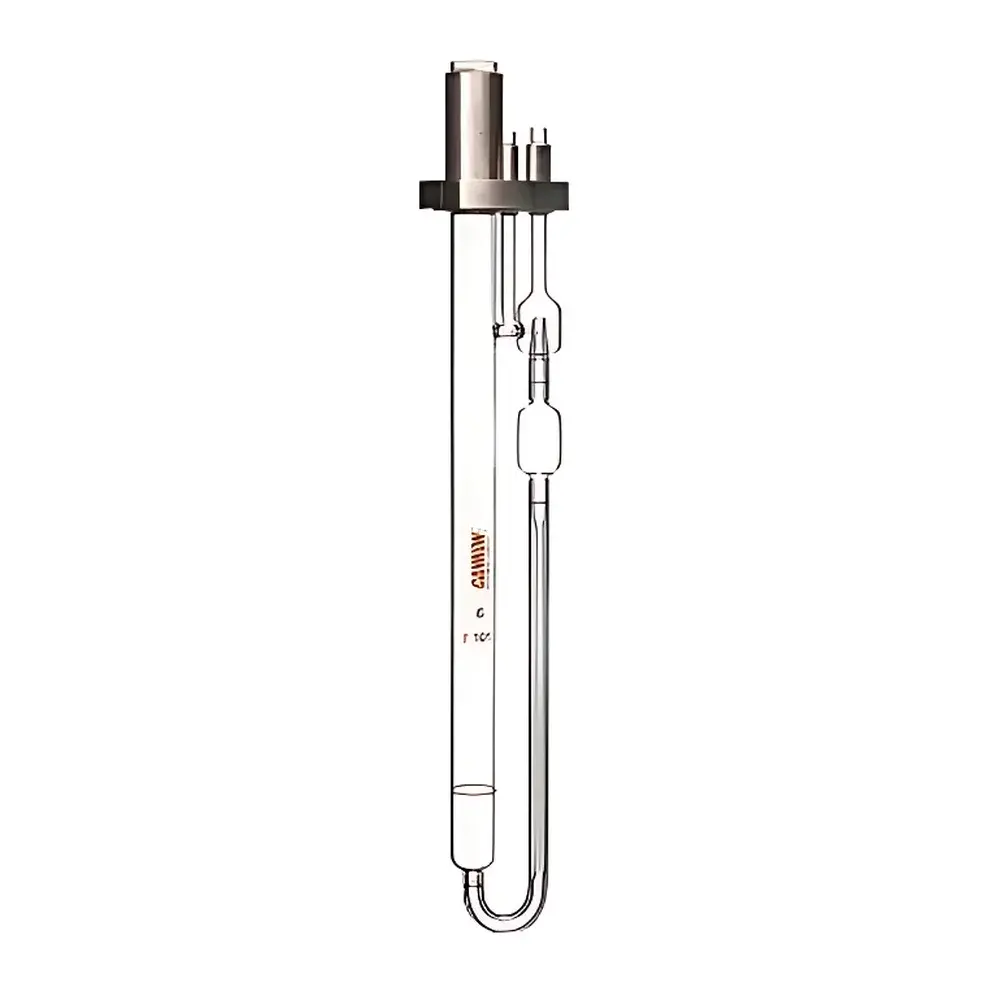
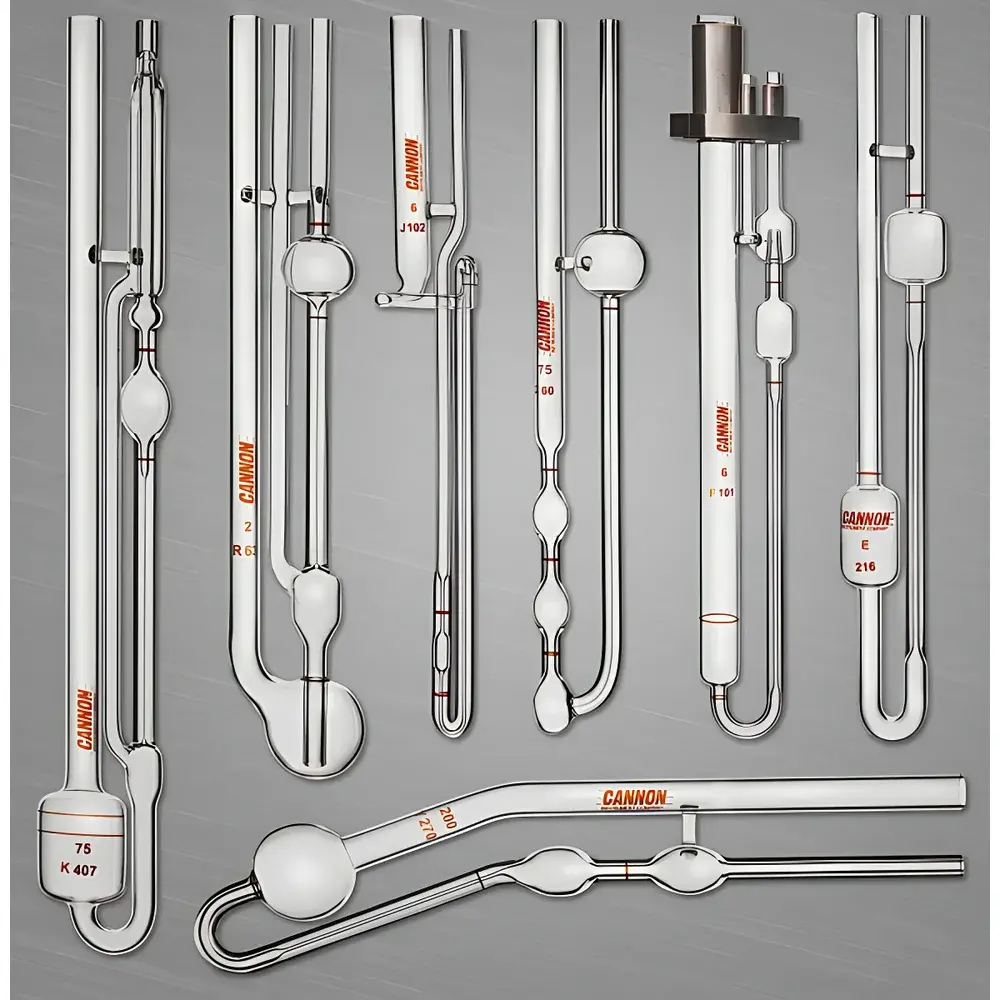
Cannon Zeitfuchs Transparent Capillary Viscometer Model 9723
| Brand | Cannon |
|---|---|
| Origin | USA |
| Instrument Type | Suspended-Level Capillary Viscometer |
| Kinematic Viscosity Range | 0.6–3000 mm²/s |
| Compliance | ASTM D445, ISO 3104 |
| Minimum Sample Volume | 15 mL |
| Minimum Bath Depth | 292 mm |
| Holder Options | Round (51 mm port), Rectangular (25 mm × 48 mm opening) |
| Calibration | Optional certified calibration with traceable certificate and instruction sheet |
Overview
The Cannon Zeitfuchs Transparent Capillary Viscometer Model 9723 is a precision-engineered suspended-level capillary viscometer designed for the accurate determination of kinematic viscosity in transparent Newtonian liquids. Based on the fundamental principle of capillary flow under gravity—governed by the Hagen–Poiseuille equation—the instrument measures the time required for a fixed volume of liquid to flow between two etched timing marks under controlled thermal conditions. Its transparent borosilicate glass construction enables direct visual monitoring of meniscus movement, bubble formation, and flow continuity without disassembly or external imaging. Unlike immersion-type or out-of-bath viscometers, the Model 9723 operates fully submerged in a constant-temperature bath, eliminating thermal lag and ensuring stable temperature equilibration across the entire capillary column. This design conforms strictly to the procedural requirements of ASTM D445 (“Standard Test Method for Kinematic Viscosity of Transparent and Opaque Liquids”) and ISO 3104 (“Petroleum products — Determination of kinematic viscosity and calculation of dynamic viscosity”), making it suitable for quality control laboratories operating under ISO/IEC 17025, GLP, or refinery QA/QC protocols.
Key Features
- True suspended-level configuration: Capillary stem remains fully immersed during filling, timing, and cleaning—no removal from bath required.
- Optimized thermal mass and wall thickness ensure minimal temperature gradient across the capillary bore (±0.01 °C stability at setpoint).
- Two mechanically robust holder options: round metal holder (compatible with standard 51 mm bath ports) and rectangular holder (designed for narrow-opening baths: 25 mm × 48 mm).
- Low sample consumption: validated operation with as little as 15 mL of test liquid—critical for high-value or limited-availability samples.
- Minimum bath depth requirement of only 292 mm (11.5 in), enabling compatibility with compact or modular thermostatic baths.
- Available in both uncalibrated and NIST-traceable calibrated versions; calibrated units include a documented certificate of calibration with uncertainty statement and full instruction sheet.
Sample Compatibility & Compliance
The Model 9723 is validated exclusively for transparent, Newtonian fluids—including hydrocarbon solvents, base oils, jet fuels, white mineral oils, and synthetic lubricants—within the kinematic viscosity range of 0.6 to 3000 mm²/s. Flow time validation (200–1000 seconds between timing marks) ensures laminar, non-turbulent flow per Poiseuille criteria. It is not intended for use with opaque, non-Newtonian, or volatile liquids exhibiting significant vapor pressure at test temperature. All configurations meet the dimensional, material, and procedural specifications outlined in ASTM D445 Annex A1 and ISO 3104 Clause 6. The instrument’s glass geometry, capillary bore tolerance (±0.5% nominal diameter), and meniscus alignment markings are verified against reference standards maintained by Cannon Instrument Company’s ISO 17025-accredited calibration laboratory.
Software & Data Management
While the Model 9723 is a manual, analog measurement device requiring stopwatch-based timing, it integrates seamlessly into digital QA workflows via standardized data capture protocols. Users may record flow times in LIMS or ELN systems using structured templates aligned with ASTM D445 Section 11 reporting requirements. For laboratories subject to FDA 21 CFR Part 11 or EU Annex 11 compliance, the optional calibration certificate includes unique serial traceability, technician signature, environmental conditions at time of calibration, and measurement uncertainty expressed at k=2 (95% confidence). Raw timing data, bath temperature logs, and operator annotations must be retained per GLP documentation guidelines for audit readiness.
Applications
- Routine kinematic viscosity testing of aviation turbine fuels (Jet A, JP-5) per ASTM D1655 and DEF STAN 91-91.
- Base stock and finished lubricant qualification in accordance with ASTM D445, ISO 3104, and IP 71.
- Quality release testing of transformer oils (IEC 60296) and heat transfer fluids (ASTM D92, D129).
- Research-grade viscosity profiling of silicone oils, polyalphaolefins (PAOs), and ester-based synthetics.
- Educational laboratory use for fluid mechanics and rheology courses emphasizing first-principles capillary flow analysis.
FAQ
What standards does the Cannon Zeitfuchs Model 9723 comply with?
It is fully compliant with ASTM D445 and ISO 3104 for kinematic viscosity measurement of transparent Newtonian liquids.
Can this viscometer be used for non-Newtonian fluids?
No. The instrument relies on laminar, time-invariant flow governed by Poiseuille’s law; non-Newtonian behavior invalidates the kinematic viscosity calculation.
Is temperature control external or built-in?
Temperature control is external—the viscometer must be used in conjunction with a certified constant-temperature bath meeting ASTM D445 Section 7 requirements (stability ±0.02 °C).
What is the minimum required bath depth?
A minimum immersion depth of 292 mm (11.5 in) is mandatory to ensure full submersion of the capillary and reservoir sections during operation.
Does the calibration certificate satisfy ISO/IEC 17025 requirements?
Yes—certified units include measurement uncertainty, environmental conditions, traceability to NIST SRMs, and technician accreditation per ISO/IEC 17025:2017 Clause 6.5.



