
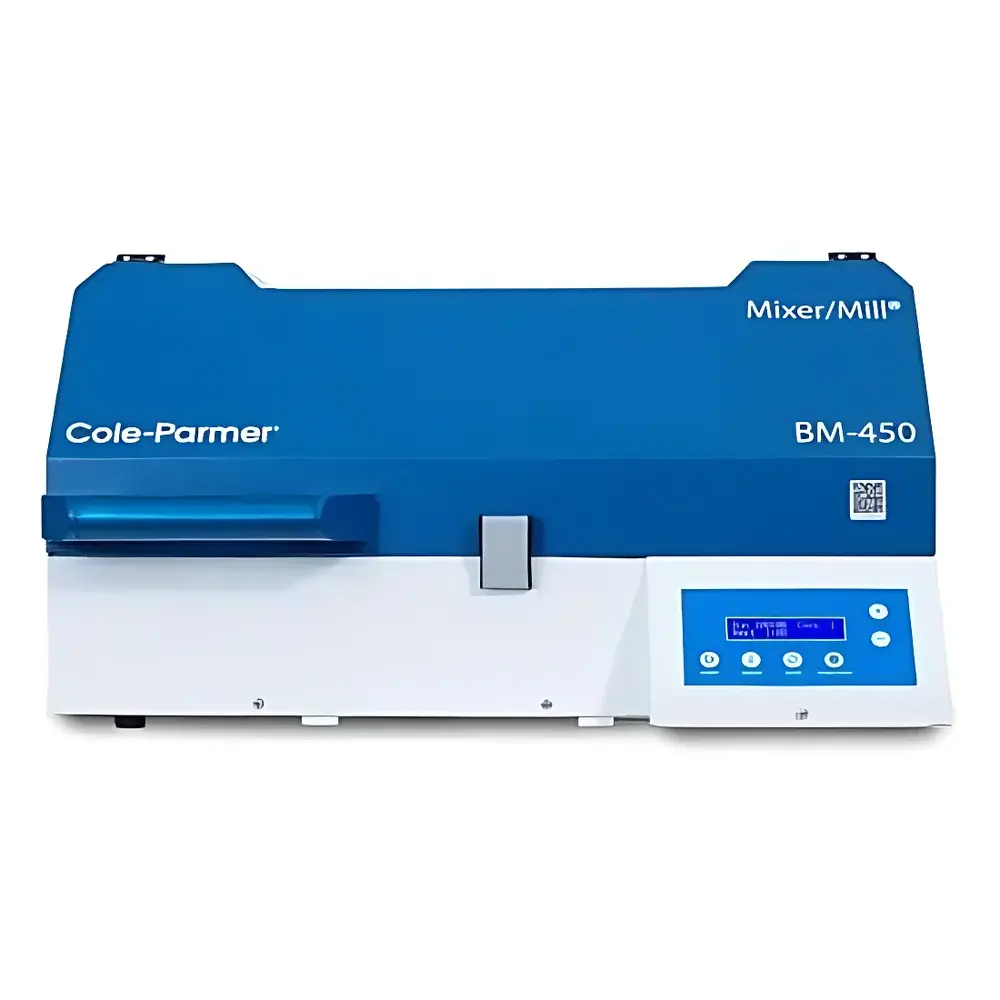
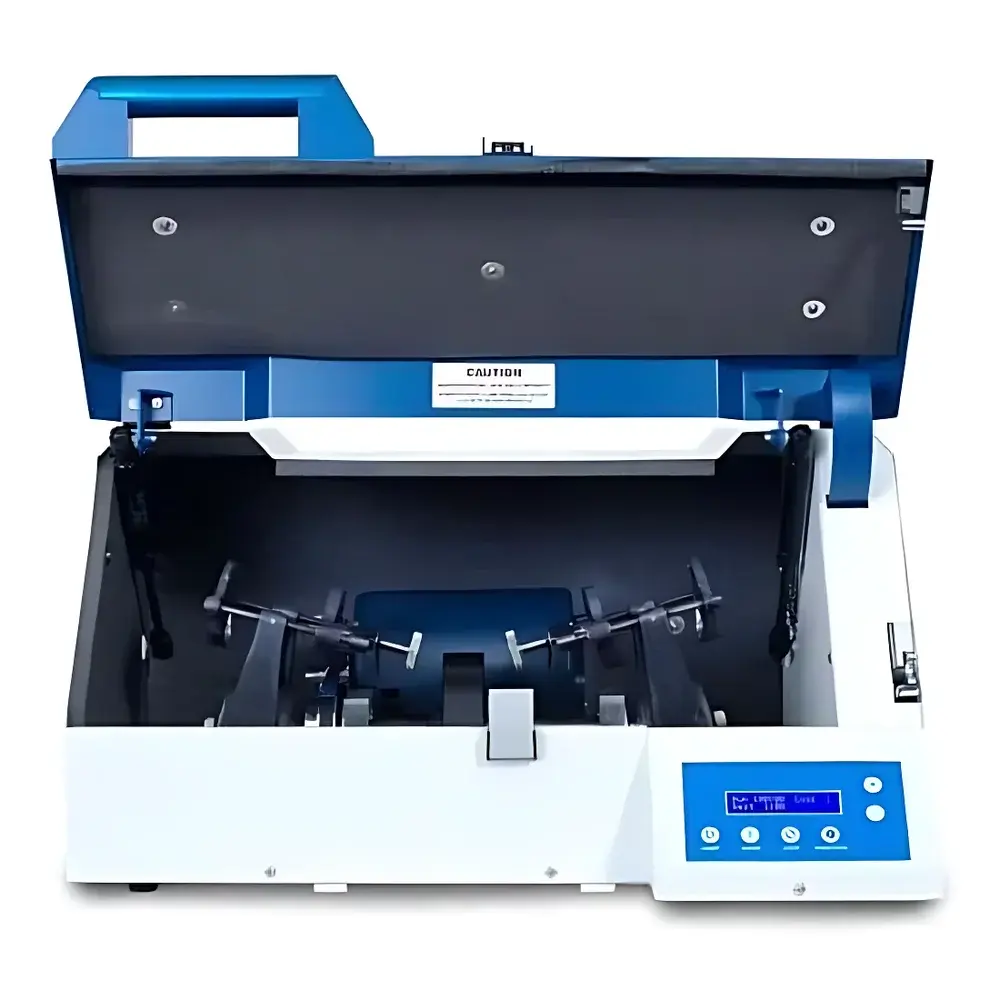
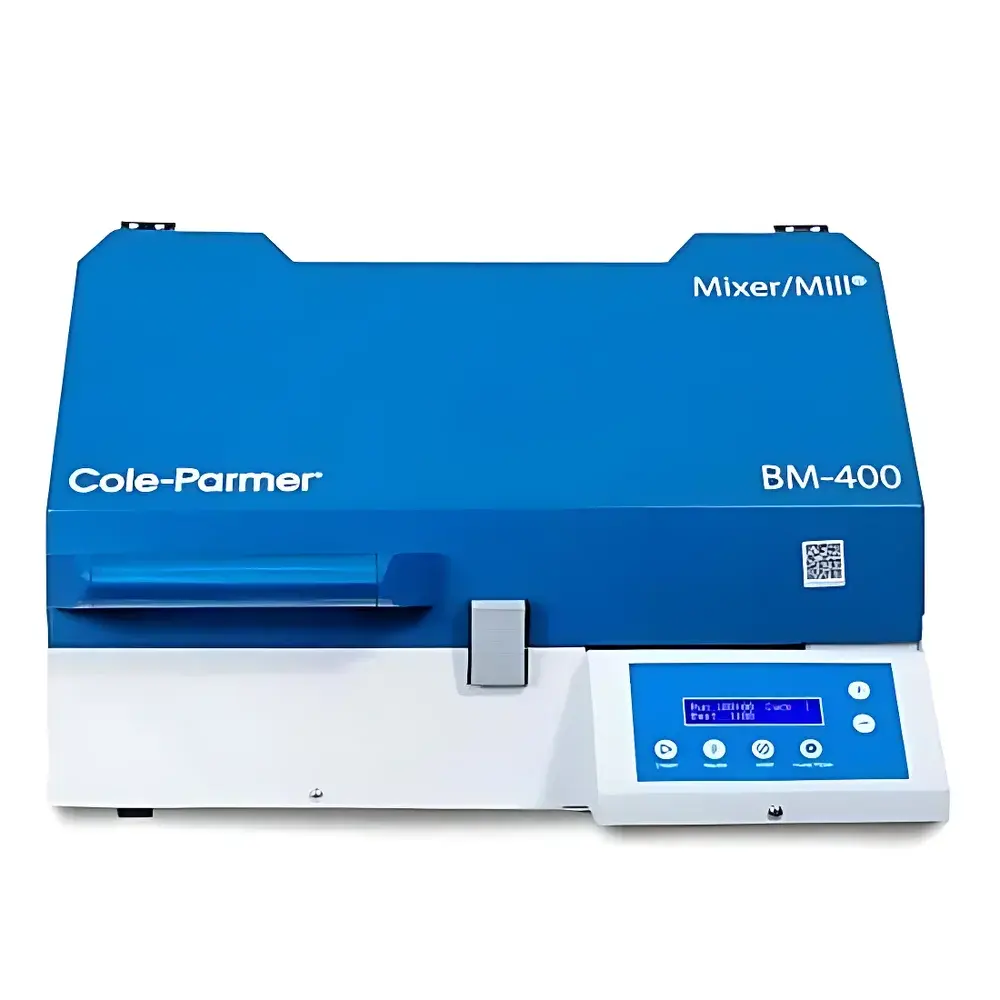
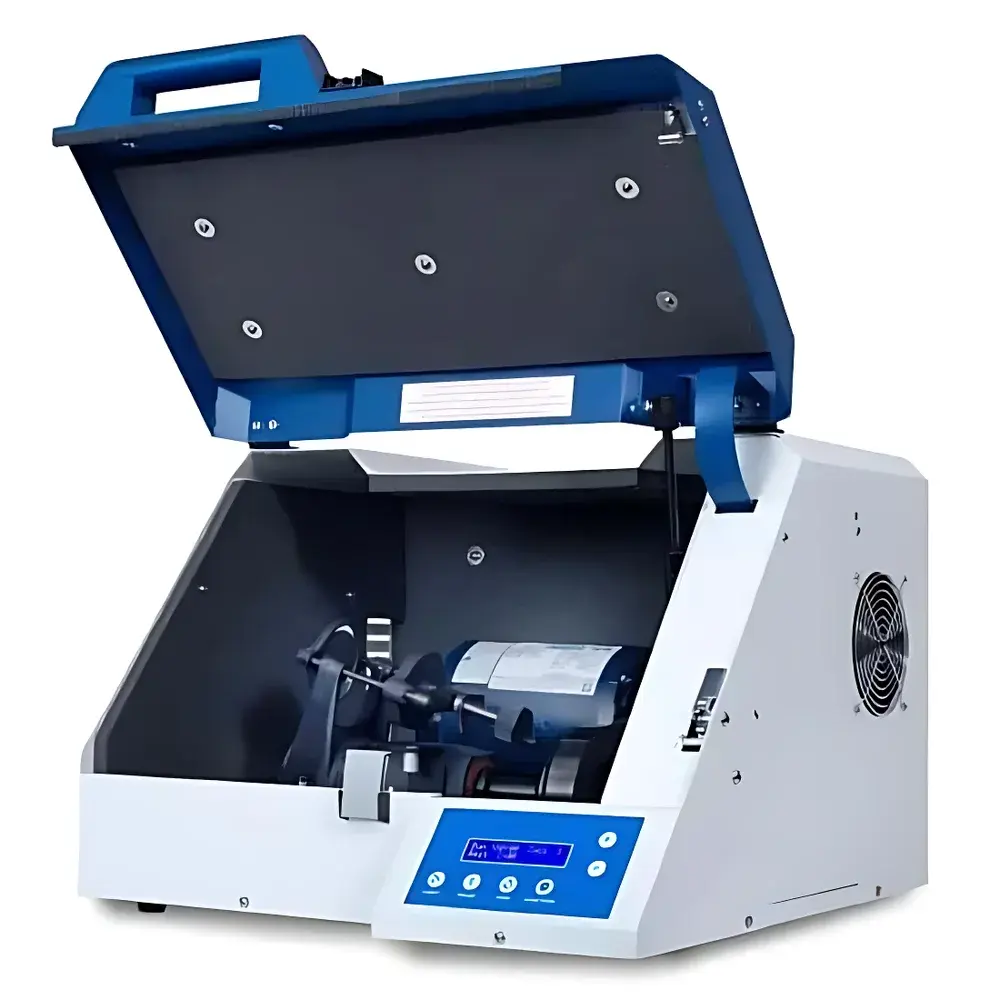
Cole-Parmer BM-400 (8000M) and BM-450 (8000D) High-Energy Ball Mills
| Brand | Cole-Parmer |
|---|---|
| Origin | USA |
| Model | BM-400 (8000M) / BM-450 (8000D) |
| Type | High-energy planetary ball mill |
| Sample Compatibility | Hard, brittle, and medium-hard solid materials |
| Drive Mechanism | Planetary gear-driven dual grinding stations |
| Maximum Speed | 1,000 rpm (BM-400), 900 rpm (BM-450) |
| Grinding Jar Capacity | Up to 50 mL per jar (BM-400) |
| Safety Compliance | CE-marked, UL-listed motor assembly |
| Control Interface | Analog dial + mechanical timer (BM-400) |
Overview
The Cole-Parmer BM-400 (8000M) and BM-450 (8000D) are high-energy planetary ball mills engineered for reproducible, scalable dry and wet comminution of hard, brittle, and medium-hard solid samples in research and quality control laboratories. Operating on the principle of planetary motion—where grinding jars rotate around a central axis while simultaneously rotating on their own axes—these mills generate intense impact and shear forces that enable efficient particle size reduction, homogenization, alloying, and mechanochemical activation. The BM-400 is a robust analog-controlled system suited for routine milling tasks requiring consistent energy input; the BM-450 integrates a digital microprocessor controller for precise parameter management, supporting method development and regulatory traceability in GLP- and GMP-aligned environments.
Key Features
- Planetary dual-station design ensures balanced load distribution and minimizes vibration-induced mechanical drift during extended operation.
- High-torque, UL-listed induction motor delivers stable rotational performance across the full speed range—up to 1,000 rpm for the BM-400 and 900 rpm for the BM-450—with minimal thermal drift.
- Interchangeable grinding jars (stainless steel, tungsten carbide, agate, and zirconia) allow optimization for contamination-sensitive applications (e.g., trace metal analysis) or extreme hardness requirements (e.g., silicon carbide, borosilicate glass).
- The BM-450 features programmable cycle parameters including speed setpoint, ramp-up/down profiles, total run time, rest intervals, and automatic shutdown—enabling repeatable execution of complex multi-step milling protocols.
- Integrated safety mechanisms include jar-clamp detection, lid interlock switches, and emergency stop circuitry compliant with IEC 61000-6-2 (EMC immunity) and IEC 61000-6-3 (EMC emission) standards.
- Compact footprint (W × D × H: 32 × 41 × 36 cm) supports integration into fume hoods or gloveboxes for handling air- or moisture-sensitive materials.
Sample Compatibility & Compliance
These mills accommodate a broad spectrum of inorganic and organic solids—including oxides, ceramics, metals, alloys, pharmaceutical actives, and geological specimens—with Mohs hardness up to 9. Both models support dry grinding, inert-atmosphere milling (with optional sealed jar kits), and solvent-based wet grinding using compatible media (e.g., ethanol, isopropanol, hexane). All components contacting samples conform to USP Class VI biocompatibility standards where applicable. The BM-450’s digital controller logs timestamped operational data (speed, duration, cycle count), facilitating audit readiness under FDA 21 CFR Part 11 when paired with secure user access controls and electronic signature workflows.
Software & Data Management
While the BM-400 operates without embedded software, the BM-450 includes a non-volatile memory module retaining up to 10 user-defined methods. Each method stores speed profile, total runtime, pause intervals, and start/stop timestamps. Data export is supported via RS-232 serial interface for integration with laboratory information management systems (LIMS) or custom SCADA platforms. No proprietary cloud service or vendor-hosted platform is required—data remains fully under institutional control. Firmware updates are delivered as signed binary files with SHA-256 checksum verification.
Applications
- Preparation of nanoscale powders for XRD, SEM-EDS, and BET surface area analysis.
- Mechanochemical synthesis of metal–organic frameworks (MOFs) and solid-state battery cathode precursors (e.g., LiFePO₄, NMC).
- Homogenization of heterogeneous catalysts prior to catalytic activity testing.
- Reduction of particle size in pharmaceutical excipients to improve dissolution kinetics and content uniformity.
- Crushing of mineralogical samples for geochemical assay preparation (e.g., ASTM D5630, ISO 12885).
- Generation of amorphous phases from crystalline precursors for thermal stability evaluation (DSC/TGA).
FAQ
What is the maximum recommended sample volume per jar?
For optimal energy transfer and reproducibility, fill jars to 20–30% of internal volume with sample and grinding media combined—typically 5–15 g for BM-400 (50 mL jars) and 8–25 g for BM-450 (80 mL jars).
Can these mills operate under inert gas or vacuum conditions?
Yes—both models accept optional gas-tight jar assemblies with Swagelok-compatible fittings for argon or nitrogen purging; vacuum compatibility requires supplemental sealing gaskets rated for ≤10 mbar.
Is calibration required before first use?
No factory calibration is needed; however, users should verify rotational speed accuracy using a certified optical tachometer at installation and after any maintenance event involving drive belts or gear trains.
Are replacement jars and grinding media available through Cole-Parmer?
Yes—genuine stainless steel, tungsten carbide, agate, and yttria-stabilized zirconia jars and balls are stocked globally with documented lot traceability and CoA documentation.
Does the BM-450 support remote monitoring or network connectivity?
No Ethernet or Wi-Fi capability is built-in; however, RS-232 output allows connection to local PCs or industrial PLCs for automated logging and alarm triggering via third-party middleware.



