
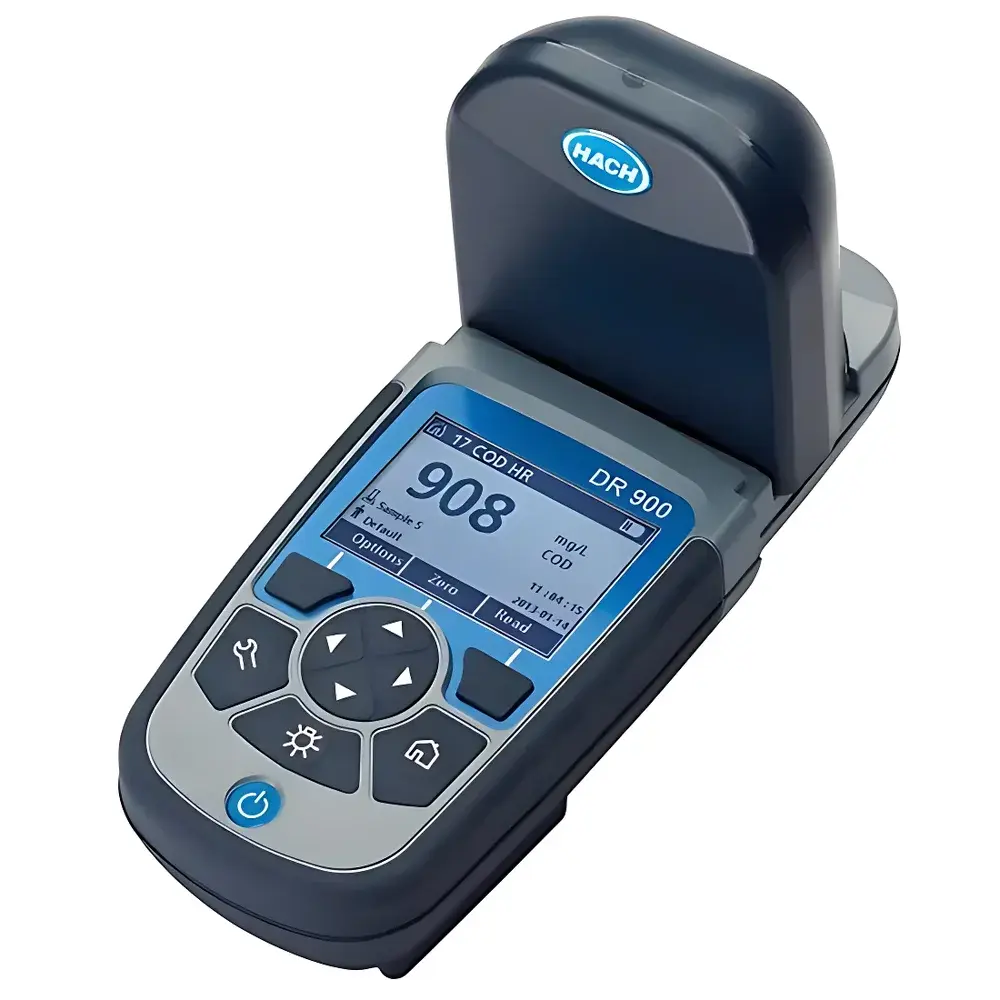
Hach DR900 Handheld Multiparameter Colorimeter
| Brand | Hach |
|---|---|
| Origin | USA |
| Model | DR900 |
| Wavelengths | 420, 520, 560, 610 nm |
| Absorbance Range | 0 to 2.0 AU |
| Preprogrammed Methods | 90 |
| Data Storage Capacity | 500 measurements with sample ID and user ID |
| Display | Backlit LCD |
| Connectivity | USB (CSV export, no software required) |
| Power | 4 × AA batteries (included) |
| IP Rating | IP67 (dust-tight and submersible up to 1 m for 30 min) |
| Dimensions | 22.9 cm × 5.1 cm × 2.5 cm (L × H × W) |
| Weight | 340 g |
Overview
The Hach DR900 Handheld Multiparameter Colorimeter is an engineered field-deployable analytical instrument designed for rapid, reliable quantification of water quality parameters using standardized colorimetric methods. Operating on the principle of Beer–Lambert absorption spectroscopy, the DR900 measures analyte-specific chromophore formation following reagent addition, enabling trace-level detection across a broad range of inorganic and organic contaminants. Its fixed-wavelength optical system—featuring four discrete LED sources at 420 nm, 520 nm, 560 nm, and 610 nm—ensures spectral accuracy without mechanical wavelength scanning, eliminating drift and enhancing long-term photometric stability. The device complies with core methodology standards referenced in EPA Methods 365.4, 365.3, and ASTM D1253 for residual chlorine, nitrate, phosphate, ammonia, COD, and over 90 additional parameters. Its compact form factor, ruggedized construction, and battery-powered operation make it suitable for routine monitoring in wastewater treatment plants, drinking water distribution networks, environmental field surveys, and industrial process control environments.
Key Features
- Four fixed-wavelength LED light sources (420, 520, 560, 610 nm) with calibrated photodiode detection for high photometric reproducibility (±0.005 AU typical)
- Automatic wavelength selection synchronized with method selection—no manual filter changes or calibration adjustments required
- Advanced reagent blank correction algorithm that compensates for background absorbance from reagents, vial material, and turbidity-induced scatter
- Built-in reaction timer supporting both preset incubation protocols (e.g., 10-min COD digestion) and user-defined intervals (1–180 min)
- Backlit graphical LCD display showing concentration (mg/L, ppm), absorbance (AU), or transmittance (%T) with real-time units and method context
- IP67-rated polycarbonate housing—tested per IEC 60529 for dust ingress protection and temporary submersion (1 m, 30 min)
- Integrated data logging with timestamp, sample ID, user ID, method name, and raw absorbance values stored locally in non-volatile memory
Sample Compatibility & Compliance
The DR900 accepts standard 10 mL plastic cuvettes and 25 mL glass vials (supplied), accommodating both Hach’s TNTplus vial-based chemistries and legacy liquid-reagent test kits. It supports EPA-accepted methods including but not limited to: chlorine (DPD), nitrate (cadmium reduction), orthophosphate (ascorbic acid), total phosphorus (persulfate digestion), ammonia (salicylate), and chemical oxygen demand (closed reflux). All preprogrammed methods adhere to documented validation protocols aligned with ISO 8466-1 (calibration function linearity), ISO 7027 (turbidity compensation), and USP (photometric system suitability). The instrument meets GLP data integrity requirements through immutable audit trails embedded in each saved record—including operator login, method version, date/time stamp, and measurement metadata.
Software & Data Management
Data export is performed via direct USB connection to any Windows or macOS host system; no proprietary drivers or middleware are required. Measurements are exported as comma-separated value (.csv) files containing columns for Sample ID, User ID, Method Name, Wavelength (nm), Absorbance (AU), Concentration (with unit), Date, Time, and Notes. The CSV structure conforms to LIMS-ready formatting conventions, facilitating seamless ingestion into laboratory information management systems (LIMS) or statistical analysis platforms such as JMP, Minitab, or Python pandas workflows. While the DR900 does not support wireless connectivity or cloud synchronization, its local storage architecture ensures full data sovereignty and compliance with FDA 21 CFR Part 11 when used in conjunction with institutional electronic signature policies.
Applications
- Routine effluent monitoring at municipal wastewater treatment facilities per NPDES permit requirements
- Drinking water compliance testing for disinfectant residuals, nitrates, and metals in distribution systems
- Industrial pretreatment verification for electroplating, food processing, and pharmaceutical manufacturing sites
- Field-based environmental assessment of surface water bodies under EPA Region-specific TMDL programs
- Educational laboratory instruction for quantitative analytical chemistry principles and method validation exercises
- Emergency response screening during spill events or natural disasters where rapid, on-site decision support is critical
FAQ
Does the DR900 require annual factory recalibration?
No—its optical path is factory-aligned and thermally stabilized; users perform only method-specific verification checks using NIST-traceable standards.
Can third-party reagents be used with preprogrammed DR900 methods?
Only Hach-certified reagents guarantee method accuracy and regulatory acceptance; deviation voids EPA method compliance claims.
Is the DR900 compatible with Hach’s SC100 or HQ series controllers?
No—it operates as a standalone instrument; integration with SC100/HQ platforms requires external data bridging via CSV import.
What is the operating temperature range for field use?
–10 °C to 50 °C (14 °F to 122 °F), with condensation-resistant optics and low-temperature battery performance optimization.
How is user access controlled for QA/QC traceability?
Each measurement logs a configurable User ID (alphanumeric, up to 8 characters); password protection is not implemented, so institutional login governance must be managed externally.



