
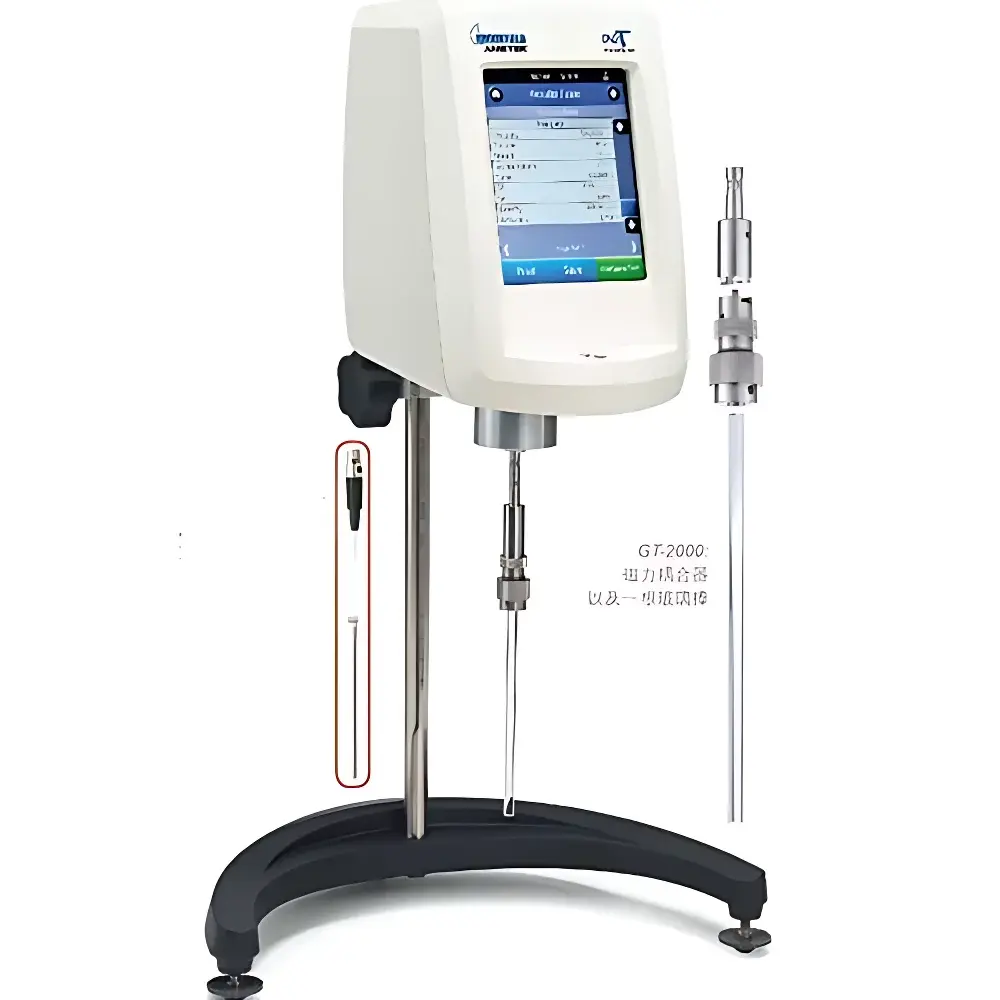
Brookfield DV2TL Gel Time Analyzer
| Brand | Brookfield |
|---|---|
| Origin | USA |
| Model | DV2TL |
| Instrument Type | Gel Time Analyzer |
| Viscosity Range | 0.1–200 cP (mPa·s) |
| Speed Control | 200 programmable RPM steps |
| Standard Spindle | Glass rod with magnetic coupling |
| Compliance | Designed for ASTM D2471, ISO 3675, and GLP-compliant gelation monitoring |
Overview
The Brookfield DV2TL Gel Time Analyzer is a precision-engineered instrument designed specifically for the quantitative determination of gel time — the elapsed time required for a thermosetting resin, adhesive, or encapsulant to transition from a low-viscosity liquid to an immobile, crosslinked gel state under controlled thermal conditions. Unlike general-purpose viscometers, the DV2TL implements a torque-based kinetic measurement principle: it continuously monitors the rotational resistance (torque) exerted on a vertically immersed glass rod as polymer chain extension and network formation progressively restrict molecular mobility. This real-time torque vs. time profile enables unambiguous identification of the gel point — defined as the inflection point where viscosity diverges exponentially and elastic modulus begins to dominate. The system operates on the time-to-torque methodology, supporting both manual endpoint detection and automated threshold-based gel time calculation per user-defined torque thresholds (e.g., 50–500 dyne·cm). Its architecture integrates seamlessly with standard Brookfield DV2T-series rheometers (LVDV2T, RVDV2T, HADV2T, HBDV2T), ensuring traceable calibration and metrological consistency across viscosity and gelation testing workflows.
Key Features
- Magnetic coupling mechanism ensures zero mechanical slippage between drive shaft and glass rod — eliminating torque transmission error and enabling high-fidelity detection of early-stage network formation.
- Adjustable depth-stop instrument stand allows precise, repeatable immersion of the glass rod to ±0.5 mm, critical for minimizing boundary effects and ensuring consistent shear history across samples.
- Integrated Pt100 temperature probe with ±0.2 °C accuracy provides synchronized thermal monitoring during gelation, supporting ISO 2808-compliant temperature-controlled protocols.
- Real-time LCD display shows simultaneous torque (dyne·cm), elapsed time (s), and sample temperature (°C/°F), with automatic timestamping for GLP audit trails.
- Onboard memory stores up to 10 pre-programmed test methods, including ramp-and-hold temperature profiles and multi-step torque threshold logic for complex cure kinetics.
- Compatible with all four DV2T platform variants (LVDV2T, RVDV2T, HADV2T, HBDV2T), allowing selection of optimal torque sensitivity range for low-, medium-, or high-viscosity systems.
Sample Compatibility & Compliance
The DV2TL supports routine gel time analysis of epoxy, polyester, polyurethane, silicone, and acrylic resins; UV-curable monomers; conductive pastes; and encapsulation compounds used in electronics manufacturing and aerospace composites. It conforms to method requirements in ASTM D2471 (Standard Test Method for Gel Time of Thermosetting Resins), ISO 3675 (Petroleum Products — Determination of Kinematic Viscosity), and supports data integrity frameworks aligned with FDA 21 CFR Part 11 (electronic records/signatures) when paired with optional PC-based software. All hardware components are CE-marked and RoHS-compliant. Calibration verification follows Brookfield’s NIST-traceable procedures, with documented uncertainty budgets available upon request.
Software & Data Management
While the DV2TL operates autonomously via front-panel controls, optional Rheo3000™ software enables full PC-based acquisition, visualization, and reporting. Software features include overlay comparison of multiple gel curves, derivative analysis (dτ/dt) to identify onset of rapid network growth, export of CSV/Excel-compatible datasets, and generation of PDF test reports with embedded metadata (operator ID, environmental conditions, instrument serial number). Audit trail functionality logs all parameter changes, test starts/stops, and calibration events — satisfying GLP and GMP documentation requirements for regulated QC laboratories.
Applications
- Quality control of batch-to-batch consistency in resin formulation and catalyst dosing.
- Development of accelerated cure schedules for composite layup and molding processes.
- Evaluation of shelf-life stability and storage-induced pre-gelation in reactive adhesives.
- Validation of thermal cure profiles in LED encapsulation and semiconductor packaging.
- Correlation of gel time with final crosslink density measured via DSC or DMA.
FAQ
What distinguishes the DV2TL from a standard Brookfield viscometer?
The DV2TL is not a viscometer — it is a dedicated gel time analyzer. It replaces conventional spindles with a magnetically coupled glass rod and uses torque kinetics—not absolute viscosity—to define the gel point. Its firmware and mechanical design are optimized for low-torque sensitivity and temporal resolution during early-stage network formation.
Can the DV2TL measure viscosity before gelation?
Yes — within its specified range (0.1–200 cP), the system provides calibrated relative viscosity values prior to gel onset. However, absolute viscosity quantification requires validation against standard oils per ASTM D2196 and is intended for comparative trend analysis rather than primary metrology.
Is temperature control built into the instrument?
No — the DV2TL includes a temperature probe for monitoring, but external heating/cooling baths (e.g., circulating water or Peltier stages) must be used to maintain isothermal conditions. The probe output is logged synchronously with torque data.
How is gel time calculated automatically?
Users define a torque threshold (e.g., 100 dyne·cm) or slope criterion (e.g., dτ/dt > 5 dyne·cm/s); the instrument identifies the first time point meeting that condition and records it as gel time, with timestamp and temperature stamp.
Does the system support IQ/OQ/PQ documentation?
Yes — Brookfield provides vendor-supplied IQ/OQ protocols and PQ templates compliant with ISO/IEC 17025 and pharmaceutical validation guidelines. Installation and operational qualification kits include test certificates, calibration records, and performance verification checklists.



