
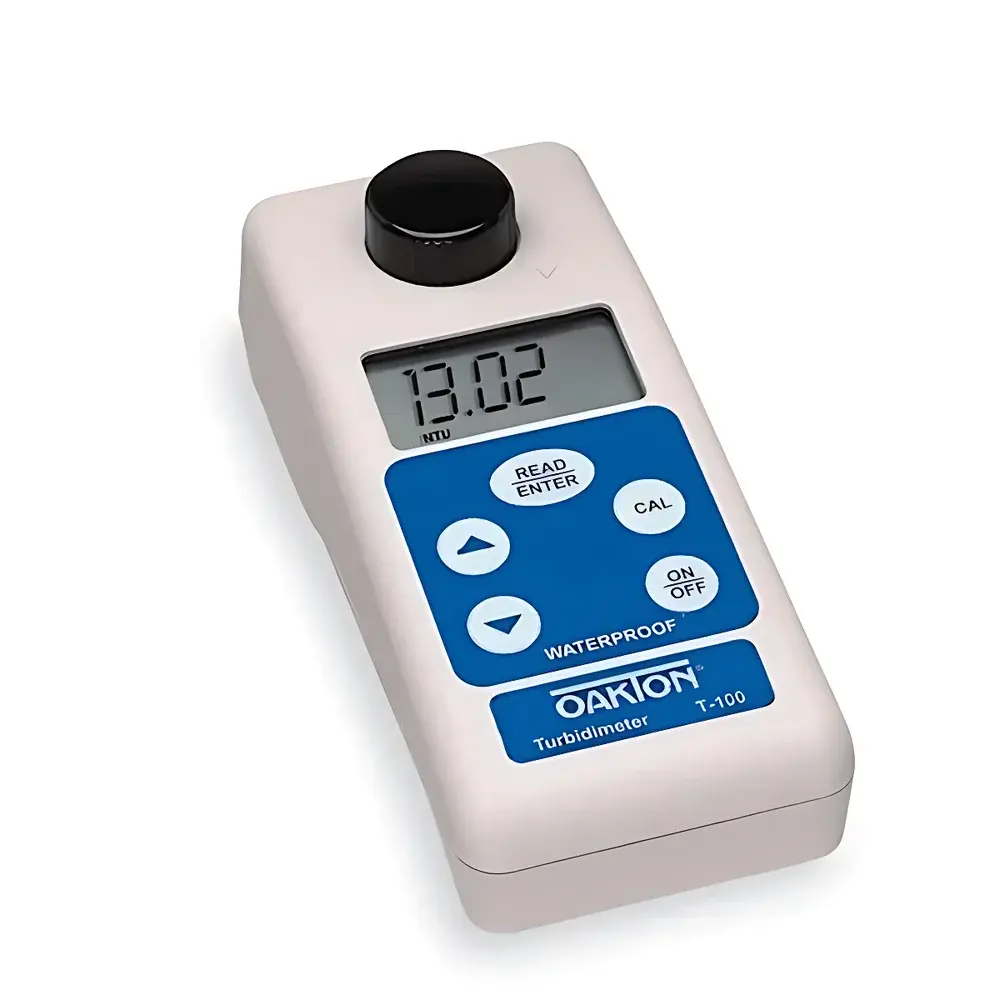
Oakton T-100 Portable Waterproof Turbidimeter
| Brand | Oakton |
|---|---|
| Origin | USA |
| Model | T-100 |
| Type | Portable |
| Measurement Range | 0–19.99 NTU, 20.0–99.9 NTU, 100–1000 NTU |
| Resolution | 0.01 NTU (0–19.99), 0.1 NTU (20.0–99.9), 1 NTU (100–1000) |
| Operating Temperature | 0–50 °C |
| Accuracy | ±2% of reading (0–500 NTU), ±3% of reading (500–1000 NTU) |
| Light Source | Infrared LED |
| Sample Volume | 10 mL |
| Cuvette Dimensions | 25 mm diameter × 50 mm height |
| Response Time | <6 seconds |
| Power Supply | 4 × AAA batteries (included) |
| IP Rating | IP67 |
| Compliance | ISO 7027 (DIN EN 27027), ASTM D6855-03 (EPA-recognized) |
Overview
The Oakton T-100 Portable Waterproof Turbidimeter is a field-deployable optical instrument engineered for rapid, reliable quantification of suspended particulate matter in water and aqueous solutions using nephelometric measurement principles. It operates on the ISO 7027-compliant infrared (850 nm) LED light source, minimizing interference from sample coloration and enabling stable performance across diverse environmental matrices—including surface water, wastewater effluent, drinking water distribution systems, and process streams in food & beverage or pharmaceutical manufacturing. Its sealed optical path eliminates drift caused by ambient light ingress or lens contamination, while the ruggedized IP67-rated housing ensures operational integrity during immersion, rain exposure, or accidental submersion—verified by its ability to float upright on water surfaces. Designed for compliance-driven workflows, the T-100 meets the photometric and calibration traceability requirements of ASTM D6855-03, an EPA-recognized standard for turbidity measurement in regulatory monitoring programs.
Key Features
- IP67-rated waterproof and dustproof enclosure—fully submersible up to 1 m for 30 minutes; buoyant design prevents loss during field deployment
- Automatic range selection across three logarithmic NTU intervals (0–19.99, 20.0–99.9, 100–1000), eliminating manual scale switching errors
- Intelligent calibration prompting: device displays step-by-step guidance and alerts user when next standard is required
- High-contrast LCD with unit-displayed readings (NTU), real-time error diagnostics (e.g., “Low Signal”, “Cuvette Misalignment”, “Out of Range”), and auto-power-off after 10 minutes of inactivity
- Energy-efficient infrared LED source with >10,000-hour lifetime; single battery set supports ≥1,000 measurements under typical field conditions
- Integrated cuvette chamber with precision-machined alignment guides ensures repeatable optical path geometry and minimizes operator-induced variability
Sample Compatibility & Compliance
The T-100 accepts standard 25 mm diameter × 50 mm height glass or high-grade acrylic cuvettes (10 mL volume). Its infrared detection system provides robust immunity to yellow-to-brown chromatic interference common in natural waters and treated effluents, satisfying the spectral requirements of ISO 7027 for formazin-equivalent turbidity reporting. The instrument’s 4-point calibration protocol—using supplied NIST-traceable standards (0.02, 20.0, 100, and 800 NTU)—ensures linearity verification across the full dynamic range. Calibration data, including date/time stamps and standard values used, are retained in non-volatile memory for GLP/GMP audit readiness. While the T-100 does not include onboard data logging or electronic output interfaces, its measurement repeatability (<1.5% RSD at 20 NTU, n=10) and accuracy profile align with routine monitoring needs under US EPA Method 180.1 and EU Directive 98/83/EC for drinking water quality assessment.
Software & Data Management
The Oakton T-100 operates as a standalone, firmware-controlled measurement platform without external software dependency or PC connectivity. All calibration parameters, instrument settings, and diagnostic logs are stored internally in EEPROM. No firmware updates or configuration changes require proprietary software—user interaction is limited to tactile keypad input and visual LCD feedback. For laboratories requiring formal recordkeeping, manual transcription of results into LIMS or paper-based logbooks remains the recommended practice. The absence of wireless transmission or USB export functionality ensures electromagnetic compatibility in electrically noisy field environments and simplifies regulatory validation under FDA 21 CFR Part 11 where electronic records are not generated.
Applications
- Field verification of municipal drinking water clarity pre- and post-filtration
- Routine effluent monitoring at wastewater treatment plant discharge points
- Process control in bottled water production lines and beverage clarification stages
- Environmental sampling of rivers, lakes, and reservoirs for sediment load assessment
- Educational laboratory instruction on water quality parameter interrelationships (e.g., turbidity vs. total suspended solids)
- Emergency response testing following storm events or infrastructure failures affecting water distribution networks
FAQ
Does the T-100 support data export or Bluetooth connectivity?
No. The T-100 is a dedicated, offline measurement instrument with no serial, USB, or wireless communication ports.
Can I use non-Oakton calibration standards?
Yes—provided they are NIST-traceable, formazin-based, and certified for ISO 7027 compliance; however, Oakton-supplied standards (Cat. No. 35635-52) are optimized for the instrument’s IR optical geometry.
What is the expected battery life under continuous daily use?
With average usage of 20 measurements per day, four AAA alkaline batteries typically last 12–14 months; low-battery indicator appears 24 hours prior to depletion.
Is the cuvette chamber compatible with quartz cuvettes?
The chamber is dimensionally compatible with standard 25 mm round cuvettes, but quartz is unnecessary—the IR LED and detector pair are optimized for borosilicate glass transmission characteristics.
How often should calibration be performed?
Daily calibration is recommended for critical applications; for routine screening, calibration before each sampling session or every 8 hours of cumulative operation is sufficient per ASTM D6855-03 guidance.





