
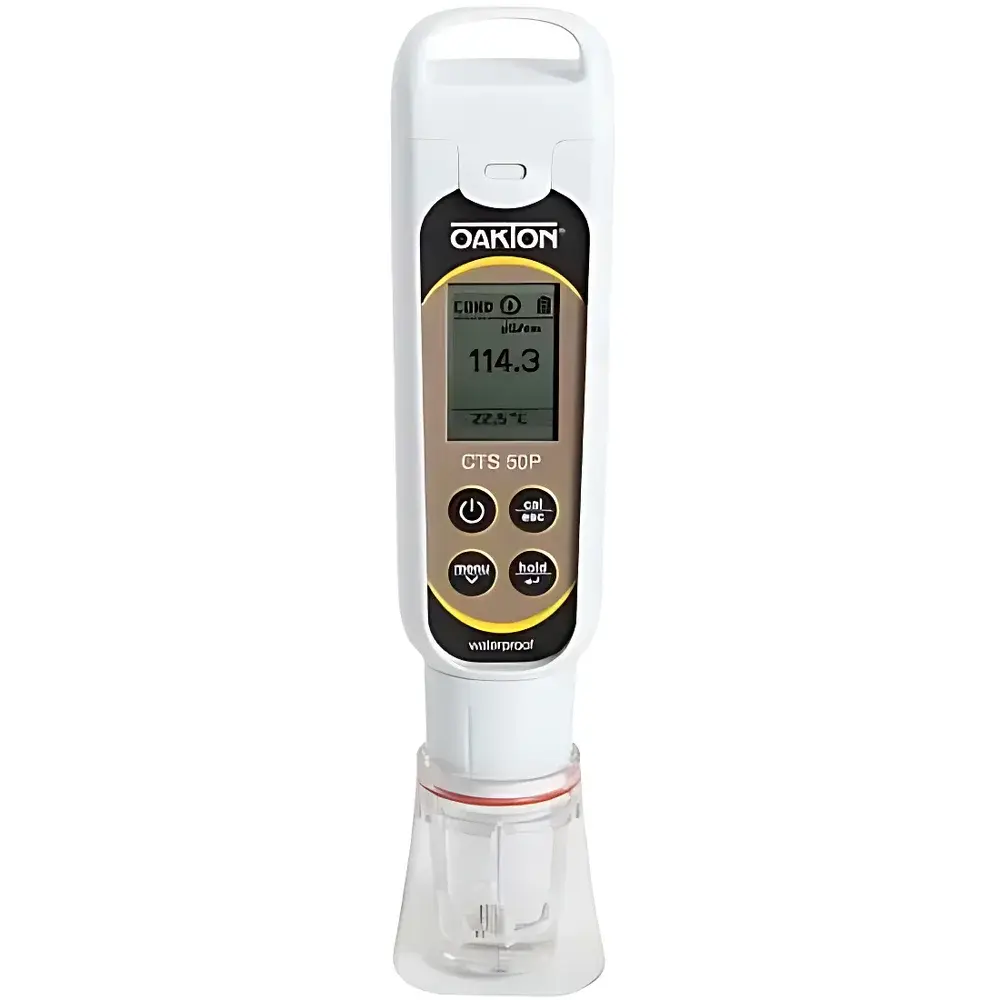
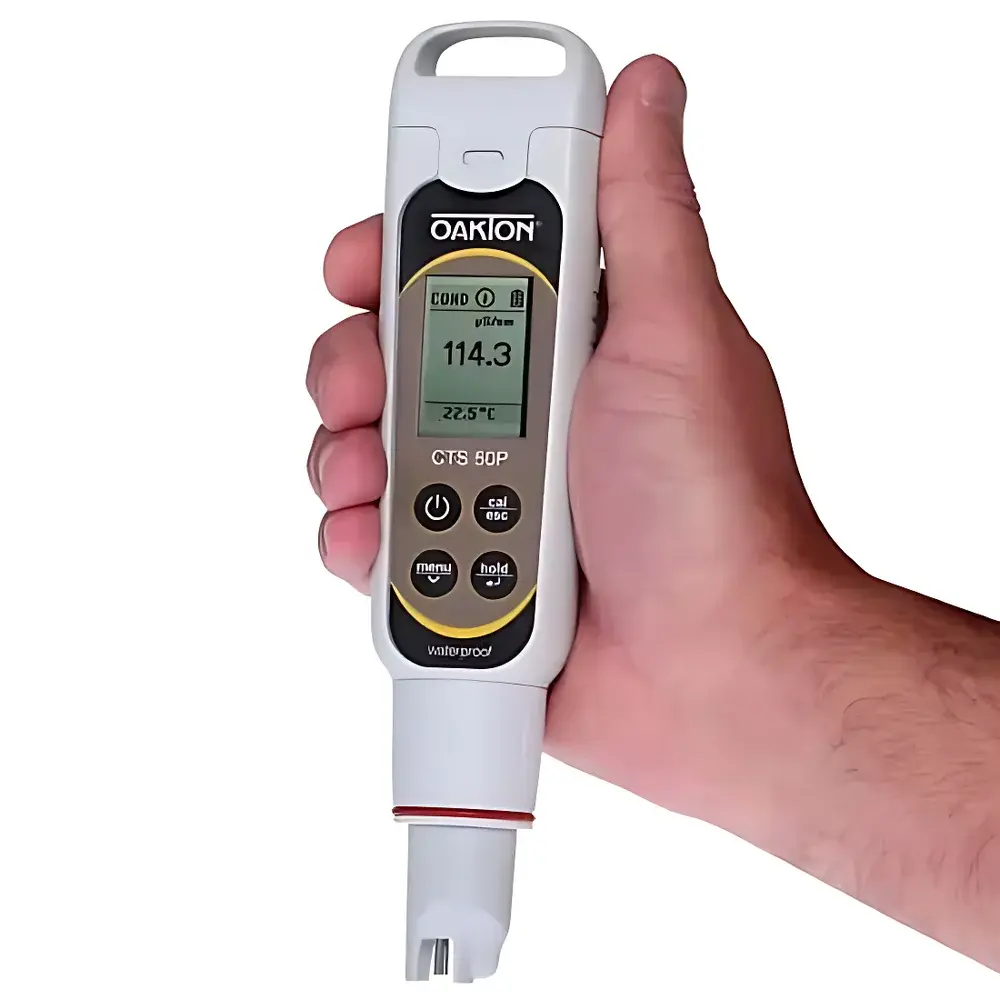
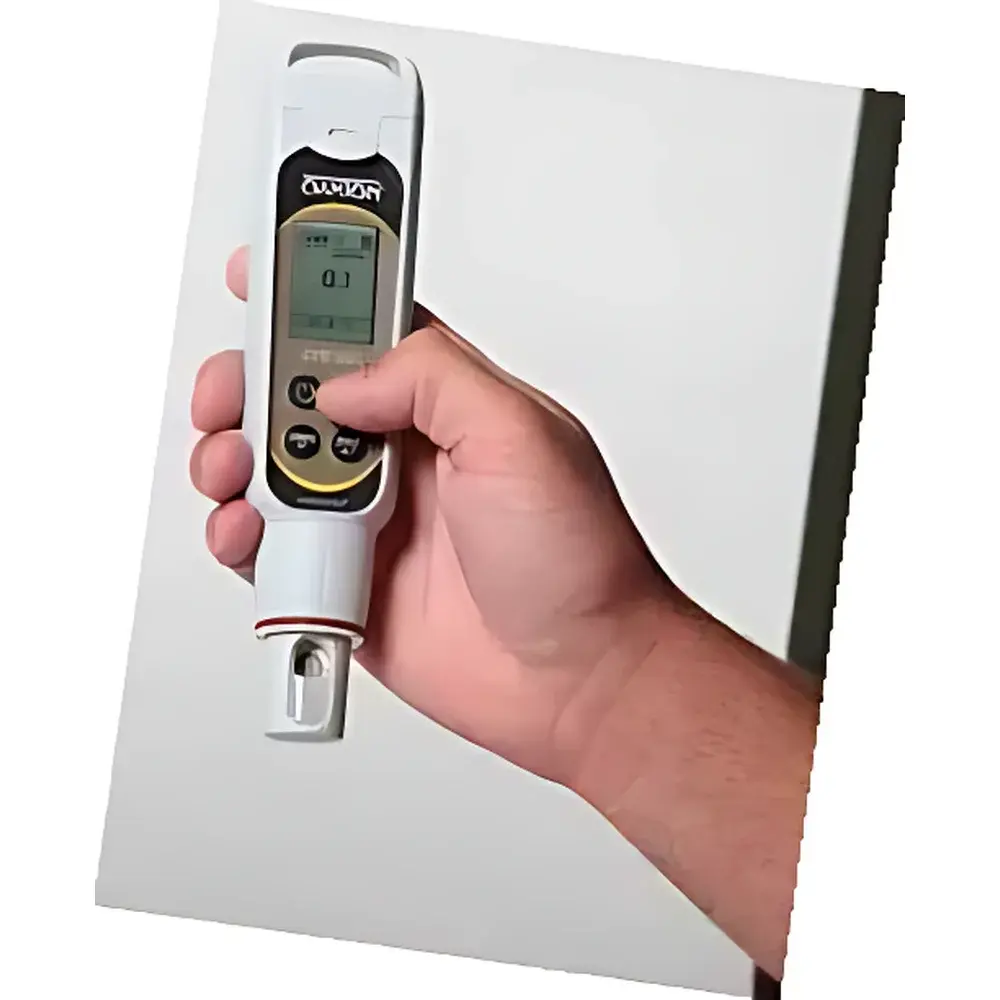
Oakton CTSTestr 50 Portable Conductivity/TDS/Salinity/Temperature Pen Meter
| Brand | Oakton |
|---|---|
| Origin | USA |
| Model | CTSTestr 50 |
| Portability | Pen-style |
| Conductivity Range | 0.0–200.0 µS/cm, 200–2000 µS/cm, 2.00–20.00 mS/cm |
| TDS Range | 0.0–100.0 ppm, 100–1000 ppm, 0.10–10.00 ppt (TDS factor selectable 0.40–1.00) |
| Salinity Range | 0.00–10.00 ppt |
| Temperature Range | 0–60 °C |
| Accuracy | ±1% of full scale (conductivity, TDS, salinity) |
| Calibration | Up to 3-point for conductivity/TDS |
| Temperature Compensation | Automatic (NTC thermistor) |
| IP Rating | IP67 |
| Power | 4 × AAA 1.5 V batteries (included) |
Overview
The Oakton CTSTestr 50 is a field-deployable, multi-parameter pen meter engineered for rapid, reliable measurement of electrical conductivity, total dissolved solids (TDS), salinity, and temperature in aqueous samples. Based on two-electrode conductometric principles, the instrument applies an alternating current across platinum electrodes to minimize polarization effects and electrode fouling—ensuring stable readings across varying ionic strengths. Its dual-range conductivity detection architecture (µS/cm and mS/cm) supports applications ranging from ultrapure water monitoring (e.g., rinse water validation in pharmaceutical cleanrooms) to brackish water analysis in environmental field surveys. Unlike benchtop meters requiring dedicated calibration stations, the CTSTestr 50 integrates factory calibration traceable to NIST-traceable standards and maintains ±1% full-scale accuracy without routine recalibration under typical usage conditions. The device operates within 0–60 °C with automatic temperature compensation (ATC) using an integrated NTC thermistor, eliminating manual correction errors common in un-compensated handheld instruments.
Key Features
- Pen-form factor with IP67-rated housing—fully submersible up to 1 meter for 30 minutes, resistant to dust ingress and accidental immersion during field sampling.
- Modular sensor design: Interchangeable probe modules (CTSTestr 50P with needle-type electrode; CTSTestr 50C with cup-type cell) enable application-specific optimization and extend host unit service life.
- Three-tier conductivity range switching (0.0–200.0 µS/cm, 200–2000 µS/cm, 2.00–20.00 mS/cm) eliminates manual range selection errors and ensures optimal resolution across low- and high-conductivity matrices.
- User-selectable TDS conversion factor (0.40–1.00) allows alignment with regulatory or process-specific conversion algorithms—critical for compliance with ASTM D1125 (standard test method for electrical conductivity and resistivity of water) or USP (water conductivity).
- Integrated protective cap serves triple function: electrode storage cover, calibration cup (with built-in volume reference), and upright stand—reducing cross-contamination risk and improving ergonomics during sequential measurements.
- Intuitive single-button interface with LCD backlight enables operation gloves-on in low-light environments (e.g., wastewater treatment plant trenches or greenhouse irrigation lines).
Sample Compatibility & Compliance
The CTSTestr 50 is validated for use with potable water, surface water, groundwater, hydroponic nutrient solutions, aquarium systems, and low-viscosity industrial process streams (e.g., boiler feedwater, cooling tower make-up). It complies with ISO 7888:2019 (water quality — determination of electrical conductivity) and supports GLP/GMP data integrity requirements through non-volatile memory retention of last calibration date, TDS factor setting, and temperature compensation mode. While not FDA 21 CFR Part 11 compliant out-of-the-box (lacking electronic signature and audit trail functionality), its calibration log and parameter configuration history meet baseline documentation needs for ISO/IEC 17025-accredited laboratories performing routine water quality verification.
Software & Data Management
The CTSTestr 50 operates as a standalone instrument with no PC connectivity or proprietary software dependency. All operational parameters—including calibration points (up to three for conductivity/TDS, one for salinity), TDS factor, and ATC activation—are stored in EEPROM and retained after battery replacement. Measurement results are displayed in real time with unit auto-switching (e.g., µS/cm → mS/cm at 2000 µS/cm threshold) and include simultaneous temperature readout. For traceable recordkeeping, users may manually log timestamps, sample IDs, and measured values per ISO 17025 Section 7.7 (result reporting), or integrate into LIMS via external barcode-scanned entry.
Applications
- Environmental field screening: Rapid assessment of stream conductivity anomalies indicating agricultural runoff or industrial discharge.
- Pharmaceutical water system monitoring: Spot-checking purified water (PW) and water for injection (WFI) conductivity against USP Stage 1 limits (≤1.3 µS/cm at 25 °C).
- Aquaculture and marine biology: Tracking salinity drift in recirculating aquaculture systems (RAS) and coral propagation tanks.
- Horticulture and hydroponics: Verifying nutrient solution EC stability prior to irrigation—critical for preventing osmotic stress in sensitive crops.
- Facility maintenance: Routine verification of deionized water loop integrity in semiconductor fab tool cooling circuits.
FAQ
What calibration standards are recommended for the CTSTestr 50?
Use NIST-traceable KCl solutions: 84 µS/cm (for low-range), 1413 µS/cm (mid-range), and 12.88 mS/cm (high-range). Perform 3-point calibration when spanning multiple ranges.
Can the CTSTestr 50 measure seawater salinity accurately?
Yes—the 0.00–10.00 ppt range covers estuarine to diluted seawater (typical open-ocean salinity is ~35 ppt; dilution to ≤10 ppt is common in coastal mixing zones or desalination pre-treatment monitoring).
How often does the sensor module require replacement?
Under normal use (≤10 measurements/day, proper rinsing and storage in damp sponge), the electrode module typically lasts 12–18 months. Performance degradation is indicated by sluggish response (>5 sec to stabilize) or calibration drift exceeding ±2% FS.
Is temperature compensation linear or non-linear?
The instrument applies linear ATC based on the standard NaCl curve (DIN EN 27888), appropriate for most freshwater and low-salinity applications. Non-linear compensation is not supported, consistent with handheld pen meter design conventions.
Does the device support GLP-compliant calibration logging?
It stores the date of last calibration and selected TDS factor, but lacks timestamped audit trails or user ID fields required for full GLP compliance. Manual logbooks or external digital records are recommended for regulated environments.
Related Products





