
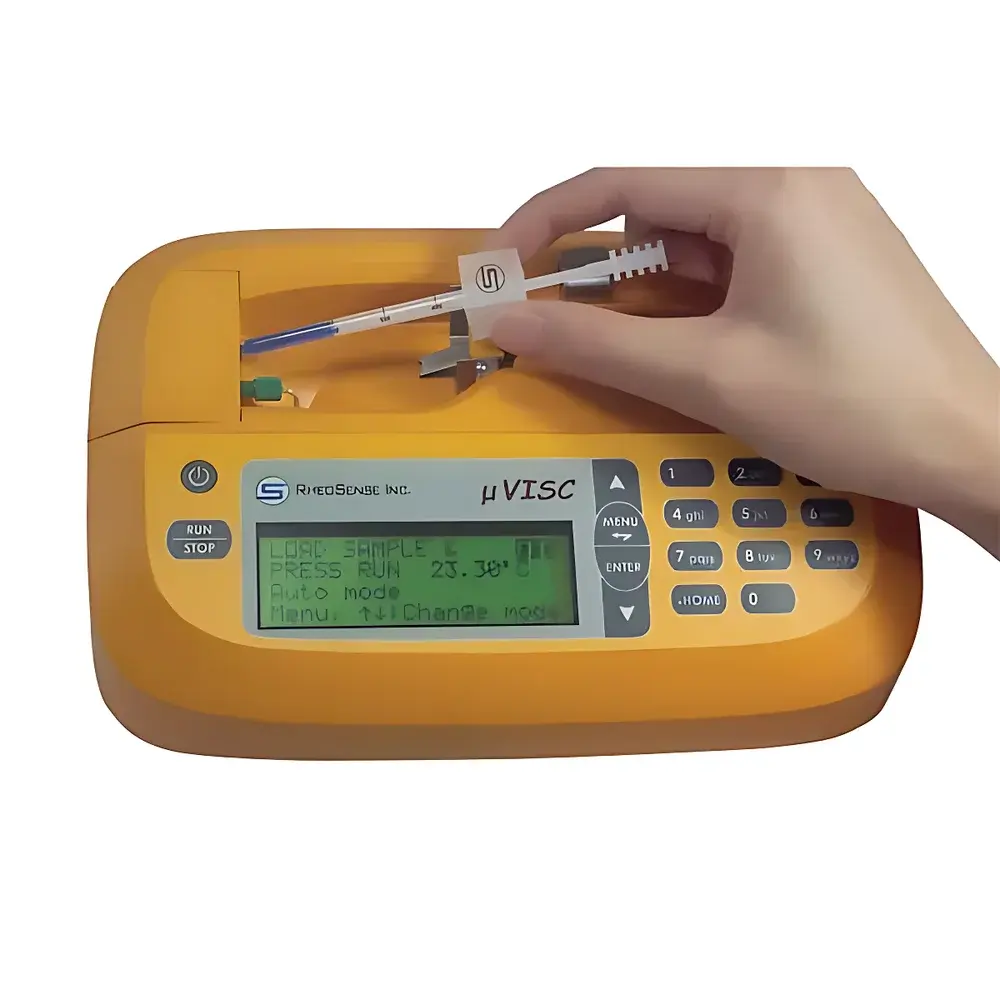
RheoSense HA01-01 Microfluidic Viscosity Chip for μVISC Platform
| Origin | USA |
|---|---|
| Manufacturer Type | Authorized Distributor |
| Origin Category | Imported |
| Model | HA01-01 |
| Pricing | Upon Request |
| Viscosity Range | 0–100 mPa·s |
| Flow Channel Depth | 50 µm |
| Sample Volume | 400 µL |
| Accuracy | ±1% FS, ±2% of reading |
| Repeatability | ±0.5% |
| Flow Rate | 0.5–450 µL/min |
| Operating Temperature Range | 15–50 °C |
| Temperature Control Accuracy | ±0.07 °C |
| Power Supply | 8 VDC |
| Syringe Fill Volume | 400 µL |
| Shear Rate Range | 6.5–5,850 s⁻¹ |
| Max Pressure | 12,000 Pa |
Overview
The RheoSense HA01-01 Microfluidic Viscosity Chip is a precision-engineered sensor module designed for integration with the μVISC microfluidic viscometry platform. It operates on the principle of pressure-drop-based viscosity measurement in laminar flow through a defined rectangular microchannel—applying the Hagen–Poiseuille relationship for Newtonian fluids and enabling robust shear-rate-dependent characterization for non-Newtonian samples. With a channel depth of 50 µm and a calibrated hydraulic resistance, the HA01-01 delivers high-fidelity dynamic viscosity data across a range of 0–100 mPa·s (cP), optimized for low-to-moderate viscosity materials commonly encountered in biopharmaceutical formulation, ink development, polymer solution screening, and lubricant R&D. Its design eliminates open-air exposure, mitigating solvent evaporation artifacts that compromise accuracy in conventional rotational or capillary systems—particularly critical for volatile solvents, aqueous protein solutions, or low-boiling-point organic media.
Key Features
- Microfluidic architecture with precisely fabricated 50 µm-deep rectangular flow channel ensures consistent hydraulic resistance and minimal wall-slip effects.
- Ultra-low sample requirement: full viscosity profile acquisition from just 400 µL—compatible with high-value, limited-availability biological or synthetic samples.
- High shear-rate capability: operational shear rate range of 6.5–5,850 s⁻¹ enables process-relevant characterization under conditions mimicking pumping, coating, or extrusion.
- Integrated MEMS pressure sensing provides real-time differential pressure measurement with ±0.07 °C temperature stability support, ensuring thermal drift compensation at the sensor level.
- Modular sensor interchangeability: HA01-01 is part of a scalable family (including HB02-01, HC02-01) allowing seamless transition between viscosity ranges without instrument reconfiguration.
- Chemically resistant wetted path constructed from fused silica and inert metal alloys, compatible with aqueous buffers, alcohols, hydrocarbons, and common polar aprotic solvents.
Sample Compatibility & Compliance
The HA01-01 chip supports direct analysis of Newtonian and non-Newtonian liquids—including shear-thinning biopolymer solutions, micellar surfactant systems, dilute polymer melts, and low-viscosity functional fluids. Its sealed, syringe-driven microfluidic path complies with GLP-aligned workflow requirements for traceable, operator-independent measurements. When paired with the optional μVISC temperature controller (IEC 61000-4-3 compliant, CE-marked), the system meets ASTM D2983 (low-temperature viscosity), ISO 3219 (rheological classification of polymers), and USP (viscosity of pharmaceutical preparations) method prerequisites. Full audit trail generation—including timestamped pressure/flow/temperature metadata—is supported under FDA 21 CFR Part 11–configured software environments.
Software & Data Management
Data acquisition and analysis are performed via RheoSense’s proprietary μVISC Control Suite, a Windows-based application supporting automated flow ramping, real-time viscosity calculation, and shear-rate sweep execution. The software computes apparent viscosity (ηa), shear stress (τ), and shear rate (γ̇) using first-principles fluid mechanics models corrected for entrance effects and compressibility where applicable. It generates export-ready CSV/PDF reports containing raw sensor outputs, fitted flow curves, and non-Newtonian parameter fits (e.g., Power Law, Carreau-Yasuda). Version-controlled firmware updates, user-level access management, and electronic signature logging ensure alignment with regulated laboratory practices.
Applications
- Biopharmaceutical process development: monitoring viscosity trends of monoclonal antibody formulations during concentration, buffer exchange, or excipient screening.
- Inkjet ink rheology: evaluating jetting stability and droplet formation thresholds at industrially relevant shear rates (>1,000 s⁻¹).
- Coating and adhesive R&D: quantifying low-shear viscosity of waterborne dispersions and UV-curable resins without sedimentation interference.
- Polymer solution characterization: determining intrinsic viscosity and molecular weight correlations from dilute-phase measurements.
- Quality control of lubricants and functional fluids: rapid batch verification against specification limits with sub-minute turnaround per sample.
FAQ
What distinguishes the HA01-01 from conventional capillary or rotational viscometers?
It employs microfluidic pressure-drop sensing within a geometrically invariant channel, eliminating mechanical bearing friction, end-effects, and air-liquid interface errors—yielding higher reproducibility (<±0.5%) and lower detection limits (0.2 cP) than macro-scale methods.
Can the HA01-01 be used for temperature-dependent viscosity studies?
Yes—when coupled with the Peltier-based μVISC temperature controller, it maintains ±0.07 °C thermal stability over 18–50 °C, enabling Arrhenius or WLF modeling with confidence intervals suitable for regulatory submissions.
Is calibration required before each measurement?
No routine recalibration is needed; the chip is factory-calibrated using NIST-traceable Newtonian standards (e.g., Cannon-Fenske oils). Users perform daily verification with a reference fluid to confirm system integrity.
How does the system handle non-Newtonian samples?
The software applies first-order entrance correction and iterative shear-rate mapping to derive true shear viscosity, with optional Carreau model fitting to extract zero-shear viscosity and relaxation time constants.
Are there cleaning protocols for residual sample carryover?
A three-step flush sequence (solvent → intermediate rinse → final purge) is programmable in the software; channel geometry allows complete removal of viscous residues without disassembly.



