
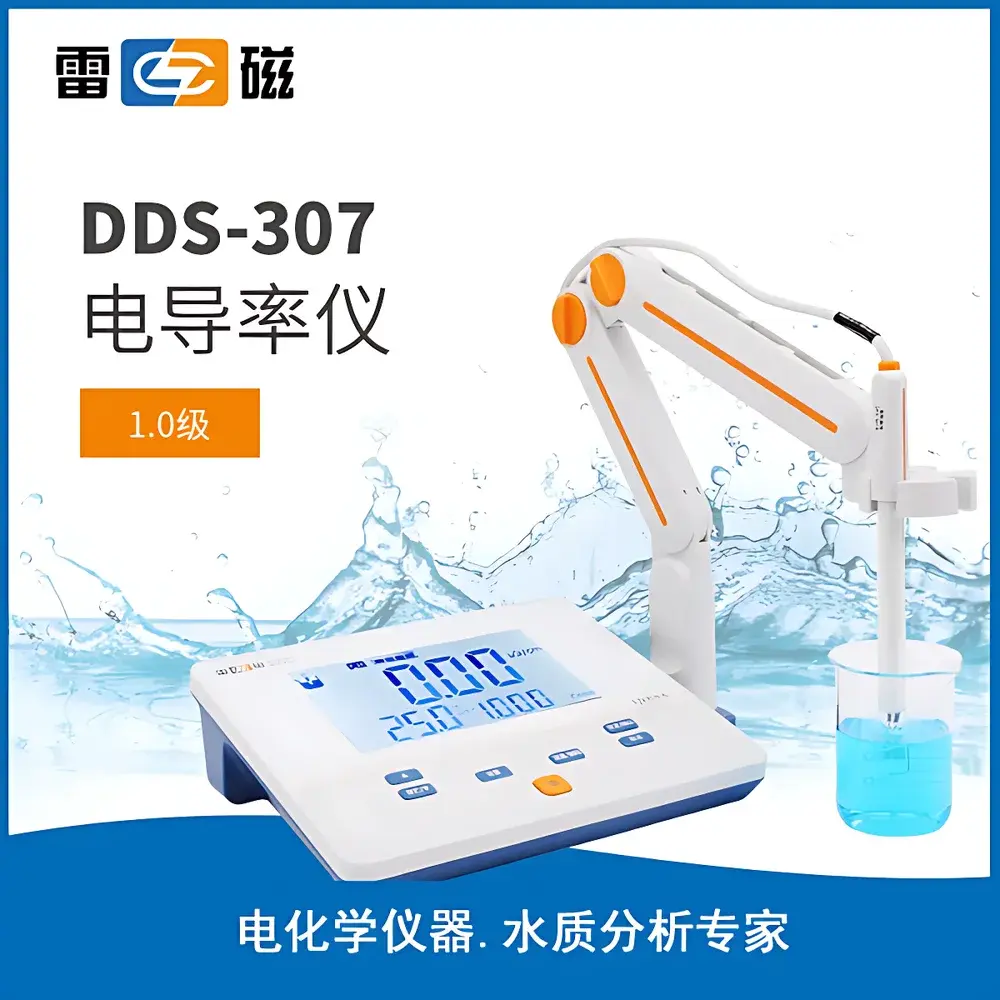
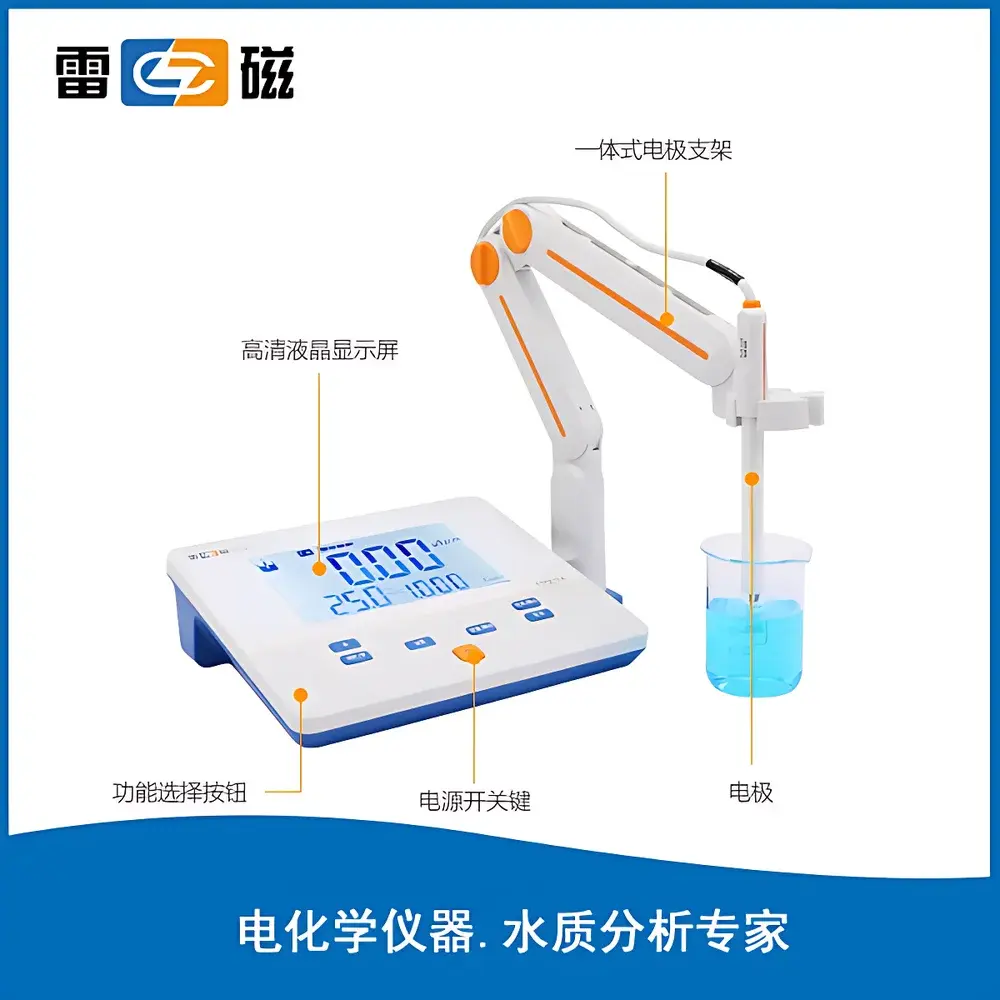
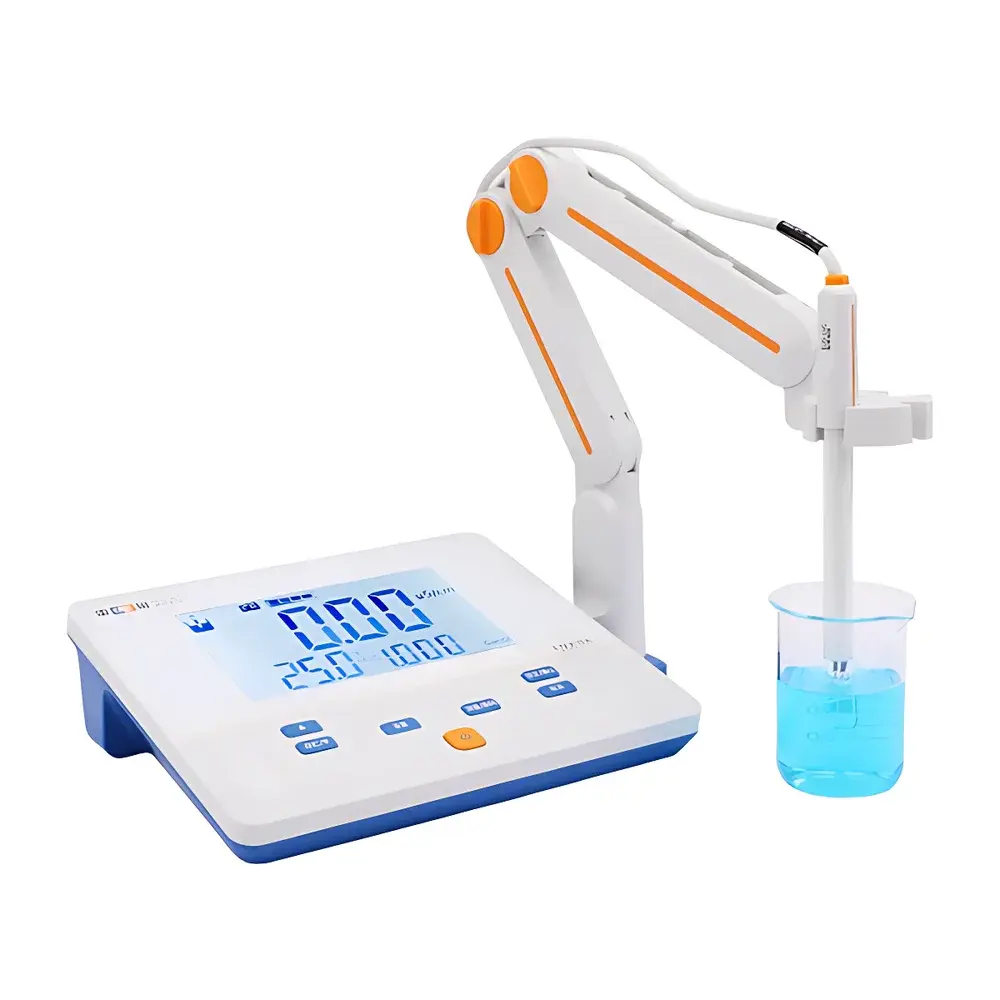
Leici DDS-307 Benchtop Conductivity Meter with Optional Titanium Electrode for Ultrapure Water Measurement
| Brand | Leici |
|---|---|
| Origin | Shanghai, China |
| Model | DDS-307 |
| Instrument Class | 1.0 |
| Conductivity Range | 0.00 μS/cm to 100 mS/cm |
| Basic Error | ±1.0% FS |
| Stability | ±0.33% FS / 3 h |
| Temperature Compensation | Manual |
| Cell Constant Compensation | Yes |
| Display | Segment LCD (dual-parameter: conductivity & temperature) |
| Power Supply | AC 220 V ±22 V, 50 Hz ±1 Hz |
| Dimensions | 290 × 210 × 95 mm |
| Weight | 1 kg |
| Minimum Resolution | 0.01 μS/cm |
| Precision | 0.01 μS/cm |
| Form Factor | Benchtop |
| Application Environment | Laboratory |
| Electrode Compatibility | Interchangeable conductivity cells (including optional titanium electrode for low-conductivity ultrapure water) |
Overview
The Leici DDS-307 is a benchtop conductivity meter engineered for precision measurement of aqueous solution conductivity in controlled laboratory environments. It operates on the principle of two-electrode AC conductometric measurement, applying a low-frequency alternating current across a pair of electrodes immersed in the sample to determine electrical conductance, which is then converted to conductivity (μS/cm or mS/cm) using the cell constant. Designed to meet ISO 8694 and ASTM D1125 standards for conductivity instrumentation, the DDS-307 delivers reliable performance for routine quality control, process validation, and research applications where trace-level ionic contamination must be monitored—particularly in ultrapure water systems used in semiconductor fabrication, pharmaceutical water-for-injection (WFI) loops, and nuclear reactor coolant monitoring.
Key Features
- Benchtop form factor with compact footprint (290 × 210 × 95 mm) and lightweight design (1 kg), optimized for integration into analytical workstations and QC labs.
- Segment-type LCD display supporting simultaneous dual-parameter readout: conductivity value and manual temperature input—enabling consistent interpretation under non-automated thermal conditions.
- Adjustable cell constant compensation (K = 0.01–10 cm⁻¹), allowing calibration and measurement flexibility across diverse electrode geometries—including optional titanium alloy electrodes specifically engineered for minimal polarization and surface adsorption in sub-1 μS/cm ultrapure water applications.
- Manual temperature compensation (MTC) with user-defined coefficient (β), compliant with standard conductivity correction protocols per IEC 60746-3 and USP for purified water testing.
- Stability of ±0.33% full-scale (FS) over 3 hours ensures reproducible measurements during extended batch analysis or multi-sample workflows.
- 1.0-class accuracy per GB/T 11018–2021 (equivalent to IEC 60746-3 Class 1.0), validated for use in GLP-compliant laboratories performing method verification under internal SOPs.
Sample Compatibility & Compliance
The DDS-307 supports measurement of low-ionic-strength samples down to 0.00 μS/cm when paired with a certified titanium electrode (e.g., Leici DJS-0.1T, K = 0.1 cm⁻¹), minimizing interfacial impedance and electrolytic decomposition artifacts common with stainless-steel or platinum probes. It is routinely deployed in settings requiring adherence to pharmacopeial water specifications—including EP 2.2.38, JP XVII, and USP , where conductivity thresholds at 25 °C are defined for Purified Water (≤1.3 μS/cm) and Water for Injection (≤1.3 μS/cm). While the instrument does not perform automatic temperature sensing, its MTC functionality permits alignment with calibrated reference thermometers traceable to NIST standards, fulfilling audit requirements for FDA 21 CFR Part 11–aligned documentation when integrated into validated lab information management systems (LIMS).
Software & Data Management
The DDS-307 operates as a standalone analog-digital hybrid instrument with no embedded data logging or USB/RS-232 connectivity. All measurements are recorded manually or via external transcription into electronic lab notebooks (ELN) or LIMS platforms. Its design prioritizes operational simplicity and electromagnetic interference (EMI) resilience—critical in shared instrumentation suites adjacent to HPLC, ICP-MS, or microwave digestion systems. For regulated environments, users implement procedural controls—including daily system suitability checks using certified KCl standards (e.g., 1413 μS/cm at 25 °C)—to satisfy GMP Annex 11 and ISO/IEC 17025 clause 7.7 requirements for measurement traceability and uncertainty estimation.
Applications
- Monitoring conductivity drift in ultrapure water distribution loops (UPW) within microelectronics cleanrooms.
- Verifying rinse water purity following cleaning-in-place (CIP) cycles in biopharmaceutical manufacturing.
- Field-deployable lab verification of effluent conductivity against EPA Method 120.1 for wastewater discharge compliance.
- Educational use in university chemistry and environmental engineering laboratories for fundamental electrochemistry experiments.
- Calibration verification of online conductivity sensors in pilot-scale desalination or boiler feedwater treatment systems.
FAQ
Does the DDS-307 support automatic temperature compensation (ATC)?
No—it provides manual temperature compensation only, requiring the user to input the measured sample temperature prior to reading.
Can it measure TDS, resistivity, or salinity?
No—the DDS-307 is a single-parameter instrument dedicated exclusively to conductivity measurement; derived parameters require external calculation per ISO 7888 or user-defined conversion factors.
Is the titanium electrode included by default?
No—the titanium electrode is an optional accessory (e.g., Leici DJS-0.1T); standard configuration includes a general-purpose graphite or stainless-steel cell.
What calibration standards are recommended?
Certified KCl solutions traceable to NIST SRM 1693 (e.g., 1413 μS/cm at 25 °C) are recommended for two-point calibration across the operational range.
Is the instrument suitable for GMP-regulated environments?
Yes—when operated under documented procedures, including regular verification, calibration logs, and traceable reference standards, it meets foundational requirements for equipment qualification in pharmaceutical QC labs.
Related Products




