
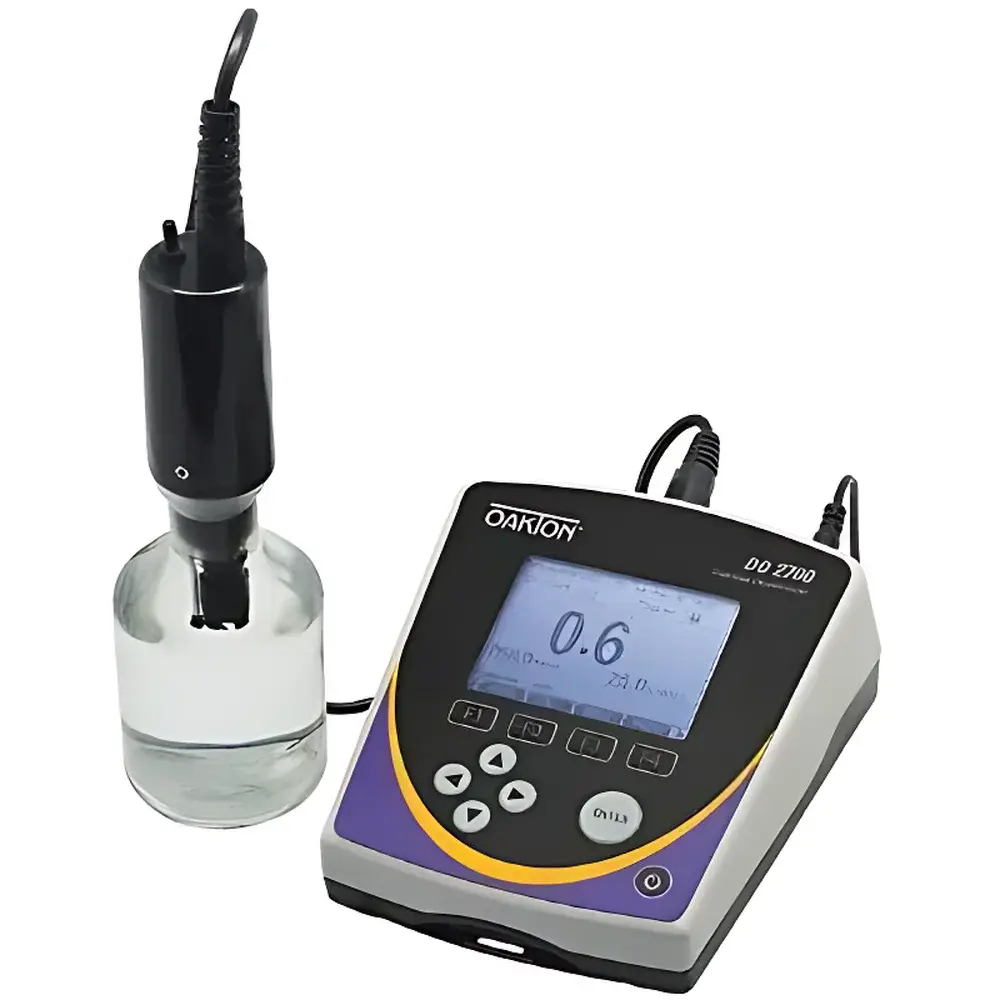
Oakton DO2700 Benchtop Dissolved Oxygen Meter
| Origin | USA |
|---|---|
| Manufacturer Type | Authorized Distributor |
| Origin Category | Imported |
| Model | DO2700 |
| Instrument Type | Laboratory |
| Measurement Principle | Electrochemical Clark-type Polarographic Probe |
| Measurement Range | 0.00–50.00 mg/L (DO), 0.0–600.0% Saturation |
| Accuracy | ±0.5% of full scale (DO and % saturation), ±0.5°F (±0.3°C) (temperature) |
| Repeatability | ±0.5% of full scale |
| Detection Limit | 0.1 mg/L |
| Resolution | 0.01 mg/L (0–19.99 mg/L), 0.1 mg/L (20.0–50.0 mg/L), 0.1% (saturation), 0.1°F / 0.1°C (temperature) |
| Temperature Compensation | Automatic or manual, 32–122°F (0–50°C) |
| Salinity Compensation | Manual input, 0.0–50.0 ppt |
| Barometric Pressure Compensation | Integrated barometer with auto-correction |
| Data Storage | 500 measurement sets (non-volatile memory) |
| Interface | Bidirectional RS-232 |
| Power Supply | 100–240 VAC universal adapter included |
Overview
The Oakton DO2700 Benchtop Dissolved Oxygen Meter is a precision-engineered laboratory instrument designed for accurate, traceable, and reproducible dissolved oxygen (DO) measurements in aqueous environmental, wastewater, and research applications. It employs a Clark-type polarographic electrochemical sensor—comprising a gold cathode, silver/silver chloride anode, and oxygen-permeable membrane—to generate a current proportional to the partial pressure of molecular oxygen diffusing across the membrane. This principle ensures stable, low-drift performance under variable temperature and salinity conditions. The DO2700 integrates an internal barometric pressure sensor to automatically correct DO readings for local atmospheric pressure, eliminating manual correction errors common in high-altitude or variable-pressure lab environments. Its dual-range DO capability (0.00–19.99 mg/L at 0.01 mg/L resolution; 20.0–50.0 mg/L at 0.1 mg/L resolution) supports both low-concentration environmental monitoring and high-saturation BOD incubation studies. Engineered for GLP-compliant workflows, every stored reading includes embedded timestamp (date/time), probe ID, calibration history, and user-defined sample ID—ensuring full auditability per ISO/IEC 17025 and EPA Method 4500-O G requirements.
Key Features
- Integrated barometric pressure sensor enabling real-time, automatic DO compensation without external gauges or manual entry
- Self-stirring DO/BOD probe (Model 35420-82) with built-in magnetic stirrer—eliminates external stir plates and ensures consistent diffusion layer control per ASTM D888 and Standard Methods 4500-O G
- Large backlit graphical LCD display (128 × 64 pixels) optimized for ambient light variability—readable under hood lighting, dimmed labs, or direct sunlight
- Non-volatile memory storing up to 500 complete datasets, each containing DO value, % saturation, temperature, pressure, salinity, calibration status, and UTC timestamp
- Manual salinity compensation (0.0–50.0 ppt) aligned with USGS and APHA protocols for estuarine, brackish, and seawater analysis
- Bidirectional RS-232 interface supporting automated data export to LIMS, Excel, or validated laboratory software—compatible with terminal emulation and ASCII command protocols
- Auto-ranging temperature measurement (0–50°C) with ±0.3°C accuracy and selectable °F/°C units
Sample Compatibility & Compliance
The DO2700 is validated for use with freshwater, wastewater effluent, surface water, groundwater, aquaculture systems, and saline matrices up to 50.0 ppt. Its polarographic probe design minimizes interference from sulfides, chlorine, and organic solvents when operated within specified membrane lifetime and electrolyte replacement intervals. All calibration and measurement records comply with Good Laboratory Practice (GLP) documentation standards—including mandatory time/date stamping, operator identification fields, and calibration verification logs. The instrument’s firmware supports 21 CFR Part 11–ready data integrity features when paired with compliant third-party software, including electronic signature capture, audit trail generation, and read-only archived exports. It meets the functional requirements of ISO 5814:2012 (electrochemical determination of dissolved oxygen) and EPA-approved methods for BOD5 testing (Method 405.1).
Software & Data Management
Data transfer occurs via standard RS-232 serial protocol using ASCII-formatted packets, enabling seamless integration into existing laboratory informatics infrastructure. Each exported record contains comma-delimited fields: timestamp (YYYY-MM-DD HH:MM:SS), DO (mg/L), % saturation, temperature (°C), pressure (kPa), salinity (ppt), probe serial number, and calibration epoch. No proprietary drivers or cloud dependencies are required—supporting air-gapped lab networks and legacy Windows/Linux terminals. Internal memory retains all data during power loss, and recall mode permits on-device review of historical trends by date range or sample group. Optional CSV batch export tools (provided separately) support batch validation against QA/QC check standards per ISO/IEC 17025 Clause 7.7.
Applications
- Regulatory wastewater compliance monitoring (NPDES, Clean Water Act reporting)
- Biochemical Oxygen Demand (BOD5) incubation assays requiring stable, self-stirred DO tracking over 5-day periods
- Drinking water treatment plant process control—especially post-aeration and pre-distribution reservoirs
- Aquatic toxicology studies where precise DO gradients influence LC50 endpoint determination
- Environmental field lab deployments using portable power inverters (100–240 VAC input accommodates generator or battery-based AC output)
- University teaching labs emphasizing method validation, uncertainty propagation, and sensor drift characterization
FAQ
Does the DO2700 support automatic temperature compensation during DO measurement?
Yes—temperature compensation is applied continuously across the full operating range (0–50°C) using an integrated NTC thermistor in the probe assembly. Both automatic and manual TC modes are configurable.
How often must the probe membrane and electrolyte be replaced?
Oakton recommends replacing the membrane and filling electrolyte every 2–4 weeks under continuous use, or immediately after exposure to particulates, oils, or high H2S concentrations—per maintenance guidelines in the DO2700 User Manual Section 4.2.
Is the RS-232 interface compatible with modern USB-equipped computers?
Yes—standard USB-to-RS-232 adapters (FTDI chipset recommended) enable connectivity; no custom drivers are needed beyond those supplied by the adapter manufacturer.
Can the instrument store calibration coefficients from multiple probes?
No—the DO2700 stores only one active calibration set per probe type. Multiple probe calibrations require manual re-entry or external documentation; probe ID tagging is supported for traceability.
What is the warranty coverage for the DO2700 and its included probe?
Oakton provides a 2-year limited warranty covering parts and labor for the meter and a 1-year warranty for the included 35420-82 self-stirring probe, subject to proper use and scheduled maintenance as defined in the warranty statement.







