
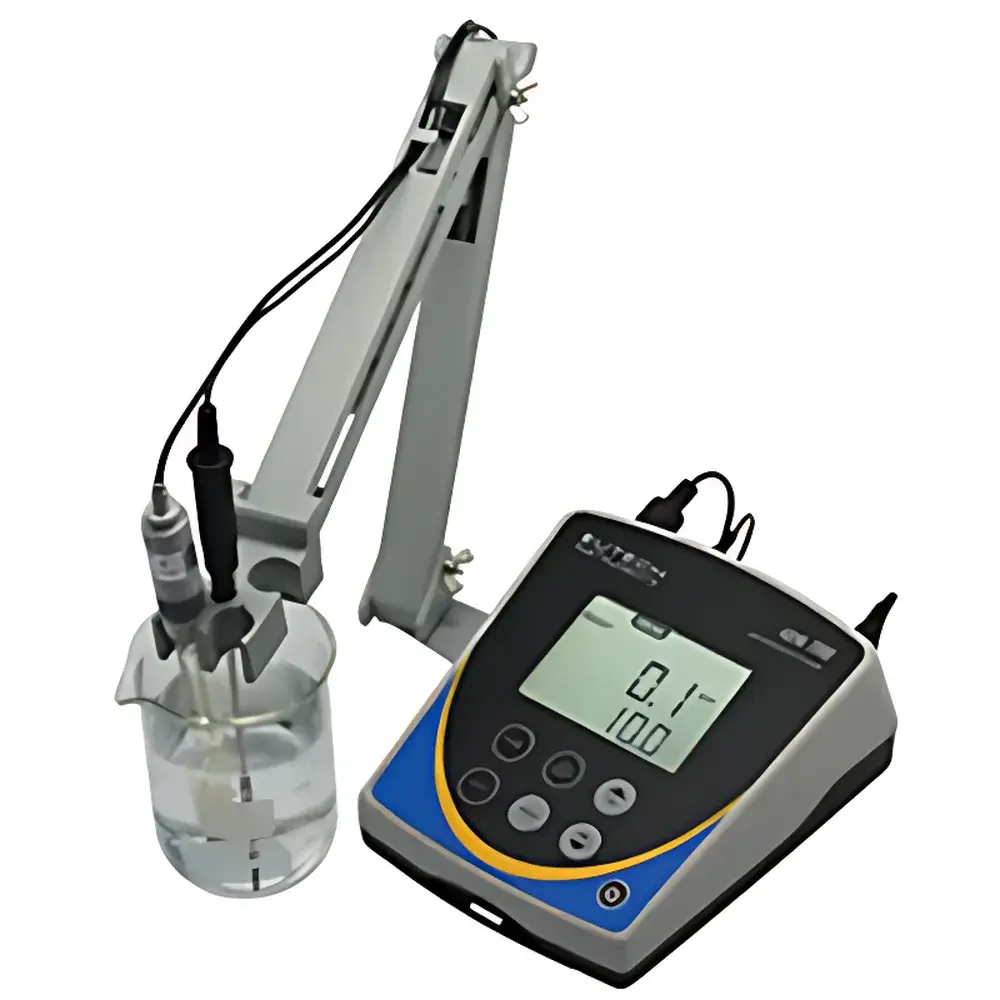
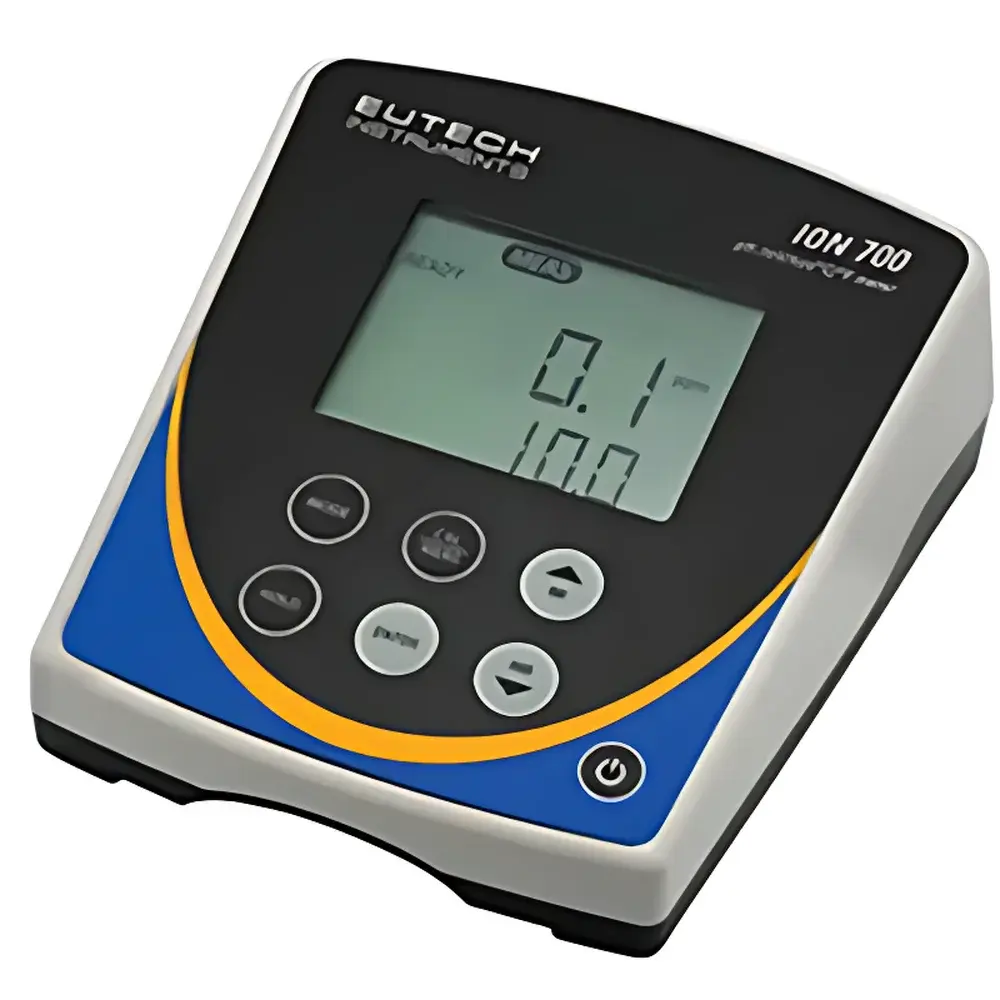
EUTECH Ion 700 Benchtop Ion Concentration Meter
| Brand | EUTECH |
|---|---|
| Origin | USA |
| Model | Ion 700 |
| Instrument Type | Benchtop |
| Ion Measurement Range | 0.01–2000 ppm |
| Detection Limits | 0.01 / 0.1 / 1 ppm (selectable resolution) |
| Accuracy | ±0.5% of reading (monovalent ions), ±1.0% (divalent ions) |
| Temperature Range | 0.0–100.0 °C |
| pH Range | –2.00 to 16.00 |
| pH Resolution | 0.01 |
| pH Accuracy | ±0.01 pH + 1 LSD |
| ORP Range | ±2000 mV |
| ORP Resolution | 0.1 mV (±199.9 mV), 1 mV (elsewhere) |
| Calibration Points | 2–5 points (pH and ion modes) |
| Data Storage | 100 measurement records |
| Temperature Compensation | Automatic or manual (0–100 °C, pH only) |
| Display | Dual-line LCD (5.6 × 7.5 cm) |
| Power | 9 V DC adapter (100–240 VAC SMPS) |
| Dimensions (H×W×D) | 17.5 × 15.5 × 6.9 cm |
| Weight | 650 g |
Overview
The EUTECH Ion 700 is a precision benchtop ion concentration meter engineered for reliable, trace-level quantification of specific ionic species—including chloride (Cl⁻), fluoride (F⁻), nitrate (NO₃⁻), calcium (Ca²⁺), sodium (Na⁺), and other monovalent or divalent ions—in environmental, industrial, and academic water quality laboratories. It operates on the principle of potentiometric measurement using ion-selective electrodes (ISEs), where the electrode potential responds logarithmically to the activity of the target ion in solution, per the Nernst equation. Coupled with integrated pH, ORP, and temperature measurement capabilities, the Ion 700 functions as a multi-parameter analytical platform compliant with standard methods for aqueous ionic analysis (e.g., ASTM D3869, ISO 10523, EPA Method 300.0). Its robust architecture supports routine calibration, stable signal acquisition, and reproducible results under variable ambient conditions—making it suitable for both regulatory monitoring and method development workflows.
Key Features
- Multi-parameter capability: Simultaneous measurement of ion concentration, pH (–2.00 to 16.00), ORP (±2000 mV), and temperature (0.0–100.0 °C)
- Configurable resolution: Selectable display resolution of 0.01, 0.1, or 1 ppm for optimized readability across low- and high-concentration ranges
- Advanced calibration logic: Up to five-point ion calibration with slope and offset diagnostics; automatic buffer recognition for USA and NIST pH standards
- Integrated temperature compensation: Auto/manual ATC (0–100 °C) applied during pH measurements; optional reference temperature input for ISE calculations
- GLP-compliant data handling: Timestamped storage of 100 measurement records with electrode ID, calibration history, slope (%), and offset (mV)
- Ergonomic design: Compact footprint (17.5 × 15.5 × 6.9 cm), dual-line LCD (5.6 × 7.5 cm), built-in electrode holder, and BNC/phono inputs for ISE, reference, and ATC probes
Sample Compatibility & Compliance
The Ion 700 is compatible with a broad range of commercially available liquid-phase ion-selective electrodes—including solid-state, polymer-membrane, and crystalline membrane types—for direct measurement in aqueous samples such as drinking water, wastewater effluents, surface water, leachates, and process streams. It meets essential requirements for laboratory-based water quality testing under ISO/IEC 17025-accredited environments when operated with traceable calibration standards and documented procedures. While not inherently 21 CFR Part 11 compliant, its GLP-oriented features—including calibration audit trails, measurement metadata logging, and user-accessible calibration diagnostics—support alignment with FDA-regulated QA/QC protocols where electronic record integrity is maintained via procedural controls.
Software & Data Management
Data export is performed manually via visual readout and manual transcription, as the Ion 700 does not feature USB, Bluetooth, or RS-232 connectivity. All stored entries include date/time stamp, measured parameter value, unit, electrode type identifier (if entered), calibration slope (%), and offset (mV). The instrument’s internal memory retains up to 100 records with no overwrite protection—users are advised to perform periodic manual archival for long-term data retention. For integration into LIMS or ELN systems, external documentation practices (e.g., CSV logbooks, scanned calibration certificates) are recommended to satisfy ALCOA+ principles (Attributable, Legible, Contemporaneous, Original, Accurate).
Applications
- Regulatory compliance testing for chloride and nitrate in potable water per WHO Guidelines and EU Drinking Water Directive (98/83/EC)
- Corrosion monitoring in cooling tower water via chloride ion tracking
- Soil leachate analysis for anion migration studies in environmental impact assessments
- Quality control of electroplating bath chemistry (e.g., cyanide, fluoride)
- Academic research in aquatic geochemistry, including ion speciation modeling and equilibrium constant validation
- Calibration verification of online ion analyzers using grab-sample reference measurements
FAQ
Does the Ion 700 support automatic temperature compensation for ion measurements?
No—temperature compensation is applied automatically only during pH measurement. For ion concentration, users must either maintain constant sample temperature or apply manual correction factors based on published thermodynamic coefficients for the specific ISE used.
Can the instrument store calibration data separately for different ion electrodes?
Yes—calibration parameters (slope, offset, date/time) are retained per measurement mode (pH, ion, ORP) but not per individual electrode serial number. Users should annotate electrode identity externally when rotating between multiple ISEs.
Is the Ion 700 suitable for measuring heavy metal ions like lead or cadmium?
It can be used with certified heavy-metal-selective electrodes (e.g., Pb²⁺, Cd²⁺), provided the electrode manufacturer specifies compatibility with the Ion 700’s mV input range and output impedance requirements. Detection limits will depend on electrode performance—not instrument specifications.
What is the recommended maintenance schedule for the Ion 700?
Daily: Rinse electrodes with deionized water; verify zero mV offset in calibration standard. Weekly: Inspect BNC connections and cable integrity. Annually: Validate meter accuracy using traceable reference solutions and document against baseline performance metrics.
Related Products







