
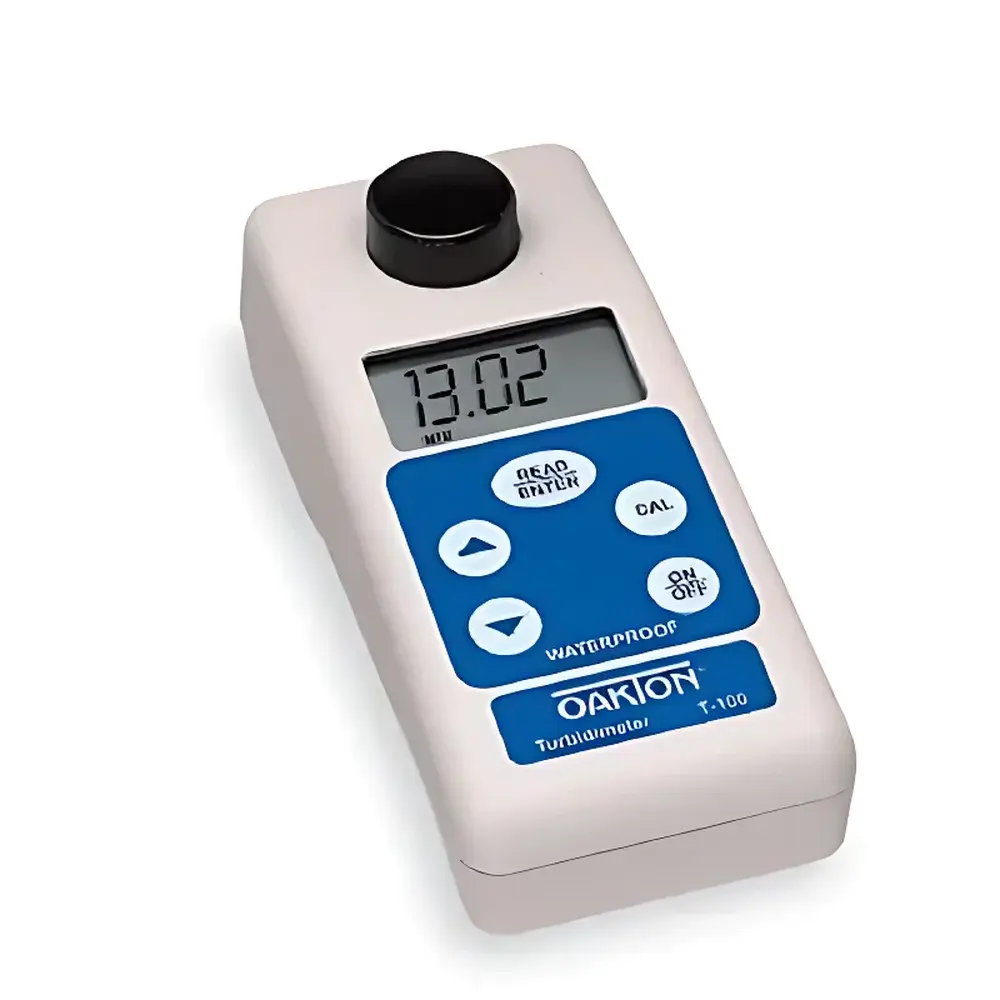
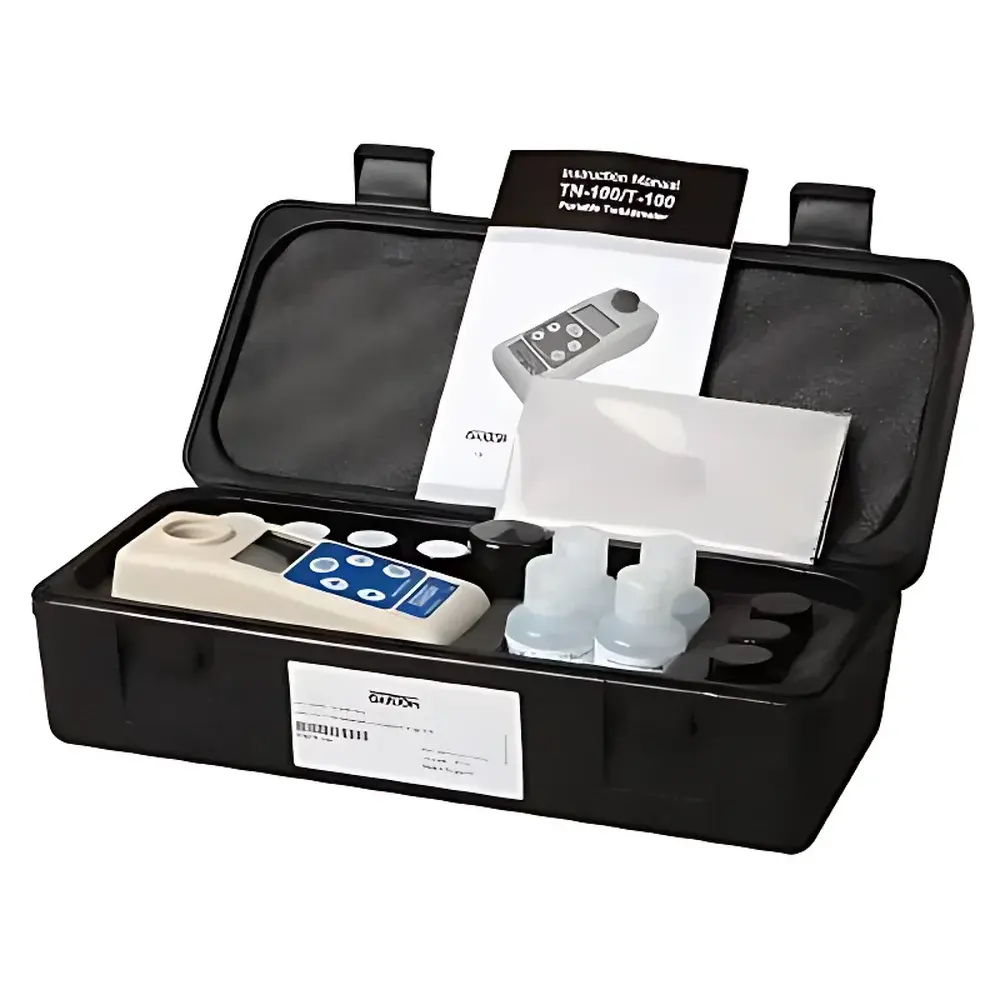
Oakton T100 Waterproof Turbidimeter
| Brand | Oakton |
|---|---|
| Origin | Singapore |
| Model | T100 |
| Form Factor | Benchtop/Laboratory |
| Measurement Range | 0–1000 NTU |
| Resolution | 0.01 NTU (0–19.99 NTU), 0.1 NTU (20–99.9 NTU), 1 NTU (100–1000 NTU) |
| Operating Temperature | 0–50 °C |
| Accuracy | ±2% of reading (0–500 NTU), ±3% of reading (501–1000 NTU) |
| Repeatability | ±1% of reading |
| Calibration Points | 4-point (0.02, 20.0, 100, 800 NTU) |
| Light Source | Infrared LED (850 nm) |
| IP Rating | IP67 |
| Power Supply | 4 × 1.5 V AAA alkaline batteries (>1200 measurements per set) |
| Dimensions (Instrument) | 15.5 × 6.8 × 4.6 cm |
| Weight (Instrument) | 200 g |
| Sample Volume | 10 mL |
| Response Time | <6 seconds |
| Compliance | ISO 7027, DIN 27027, US EPA Method 180.1 (non-formazin standard) |
Overview
The Oakton T100 Waterproof Turbidimeter is a precision benchtop instrument engineered for reliable, field- and lab-grade turbidity measurement in accordance with internationally recognized optical standards. Based on the nephelometric principle—measuring scattered infrared light at 850 nm—the T100 adheres strictly to ISO 7027 and DIN 27027 protocols, ensuring metrological consistency across diverse water quality applications. Unlike traditional formazin-based calibration approaches, the T100 implements a non-formazin reference standard compliant with US EPA Method 180.1, eliminating stability drift, biological degradation, and hazardous handling concerns associated with formazin suspensions. Its compact, ABS-plastic housing achieves IP67 ingress protection—fully dust-tight and submersible up to 1 meter for 30 minutes—making it uniquely suited for demanding environments including wastewater treatment plants, environmental monitoring stations, and mobile field laboratories where robustness and portability are critical without compromising analytical fidelity.
Key Features
- Infrared LED light source (850 nm) minimizes color interference and eliminates photobleaching effects common with visible-light turbidimeters, enhancing long-term calibration stability.
- Auto-ranging detection system with three dynamic resolution modes: 0.01 NTU (0–19.99 NTU), 0.1 NTU (20–99.9 NTU), and 1 NTU (100–1000 NTU), enabling high-resolution low-range quantification and broad dynamic coverage in a single instrument.
- Four-point calibration using certified non-formazin standards (0.02, 20.0, 100, and 800 NTU) ensures traceable accuracy across the full measurement span and supports GLP-compliant documentation workflows.
- Large backlit LCD display with intuitive icon-driven interface enables rapid parameter navigation and real-time result visualization—even under variable ambient lighting conditions.
- Optimized optical path design and precision-machined sample cell holder guarantee consistent 10 mL sample positioning, minimizing alignment-induced variability and supporting high repeatability (±1% of reading).
- Battery-powered operation (4 × AAA alkaline) delivers >1200 measurements per set—ideal for off-grid deployments—while maintaining stable output voltage throughout discharge cycle to prevent signal drift.
Sample Compatibility & Compliance
The T100 is validated for use with clarified, filtered, and raw aqueous samples—including drinking water, surface water, wastewater effluents, and process streams—provided particulate composition remains within ISO 7027’s defined scattering geometry constraints. Its infrared detection scheme reduces sensitivity to yellow-colored dissolved organic matter (e.g., humic substances), offering improved specificity for suspended solids quantification compared to white-light instruments. Regulatory alignment includes full conformance with ISO 7027:2016 (turbidity measurement—nephelometric method), DIN EN 27027 (identical technical content), and US EPA Method 180.1 for non-formazin calibration verification. The instrument meets CE marking requirements for electromagnetic compatibility (EMC Directive 2014/30/EU) and low-voltage safety (LVD Directive 2014/35/EU). While not inherently 21 CFR Part 11–compliant, its audit-ready calibration logs and fixed-point traceability support integration into GMP/GLP environments when paired with controlled procedural documentation.
Software & Data Management
The T100 operates as a standalone, firmware-controlled platform with no proprietary PC software dependency. All calibration coefficients, date/time stamps, and measurement history are retained in non-volatile memory. Each reading stores instrument ID, calibration status, user-defined sample ID (via alphanumeric keypad input), and timestamp—facilitating manual transcription into LIMS or electronic lab notebooks. Though lacking Bluetooth or USB connectivity, its deterministic 6-second response time and immediate on-screen numeric output enable efficient high-throughput screening in regulated QC labs where data entry latency must be minimized. For organizations requiring digital archiving, optional third-party barcode scanners or serial-to-USB adapters (RS-232 TTL level) may be integrated via the device’s diagnostic port for ASCII-formatted data streaming compatible with Excel, LabArchives, or custom Python-based ingestion pipelines.
Applications
- Drinking water treatment: Verification of coagulation/flocculation efficiency and final filter performance against WHO and national regulatory thresholds (e.g., ≤0.3 NTU).
- Wastewater discharge monitoring: Compliance testing per NPDES permits and ISO 10523-based reporting for effluent turbidity limits.
- Pharmaceutical water systems: USP purified water and water-for-injection (WFI) clarity assessment during distribution loop validation.
- Environmental field surveys: Rapid assessment of sediment plumes, stormwater runoff impact, and lake stratification dynamics using battery-powered portability.
- Educational laboratories: Teaching core principles of light scattering theory, calibration traceability, and ISO-standardized environmental analytics.
FAQ
Does the T100 require annual recalibration by an accredited lab?
No—user-performed 4-point calibration with certified non-formazin standards satisfies routine verification requirements. External recalibration is only recommended if drift exceeds ±2% of reading during daily checks or after physical shock exposure.
Can the T100 measure samples above 1000 NTU?
No. Samples exceeding 1000 NTU must be diluted with turbidity-free water (e.g., filtered 0.1 µm DI water) and results multiplied by the dilution factor. Dilution protocols must follow ISO 7027 Annex B guidelines to preserve scattering geometry integrity.
Is the included sample cell autoclavable?
No. The supplied glass vial is borosilicate but not rated for autoclave cycles. It is designed for chemical cleaning (e.g., 10% HCl rinse followed by DI water flush) and mechanical polishing to remove residual film deposits.
What does IP67 rating mean for daily use?
IP67 certifies complete dust ingress protection and temporary submersion (1 m depth, 30 min). This allows safe operation in humid labs, rain-exposed field sites, or accidental immersion during transport—though prolonged underwater use or pressure washing is not advised.
How is traceability maintained without digital data export?
Each calibration event generates a printed or handwritten log documenting standard values, dates, operator initials, and instrument serial number—sufficient for ISO/IEC 17025 internal audits when combined with documented SOP adherence.





