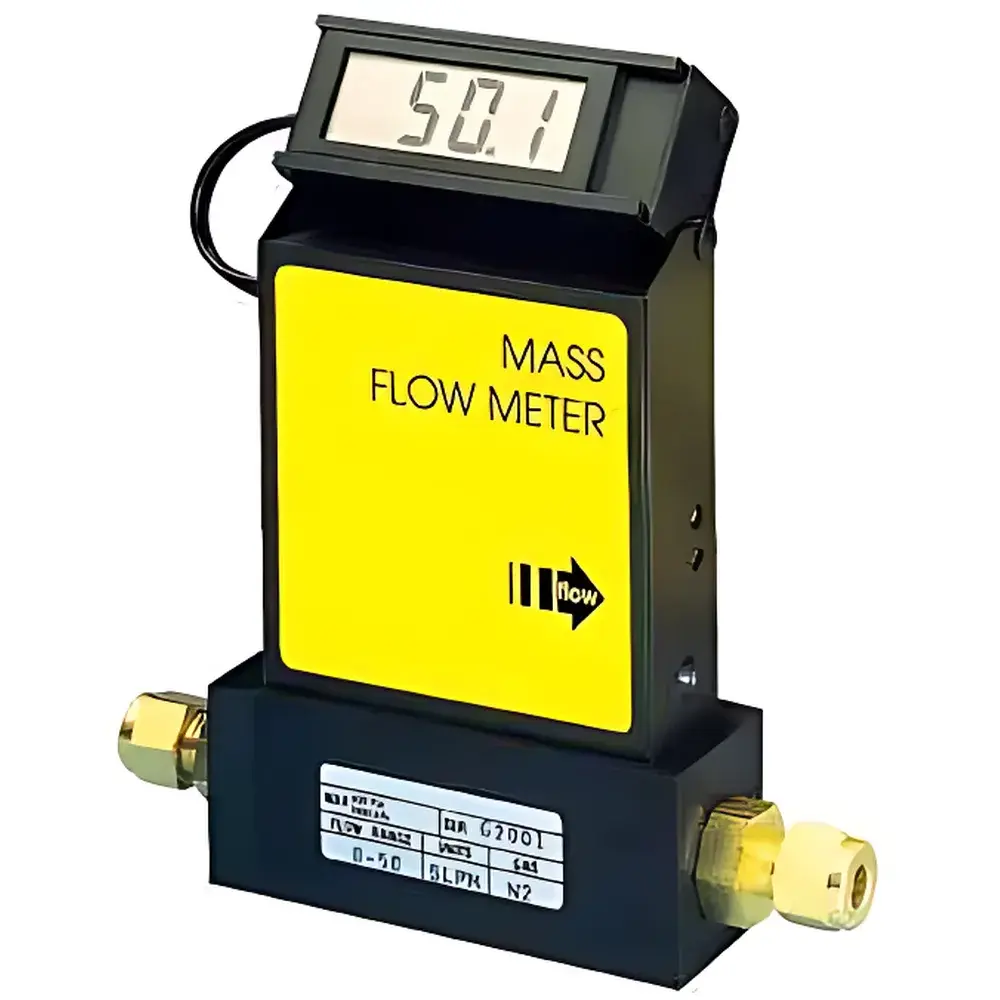
Cole-Parmer Model 32648-00 Compact Thermal Mass Flow Meter
| Brand | Cole-Parmer |
|---|---|
| Origin | USA |
| Manufacturer Type | Authorized Distributor |
| Product Origin | Imported |
| Model | 32648-00 |
| Measurement Principle | Thermal Mass Flow (Constant-Temperature Anemometry) |
| Flow Range Options | 0–10 to 0–1000 sL/min (standardized at 25 °C, 101.325 kPa) |
| Pressure Drop | 0.04–10 psi (varies by range) |
| Output Signals | 0–5 VDC and 4–20 mA analog |
| Display | Removable 3½-digit LCD, 90° tilt-adjustable |
| Remote Display Option | Up to 3 ft via extension cable (Cat. No. 32662-70) |
| Totalizer Option | Integrated accumulator (Cat. No. 32650-70) |
| Wetted Materials | Anodized aluminum / brass / Viton® (Al series) or 316 stainless steel / Viton® (SS series) |
| Protection | Resettable polymeric fuse for reverse polarity and short-circuit protection |
| Calibration | NIST-traceable certificate supplied with each unit |
| Construction | Robust metal housing with precision-machined flow body |
Overview
The Cole-Parmer Model 32648-00 Compact Thermal Mass Flow Meter is an engineered solution for high-accuracy, real-time measurement of gas mass flow rates in laboratory, pilot-scale, and light industrial applications. Unlike volumetric flow devices, this instrument employs constant-temperature anemometry (CTA) — a thermal dispersion principle — to directly quantify mass flow without requiring separate temperature or pressure compensation. A heated sensor element and reference sensor are positioned in the gas stream; the differential cooling effect caused by gas flow is linearly correlated to mass flow rate. This design ensures stable performance across moderate variations in inlet temperature and pressure (±15 °C, ±10 % of rated pressure), eliminating the need for external transducers in many standard operating conditions. Its compact footprint, modular construction, and standardized mounting interface make it suitable for integration into gas delivery systems, environmental chambers, reactor feed lines, and analytical instrumentation manifolds.
Key Features
- Thermal mass flow sensing technology with inherent independence from gas density fluctuations under typical lab conditions
- Metal-body construction (anodized aluminum or 316 stainless steel) for mechanical durability and chemical compatibility with common process gases (N₂, O₂, Ar, H₂, CO₂, synthetic air)
- Precision-machined straight-tube flow path minimizing turbulence and ensuring laminar flow profile integrity
- Factory-calibrated across four points per range to optimize linearity (typical non-linearity < ±1.0 % of full scale)
- Dual analog outputs (0–5 VDC and 4–20 mA) supporting direct connection to PLCs, data loggers, or control systems
- 3½-digit backlit LCD display with 90° rotational mount for ergonomic viewing in constrained installations
- Optional remote display capability using shielded extension cable (Cat. No. 32662-70, up to 0.9 m)
- Integrated totalizer function (optional Cat. No. 32650-70) for cumulative volume tracking over time
- Resettable polymeric fuse providing protection against wiring faults, including reverse polarity and output short circuits
- Supplied with NIST-traceable calibration certificate documenting as-tested accuracy at multiple points across the specified range
Sample Compatibility & Compliance
The Model 32648-00 is validated for use with non-corrosive, non-condensing gases at ambient to moderately elevated temperatures (operating range: 0–50 °C). Wetted materials are selected per configuration: anodized aluminum, brass, and Viton® elastomers (Al-series) or 316 stainless steel and Viton® (SS-series), enabling compatibility with inert, oxidizing, and mildly reducing atmospheres. It is not intended for use with aggressive halogens, ammonia, or solvent vapors. While not certified to IECEx or ATEX standards, its robust enclosure meets IP54-rated ingress protection when installed per manufacturer guidelines. The instrument supports compliance with GLP and GMP workflows through documented calibration traceability and stable analog signal output suitable for 21 CFR Part 11–compliant data acquisition systems when paired with appropriate audit-trail-capable software.
Software & Data Management
This flow meter operates as a stand-alone analog transducer and does not require proprietary firmware or driver installation. Analog outputs are compatible with industry-standard SCADA platforms (e.g., Ignition, Siemens WinCC), LabVIEW DAQ modules, and programmable logic controllers. When interfaced via RS-232/485 using optional analog-to-digital converters (e.g., USB-serial adapters with isolation), raw voltage or current signals can be logged in Excel, MATLAB, or Python-based analysis environments. For regulated environments, users may implement electronic record retention protocols using timestamped CSV exports and metadata tagging consistent with ALCOA+ principles (Attributable, Legible, Contemporaneous, Original, Accurate, Complete, Consistent, Enduring, Available).
Applications
- Gas flow verification in glovebox inerting and purge cycles
- Mass flow monitoring in catalytic reaction studies and fixed-bed reactor feed control
- Leak testing and pressure decay validation in sealed system qualification
- Calibration transfer between primary standards (e.g., bubble meters, critical flow orifices) and secondary instruments
- Environmental simulation chamber gas dosing (e.g., O₃, CO, NOₓ exposure studies)
- Medical device gas delivery validation (e.g., ventilator test benches, anesthesia gas analyzers)
- Quality control of gas cylinder filling processes and regulator performance testing
FAQ
Does this flow meter require gas-specific calibration?
Yes — while factory-calibrated for air/N₂, accurate measurement of other gases requires either built-in gas correction factors (if supported by downstream electronics) or recalibration using the target gas. Cole-Parmer provides gas-specific calibration services upon request.
Can it measure bidirectional flow?
No — the Model 32648-00 is unidirectional and designed for forward-flow applications only.
Is the NIST-traceable certificate included with every unit?
Yes — each instrument ships with a unique, dated calibration report showing measured values, uncertainties, and traceability to NIST Standard Reference Materials.
What is the maximum allowable system pressure?
The maximum working pressure is 150 psig (10.3 bar), independent of flow range. Pressure rating is verified per ASME B31.1 piping guidelines for instrument tubing connections.
How often should recalibration be performed?
Annual recalibration is recommended for GLP-compliant operations; frequency may be adjusted based on usage intensity, environmental conditions, and internal quality procedures.