
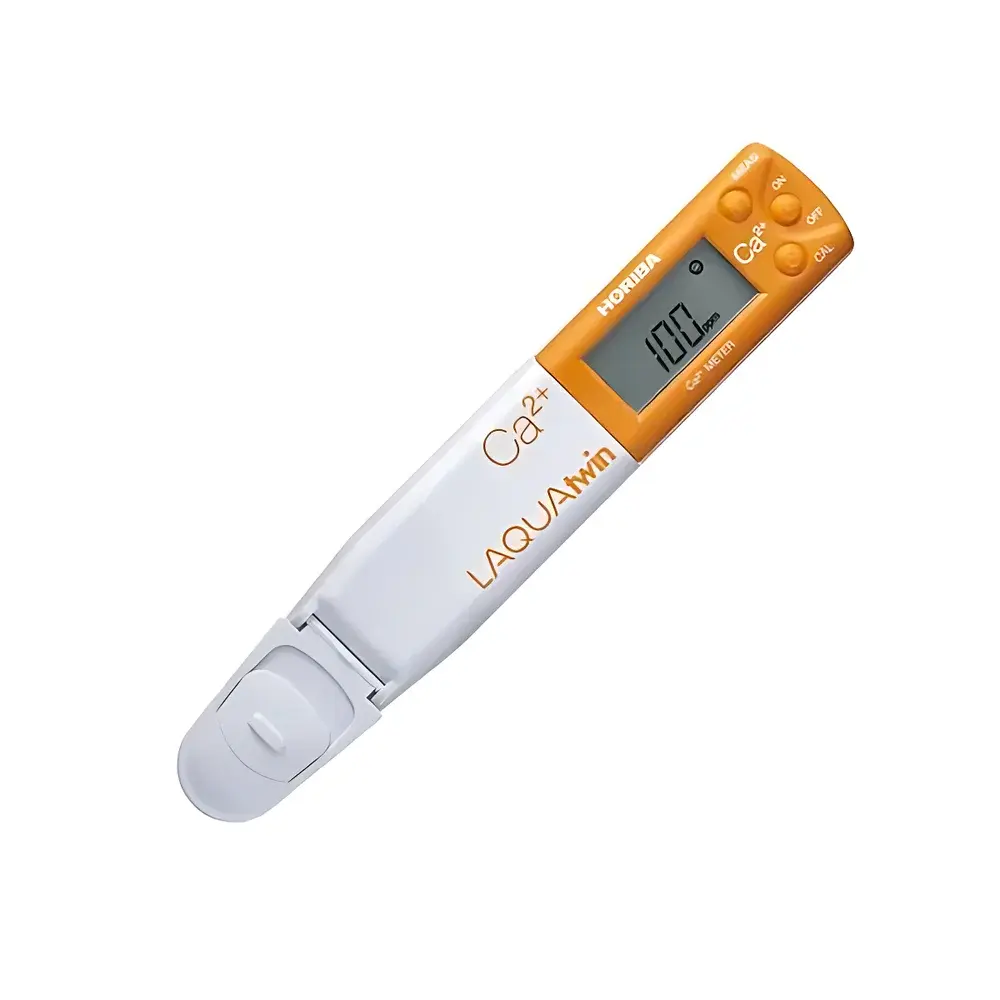
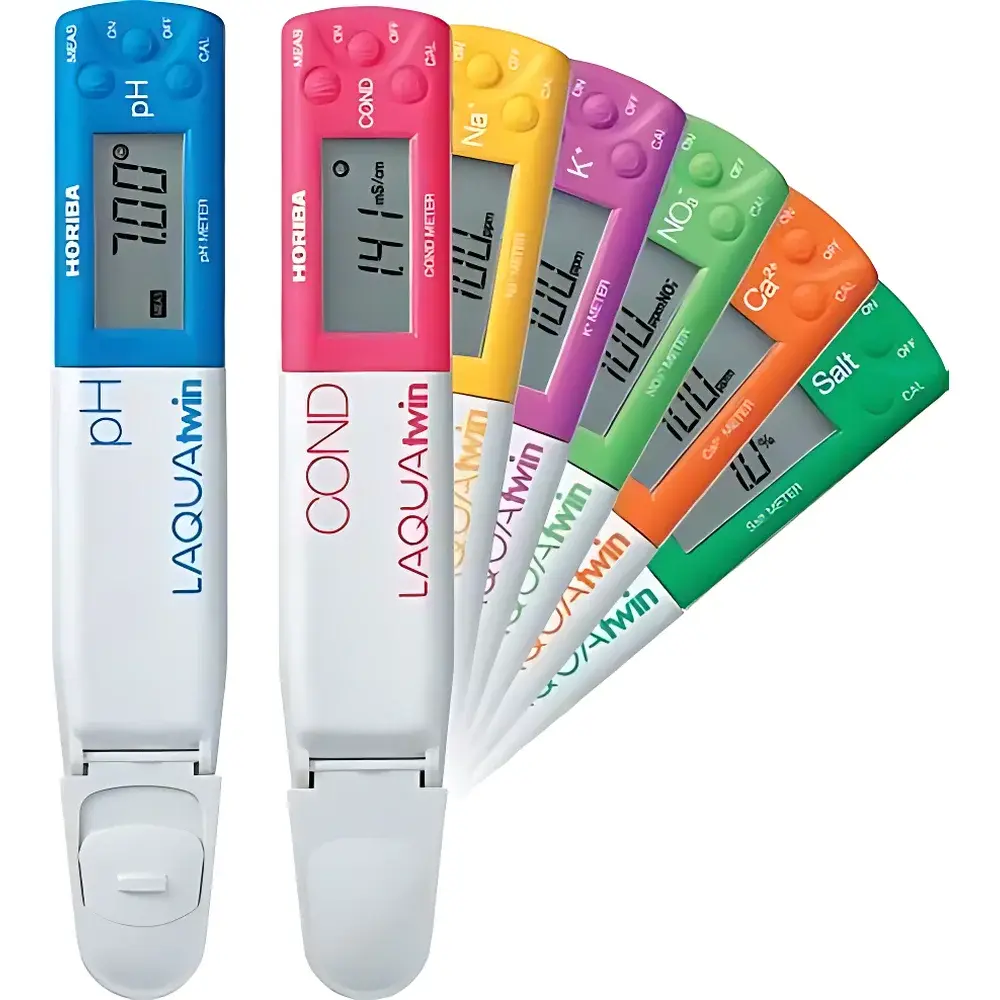
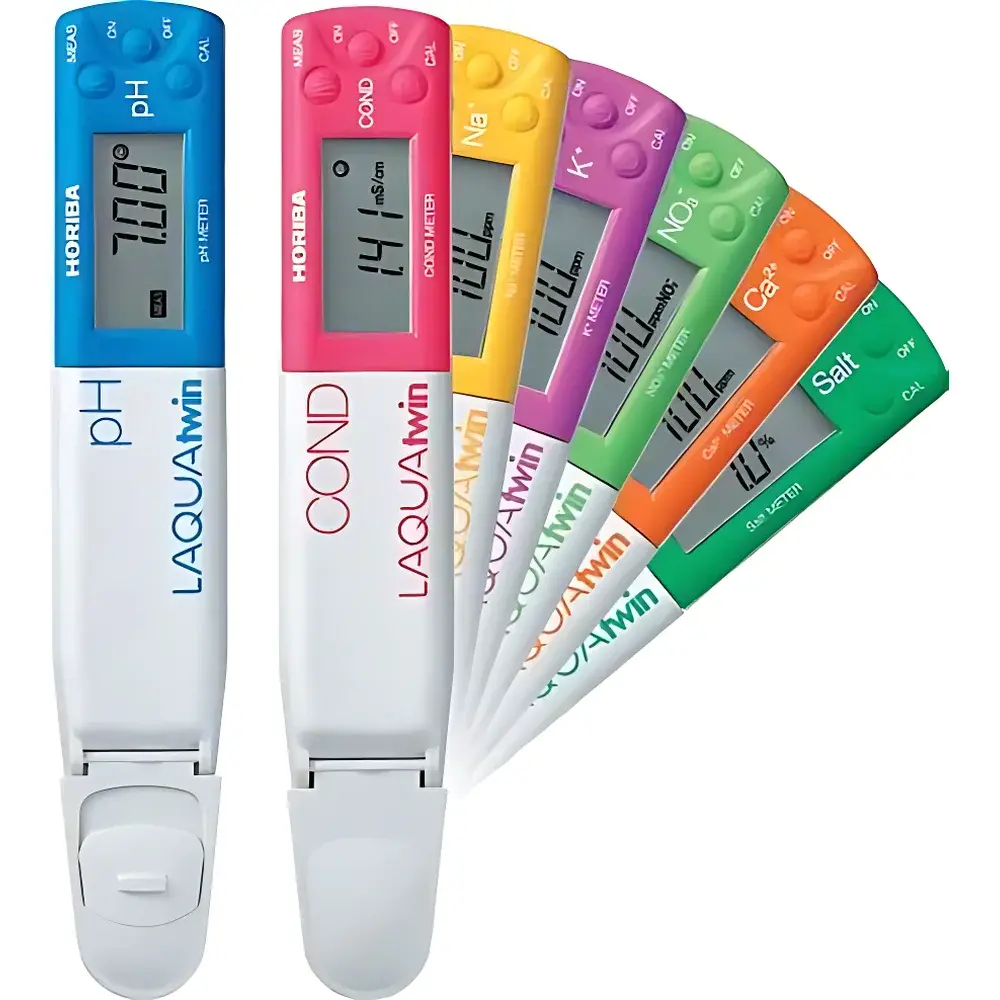
HORIBA LAQUAtwin B-751 Calcium Ion (Ca²⁺) Pocket-Sized Meter
| Brand | HORIBA |
|---|---|
| Origin | Japan |
| Model | B-751 |
| Instrument Type | Portable Ion Meter |
| Measurement Range | 40–4000 ppm Ca²⁺ |
| Accuracy | ±20% of reading |
| Operating Temperature | 5–40°C, ≤85% RH (non-condensing) |
| IP Rating | IP67 |
| Sample Volume | 0.05 mL (with Sampling Sheet B) to 0.3 mL |
| Calibration | 2-point |
| Display | Custom monochrome LCD |
| Power | 2 × CR2032 (≈400 h lifetime) |
| Dimensions | 164 × 29 × 20 mm |
| Weight | ~50 g (instrument only) |
Overview
The HORIBA LAQUAtwin B-751 is a compact, handheld calcium ion (Ca²⁺) meter engineered for rapid, on-site quantitative analysis in field and laboratory environments. It employs solid-state ion-selective electrode (ISE) technology—specifically a calcium-selective membrane sensor—based on the potentiometric principle: the measured potential difference between the working ISE and an integrated reference electrode correlates logarithmically with Ca²⁺ activity in solution (Nernstian response). Unlike benchtop ISE systems requiring bulky modules and liquid-filled reference junctions, the B-751 integrates all sensing elements—including microfabricated ion-sensitive membrane, Ag/AgCl reference, and temperature sensor—onto a single sub-millimeter-thick planar chip. This architecture eliminates clogging, minimizes maintenance, and ensures stable baseline potential under variable environmental conditions. Designed for routine water hardness assessment, aquaculture monitoring, food safety screening, and coral reef aquarium management, the B-751 delivers field-deployable performance without sacrificing metrological traceability to standard laboratory methods.
Key Features
- IP67-rated enclosure: Fully dust-tight and submersible up to 1 m for 30 minutes—validated per IEC 60529—enabling reliable operation in humid greenhouses, coastal sampling sites, or wet lab benches.
- Multi-modal sampling flexibility: Supports six distinct sample introduction protocols—drop, immersion, scoop, wipe, solid placement, and powder reconstitution—each optimized for matrix-specific interferences and volume constraints.
- Integrated temperature compensation: Automatic correction using an on-chip thermistor (±0.5°C accuracy), applying Nernst slope adjustment across the full 5–40°C operating range.
- Intuitive visual feedback: Real-time status indicator (smiley icon) confirms measurement stabilization—eliminating subjective endpoint judgment and reducing operator-dependent variability.
- Low-volume capability: As little as 0.05 mL sample required when used with Sampling Sheet B, minimizing reagent consumption and enabling analysis of precious or limited-access samples (e.g., pore water from soil cores).
- Auto-ranging display with context-sensitive resolution: Dynamically switches between 0.1 ppm (0–1.0 ppm), 1 ppm (0–99 ppm), 10 ppm (100–990 ppm), and 100 ppm (1000–9900 ppm) increments to maintain significant-digit integrity across the 40–4000 ppm measurement span.
Sample Compatibility & Compliance
The B-751 is validated for aqueous matrices including freshwater, seawater-diluted samples, nutrient solutions, aquarium water, dairy whey filtrates, and leachates from agricultural soils. Its robust ISE design tolerates moderate turbidity and low-to-moderate organic load, though high concentrations of complexing agents (e.g., EDTA, citrate) or elevated pH (>10) may require matrix-matched calibration or acidification pretreatment. While not certified for regulatory compliance testing per ISO 10523 or ASTM D511, the instrument supports GLP-aligned workflows via documented 2-point calibration (using supplied 100 ppm and 1000 ppm Ca²⁺ standards), audit-ready manual log entries, and stable long-term drift characteristics (<2% per 30 days under controlled storage). The ABS/epoxy housing complies with RoHS Directive 2011/65/EU and REACH Annex XVII restrictions on hazardous substances.
Software & Data Management
The B-751 operates as a standalone, firmware-driven instrument with no Bluetooth, USB, or PC connectivity. All data handling occurs locally via the monochrome LCD and tactile keypad interface. Measurement records are not stored internally; users must manually transcribe values into field notebooks or LIMS-compatible spreadsheets. However, its deterministic response time (<15 s to stabilized reading) and auto-hold function support efficient batch logging during multi-site surveys. Calibration coefficients (slope, offset, and user-defined multiplication factors ranging 0.01–9.90) are retained in non-volatile memory after power cycling. For laboratories requiring electronic records, integration with external data capture tools (e.g., barcode-scanned entry into ELN platforms) is feasible through standardized manual transcription protocols aligned with FDA 21 CFR Part 11 principles for handwritten entries.
Applications
- Aquaculture & Aquarium Management: Continuous monitoring of Ca²⁺ in recirculating marine systems to sustain calcification rates in corals and shellfish larvae.
- Soil & Irrigation Water Testing: Rapid assessment of calcium saturation ratio (CSR) and water hardness to guide gypsum application or prevent sodium-induced dispersion in sodic soils.
- Food & Beverage QA/QC: Spot-checking Ca²⁺ fortification levels in plant-based milks, bottled waters, and dietary supplements—particularly where regulatory labeling thresholds apply (e.g., EU Regulation (EU) No 1169/2011).
- Health & Wellness Screening: Semi-quantitative evaluation of calcium content in sweat, saliva, or oral rinse samples during nutritional intervention studies.
- Environmental Field Surveys: Mapping spatial gradients of Ca²⁺ in streams impacted by limestone bedrock weathering or industrial effluent discharge.
FAQ
What sample preparation is required before measurement?
Minimal preparation is needed for clear, low-turbidity aqueous samples. For viscous, particulate-laden, or buffered matrices (e.g., milk, soil extracts), centrifugation or filtration (0.45 µm) is recommended to avoid sensor fouling. Powdered samples require addition of deionized water (1:1 v/w) and brief homogenization prior to direct sensor placement.
Can the B-751 measure total hardness or only Ca²⁺?
The B-751 is calibrated exclusively for Ca²⁺ activity. Total hardness (as CaCO₃) requires separate Mg²⁺ measurement or estimation via titration (e.g., EDTA method per ISO 6059), as magnesium interference is not compensated in this single-ion configuration.
How often must the sensor be cleaned or replaced?
Routine cleaning with deionized water and soft lint-free tissue after each use is sufficient. Sensor lifetime exceeds 12 months under typical field use; replacement is indicated by >30% deviation from calibration check standards or persistent signal drift exceeding ±50 ppm at mid-range (500 ppm).
Is temperature compensation mandatory?
Yes—temperature compensation is enabled by default and cannot be disabled. The built-in thermistor ensures Nernst slope correction (≈29.6 mV/decade at 25°C) is applied continuously, which is essential for maintaining accuracy across seasonal or diurnal ambient fluctuations.
Does the device meet any international calibration traceability standards?
The supplied calibration standards are traceable to NIST SRM 3109a (Calcium Standard Solution); certificates of analysis are included. While the B-751 itself lacks formal ISO/IEC 17025 accreditation, its measurement uncertainty budget (±20% at 95% confidence) is consistent with ISO 8466-1 guidance for field-portable ISE instruments used in non-regulated screening applications.







