
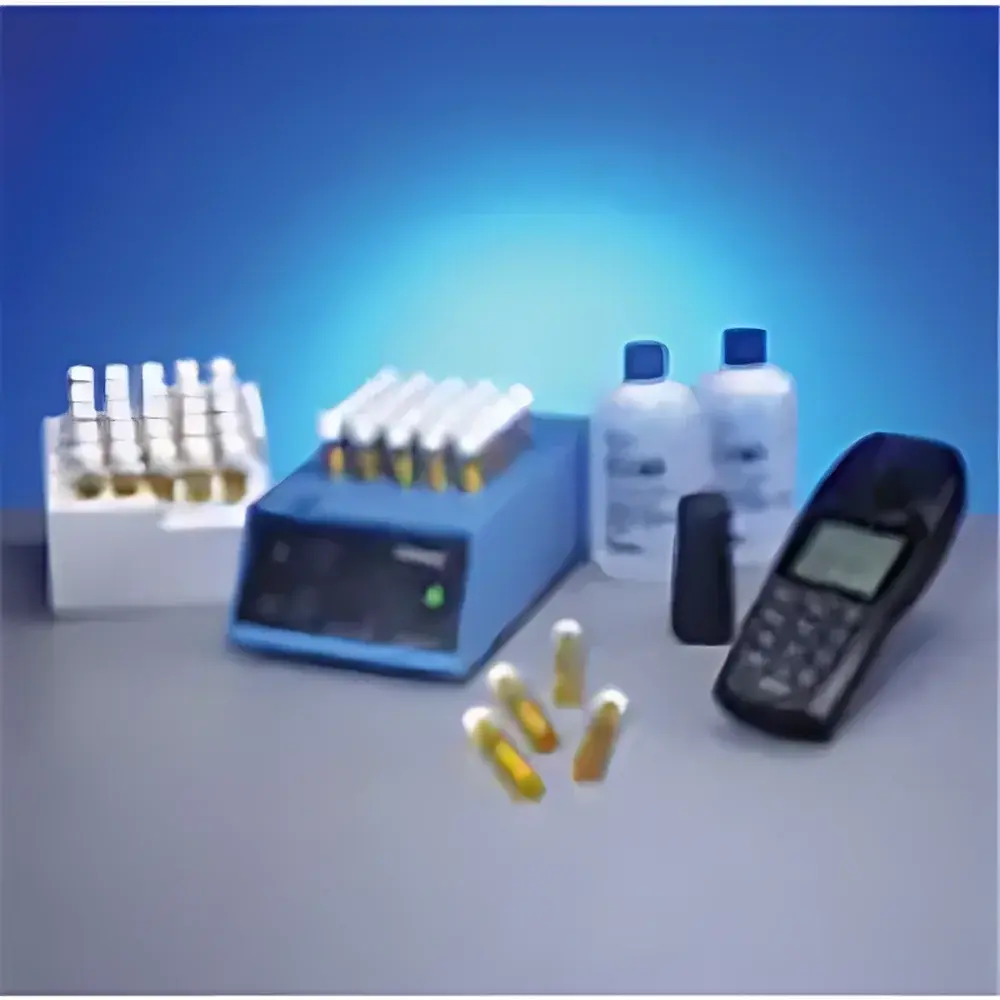
Thermo Scientific Orion AQ4001 Portable COD Measurement System
| Brand | Thermo Scientific Orion |
|---|---|
| Origin | USA |
| Model | AQ4001 |
| Instrument Type | Portable |
| Measurement Principle | Closed Reflux Colorimetric Method (Dichromate Oxidation) |
| Measurement Range | 0–150 mg/L COD (Low Range), 0–1500 mg/L (Medium Range), 0–15000 mg/L (High Range) |
| Detection Limit | 1.5 mg/L (Low Range), 15 mg/L (Medium Range), 150 mg/L (High Range) |
| Sample Throughput | 25 samples per digestion cycle |
| Digestion Temperature Options | 100, 120, 150, 160, 165 °C |
| Digestion Time Options | 30, 60, 120 min or continuous |
| Temperature Accuracy | ±1 °C |
| Temperature Stability | ±0.5 °C |
| Heater Power | 400 W |
| Dimensions (Digestor) | 155 × 95 × 275 mm |
| Weight (Digestor) | 3.6 kg |
| Data Storage | 100 measurement records |
| Ingress Protection | IP67 |
| Battery Life | Up to 10,000 hours (AQ4000 colorimeter) |
Overview
The Thermo Scientific Orion AQ4001 Portable COD Measurement System is a fully integrated, field-deployable solution for accurate and compliant Chemical Oxygen Demand (COD) analysis in wastewater, surface water, and industrial effluents. It combines the AQ4000 portable colorimeter with the COD165 block digester and pre-packaged, certified dichromate-based reagents—enabling implementation of the EPA-approved closed-reflux colorimetric method (Method 410.4 and Standard Methods 5220 D). Unlike permanganate-based approaches, the dichromate oxidation process achieves >80% oxidation efficiency for most organic compounds—including refractory organics—making it suitable for regulatory reporting and process control in municipal and industrial wastewater treatment facilities. The system operates on the principle of spectrophotometric quantification of Cr3+ formed during acidic dichromate oxidation, measured at 600 nm (fixed-wavelength detection), with absorbance directly proportional to COD concentration.
Key Features
- Complete EPA-compliant workflow: digestion + colorimetric measurement in under 90 minutes (30-min digestion + <5-min analysis)
- AQ4000 colorimeter supports 189 pre-programmed methods—including COD, nitrate, phosphate, chlorine, and heavy metals—eliminating need for method development
- Three pre-calibrated, sealed reagent ranges (0–150, 0–1500, 0–15000 mg/L COD) minimize analyst exposure to hazardous chemicals and ensure traceability per ISO/IEC 17025 requirements
- COD165 digester features PID-controlled Pt100 (Class A) temperature sensing, ±0.5 °C stability at 165 °C, and over-temperature cutoff for unattended operation
- Robust AQ4000 architecture: IP67-rated housing, 10,000-hour battery life, and non-volatile memory storing 100 results with timestamps and operator IDs
- Dual-use design validated for both laboratory benchtop and remote field deployment—no external power required for colorimetry
Sample Compatibility & Compliance
The AQ4001 system accommodates raw wastewater, treated effluent, leachate, and industrial process streams—with turbidity up to 1000 NTU and chloride concentrations ≤2000 mg/L (with chloride interference correction enabled via reagent formulation). All reagents are manufactured under ISO 9001-certified processes and supplied with lot-specific certificates of analysis. The closed-reflux digestion protocol complies with U.S. EPA Method 410.4, ASTM D1252–05 (Parts A & B), and ISO 6060. Data integrity meets GLP and GMP expectations: AQ4000 stores audit-trail-capable metadata (date/time, method ID, range selected, calibration status) and supports optional export to LIMS via USB. The system is routinely validated in accordance with USP Analytical Instrument Qualification protocols.
Software & Data Management
The AQ4000 colorimeter operates without PC dependency but supports optional Thermo Scientific Orion Link software for data export (CSV/Excel), report generation, and firmware updates. All measurements include embedded metadata: operator ID, sample ID, digestion temperature/duration, reagent lot number, and calibration verification timestamp. Data files are stored in non-erasable memory with write-protection enabled by default. For regulated environments, the system can be configured to enforce user authentication, method lockout, and electronic signature workflows aligned with FDA 21 CFR Part 11 requirements when paired with compliant enterprise software.
Applications
- Regulatory compliance monitoring for NPDES permits and discharge reporting
- Biological treatment plant performance assessment (influent/effluent load tracking)
- Industrial pretreatment program verification (e.g., food processing, pharmaceutical, textile sectors)
- Leachate characterization at landfill sites
- Research and development of advanced oxidation processes (AOPs)
- Field-based emergency response screening following chemical spills or sewer overflows
FAQ
What digestion temperature is recommended for standard wastewater analysis?
EPA Method 410.4 specifies 165 °C for 2 hours; however, the AQ4001 system validates 165 °C for 30 minutes using high-purity reagents and calibrated digestion blocks—reducing energy use and turnaround time without compromising recovery.
Can the AQ4000 measure COD without the COD165 digester?
No. COD determination requires thermal digestion to oxidize organics; the AQ4000 functions solely as a photometer and cannot perform digestion. The COD165 or equivalent EPA-validated digester is mandatory.
How is chloride interference managed in high-salinity samples?
Pre-formulated reagents contain mercury sulfate to complex chloride ions up to 2000 mg/L. For samples exceeding this limit, dilution or alternative methods (e.g., titrimetric COD) are advised per Standard Methods guidance.
Is calibration verification required before each batch?
Yes. Per EPA guidance, a reagent blank and at least one certified reference material (CRM) must be processed alongside each sample batch. The AQ4000 includes built-in CRM validation routines with pass/fail thresholds.
Does the system support multi-point calibration?
The AQ4000 uses factory-established calibration curves for each reagent lot. User calibration is not permitted—ensuring method consistency and eliminating inter-operator variability.
Related Products







