
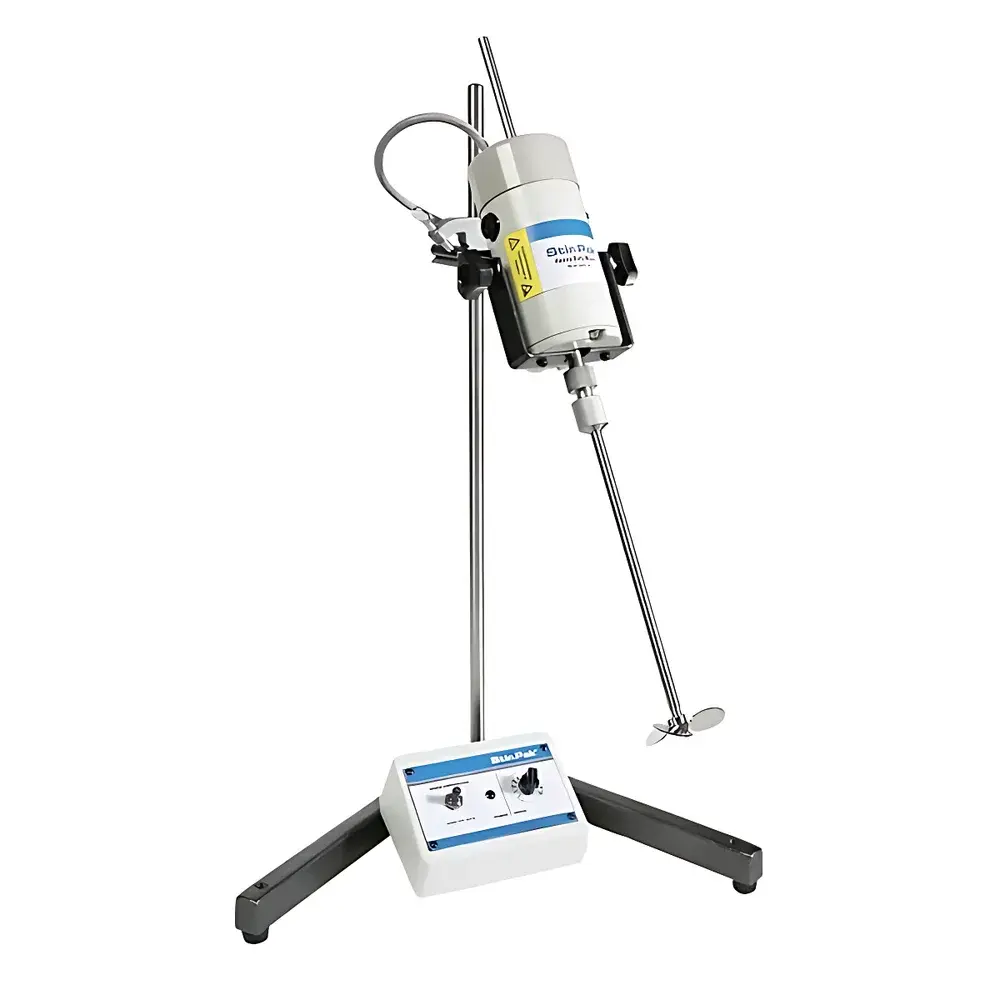
Stir-Pak® 50007-47 Heavy-Duty Modular Mixing System
| Brand | Stir-Pak |
|---|---|
| Origin | USA |
| Manufacturer Type | Authorized Distributor |
| Product Category | Imported Laboratory Equipment |
| Model | 50007-47 |
| Speed Range | 60–6000 rpm |
| Motor Power | 1/10 HP |
| Voltage | 230 VAC |
| Max Torque | 17 in·oz |
| Shaft Type | Through-shaft |
| Construction Material | 316 Stainless Steel |
| Drive Type | Solid-State Speed Controller |
Overview
The Stir-Pak® 50007-47 Heavy-Duty Modular Mixing System is an engineered solution for laboratories and industrial R&D facilities requiring precise, repeatable, and scalable agitation across diverse viscous and non-Newtonian media. Built on a robust through-shaft architecture with a solid-state speed controller, this system operates on the principle of direct-drive rotational mixing—delivering stable torque transmission and minimal speed drift under variable load conditions. Its design adheres to fundamental fluid dynamics requirements for laminar-to-turbulent transition control, enabling consistent shear rate application across batch volumes from 50 mL to 20 L (dependent on impeller geometry and vessel configuration). The system is not a fixed-unit mixer but a purpose-built platform: users select components based on defined rheological demands, ensuring alignment with ASTM D1893 (Standard Test Method for Viscosity of Paints, Varnishes, Lacquers, and Related Products) and ISO 2555 (Plastics — Aqueous dispersions and emulsions — Determination of apparent viscosity), where controlled rotational speed and geometric reproducibility are critical.
Key Features
- Modular architecture supporting field-configurable head assemblies—including high-speed low-torque (HSLT), high-torque low-speed (HTLS), dual-shaft, and overhead drive options.
- 316 stainless steel construction throughout wetted and structural components, providing corrosion resistance compliant with FDA 21 CFR Part 117 (Current Good Manufacturing Practice in Manufacturing, Packing, or Holding Human Food) for pharmaceutical and food-grade applications.
- Solid-state electronic speed controller with analog potentiometer interface, offering continuous 60–6000 rpm adjustment with ±1% speed stability across full load range.
- Through-shaft design ensures axial alignment integrity and eliminates coupler-induced vibration, supporting long-duration operation (>8 hrs) without thermal drift or bearing fatigue.
- Interchangeable spindle and impeller sets compatible with ISO-standard mounting threads (M12×1.75), facilitating traceable calibration using NIST-traceable tachometers and torque sensors.
Sample Compatibility & Compliance
The Stir-Pak® 50007-47 accommodates a broad spectrum of sample types—including aqueous suspensions, polymer melts, ceramic slurries, biopharmaceutical buffers, and high-solids coatings—without compromising mechanical integrity or measurement fidelity. Its 17 in·oz maximum torque output is calibrated for Newtonian fluids up to 10,000 cP and pseudoplastic systems exhibiting shear-thinning behavior down to G’ > 10 Pa (as measured via parallel-plate rheometry validation). All component interfaces meet ISO 8573-1:2010 (compressed air purity) for cleanroom-integrated installations and support GLP-compliant documentation workflows when paired with Stir-Pak’s optional audit-trail-enabled controller firmware (v3.2+). CE marking and UL 61010-1 certification confirm electrical safety compliance for laboratory use in EU and North American jurisdictions.
Software & Data Management
While the base 50007-47 system operates via analog control, Stir-Pak offers optional digital integration modules—including RS-485 Modbus RTU and USB-C serial interfaces—for connection to LIMS or ELN platforms. When deployed with Stir-Pak ControlSuite™ (v2.4), users gain real-time RPM logging, torque profiling, run-time event tagging, and exportable CSV datasets conforming to ASTM E2500-21 (Standard Guide for Specification, Design, and Verification of Pharmaceutical and Biopharmaceutical Manufacturing Systems). Audit trails record operator ID, timestamp, parameter setpoints, and deviation alerts—fully satisfying FDA 21 CFR Part 11 requirements for electronic records and signatures in regulated environments.
Applications
- Formulation development of injectable nanosuspensions requiring uniform particle dispersion without cavitation-induced degradation.
- Batch homogenization of battery cathode slurries (e.g., NMC/LFP in NMP) prior to coating, where shear history directly impacts electrode density and porosity.
- Accelerated stability testing of topical gels and ointments per USP Uniformity of Dosage Units, using defined agitation protocols to simulate storage-induced phase separation.
- Process validation of sterile filtration pre-mix steps in biomanufacturing, where mixing time and energy input must remain within validated ranges to prevent protein aggregation.
- QC release testing of architectural coatings per ASTM D1210 (Hegman Fineness of Grind), where consistent dispersion intensity ensures reproducible grind gauge readings.
FAQ
Is the Stir-Pak® 50007-47 suitable for explosive or flammable solvent environments?
No—this system is rated for general laboratory use only (Class I, Division 2 not certified). For hazardous area applications, consult Stir-Pak’s explosion-proof EX-series controllers (models 50007-EX1A and 50007-EX2B).
Can the system be integrated into automated reactor platforms?
Yes—via optional 0–10 V analog input/output signals or Modbus RTU, enabling synchronization with PID-controlled temperature jackets and mass flow controllers.
What calibration documentation is provided with shipment?
Each unit ships with a factory calibration certificate traceable to NIST standards, including speed verification at 60, 600, and 6000 rpm under no-load and 50% torque load conditions.
Does Stir-Pak offer validation support for GMP environments?
Yes—IQ/OQ protocol templates, URS alignment matrices, and on-site DQ execution services are available through Stir-Pak’s Global Validation Services division.



