
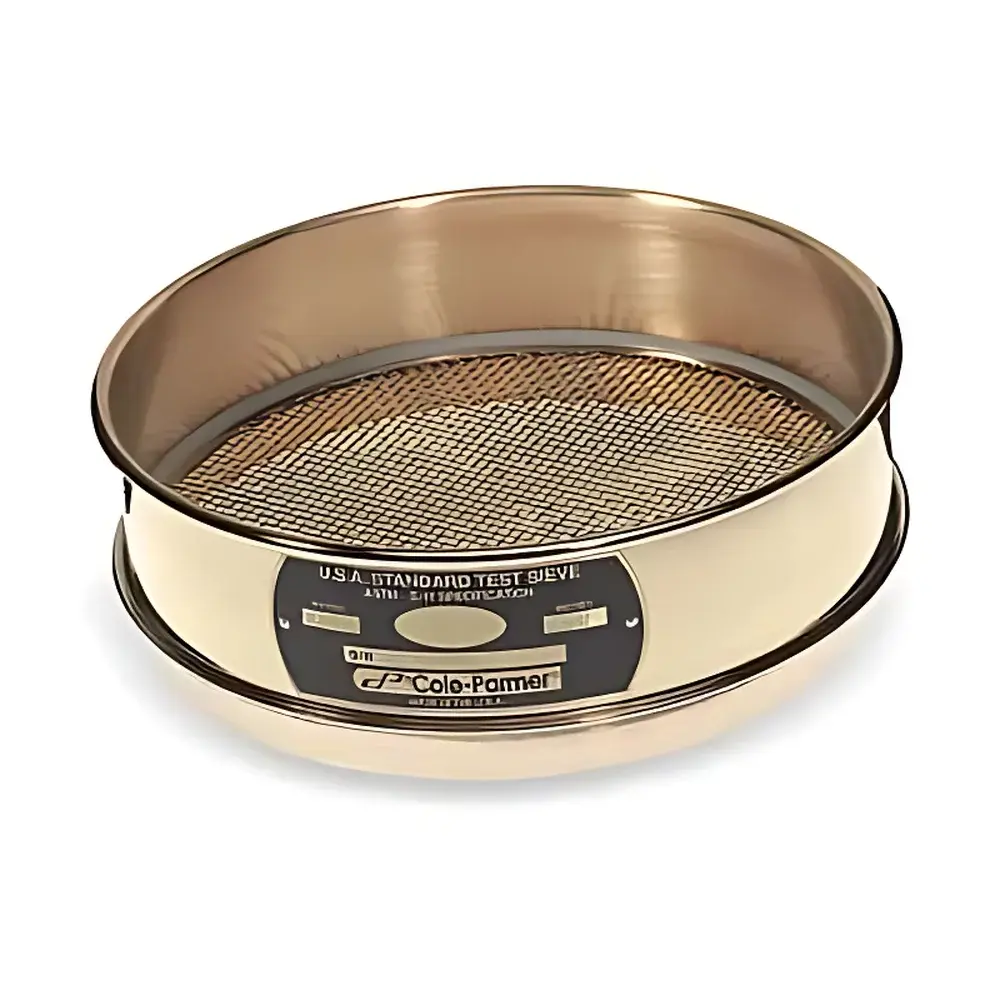
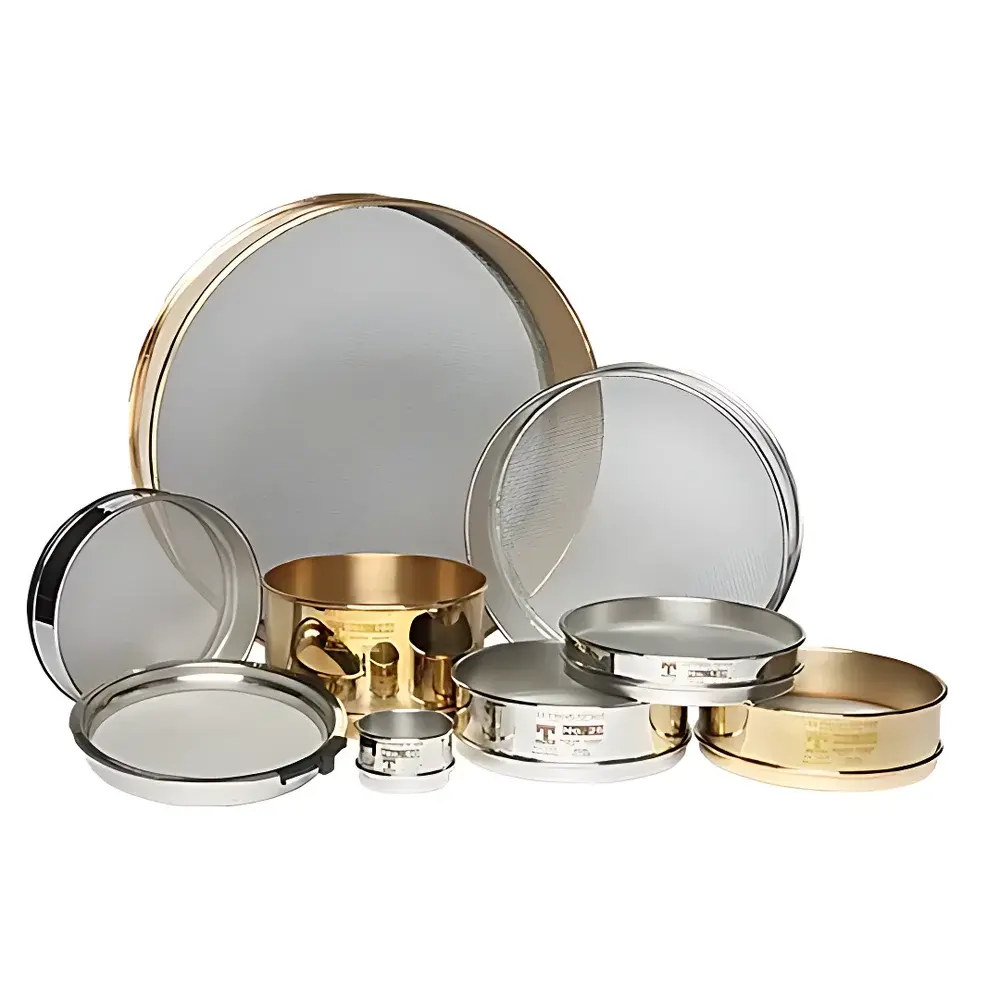
Tyler Tyler 1290 3-Inch Stainless Steel & Brass Test Sieves
| Brand | Tyler |
|---|---|
| Origin | USA |
| Model | 1290 |
| Frame Material | Stainless Steel or Brass |
| Mesh Material | Stainless Steel Wire |
| Nominal Aperture | 2.36 mm (No. 8) |
| Overall Height | Full Height 1-3/4" |
| Depth to Cloth | Full 1-1/4" |
| Compliance | ASTM E11-09 |
| Certification | Serialized with Traceable Compliance Certificate |
Overview
The Tyler 1290 3-inch test sieve is a precision-engineered mechanical sieving component designed for standardized dry and wet particle size distribution analysis in laboratory, quality control, and R&D environments. As part of the globally recognized Tyler Test Sieve Series, this unit operates on the principle of mechanical separation—relying on controlled vibration or hand-sieving to segregate particulate materials according to defined aperture dimensions. The No. 8 designation corresponds to a nominal opening of 2.36 mm, conforming to the dimensional tolerances and wire diameter specifications outlined in ASTM E11–09 (Standard Specification for Woven Wire Test Sieve Cloth and Test Sieves). Manufactured in the United States, each sieve undergoes individual serialization and is supplied with a traceable compliance certificate verifying conformance to international sieve calibration standards. Its dual-frame configuration—available in either stainless steel or brass—ensures long-term dimensional stability, corrosion resistance, and compatibility with both aggressive chemical environments and high-purity applications.
Key Features
- Serialized unit with individual ASTM E11–09 compliance certificate for audit-ready traceability
- Dual frame options: electropolished stainless steel (corrosion-resistant, non-magnetic, GLP-compliant) or high-purity brass (non-sparking, ideal for hazardous or explosive atmospheres)
- Stainless steel woven wire cloth with precise 2.36 mm square aperture (No. 8), engineered for consistent open-area ratio and minimal blinding
- Full-height (1-3/4″) and half-height (1-1/4″) configurations support compatibility with standard sieve shakers (e.g., Gilson RX-29, Endecotts AS200, Fritsch Analysette 3) and manual sieve nests
- Controlled depth-to-cloth geometry (1-1/4″ full / 5/8″ half) ensures optimal sample retention and uniform bed depth during vibratory analysis
- Interchangeable design compliant with ISO 3310-1 and USP , enabling integration into multi-sieve stacks for cumulative particle size distribution profiling
Sample Compatibility & Compliance
This sieve is validated for use across a broad range of dry granular, powdered, and milled solids—including pharmaceutical actives and excipients, mineral aggregates, catalysts, metal powders, food ingredients, and ceramic precursors. It supports both single-sieve endpoint testing and multi-stage sieve battery analysis per ASTM C136/C136M (aggregate gradation), ASTM D6913 (soil particle-size analysis), and ISO 13320 (laser diffraction correlation reference). All Tyler 3-inch sieves are manufactured under a documented quality management system aligned with ISO 9001 requirements. Each unit meets the geometric and metrological criteria specified in ASTM E11–09, including maximum permissible deviations in aperture size (±3.5% for 2.36 mm), wire diameter tolerance, and flatness of the sieve cloth surface. Certificates include serial number, nominal aperture, measured mean aperture (where applicable), and date of certification—supporting 21 CFR Part 11–aligned data integrity practices when used in regulated GMP/GLP workflows.
Software & Data Management
While the Tyler 1290 sieve itself is a passive mechanical component, its certified dimensional accuracy enables reliable integration into digital particle analysis workflows. When used with automated sieve shakers equipped with integrated weight transducers (e.g., Gilson AutoTAP, Hosokawa Alpine AS 200), mass-on-sieve data can be exported via RS-232 or USB to LIMS or ELN platforms. The serialized identifier allows direct linkage between physical sieve identity and analytical records—critical for FDA audit readiness and ISO/IEC 17025 accreditation. For laboratories implementing electronic batch records, the ASTM E11 certificate serves as a controlled document supporting instrument qualification (IQ/OQ) and periodic re-certification per SOP-defined intervals (typically every 12–24 months depending on usage frequency and criticality).
Applications
- Pharmaceutical granulation and blend uniformity assessment per USP and ICH Q5A
- Quality assurance of API particle size distribution in solid dosage form development
- Aggregate gradation testing in civil engineering and asphalt mix design (ASTM C136)
- Catalyst and battery material screening in R&D labs evaluating flowability and packing density
- Food powder consistency verification (e.g., flour, sugar, dairy powders) per AACC Method 28–10
- Environmental soil and sediment analysis per EPA Method 9200.1B and ASTM D6913
- Metallurgical powder characterization for additive manufacturing feedstock qualification
FAQ
Is the Tyler 1290 sieve supplied with a calibration certificate?
Yes—each unit is individually serialized and shipped with a traceable ASTM E11–09 compliance certificate documenting nominal aperture, frame material, height configuration, and certification date.
Can this sieve be used in regulated GMP environments?
Yes—its documented conformance to ASTM E11, serialized traceability, and availability in stainless steel (non-reactive, cleanable) make it suitable for GMP-compliant particle size testing when included in a validated sieve shaker system.
What is the difference between full-height and half-height configurations?
Full-height (1-3/4″) sieves provide greater sample capacity and are recommended for high-mass samples or extended-duration shaking; half-height (1-1/4″) units reduce stack inertia and improve efficiency in multi-sieve analyses with automated shakers.
How often should Tyler test sieves be recertified?
Per ASTM E11 guidance and industry best practice, recertification is recommended every 12–24 months—or after 200 operational hours—whichever occurs first, especially in high-use QC laboratories.
Are replacement mesh cloths available for this model?
Yes—Tyler offers factory-replacement stainless steel cloth kits for the 1290 frame, installed under controlled tensioning protocols to maintain original aperture fidelity and compliance.



