
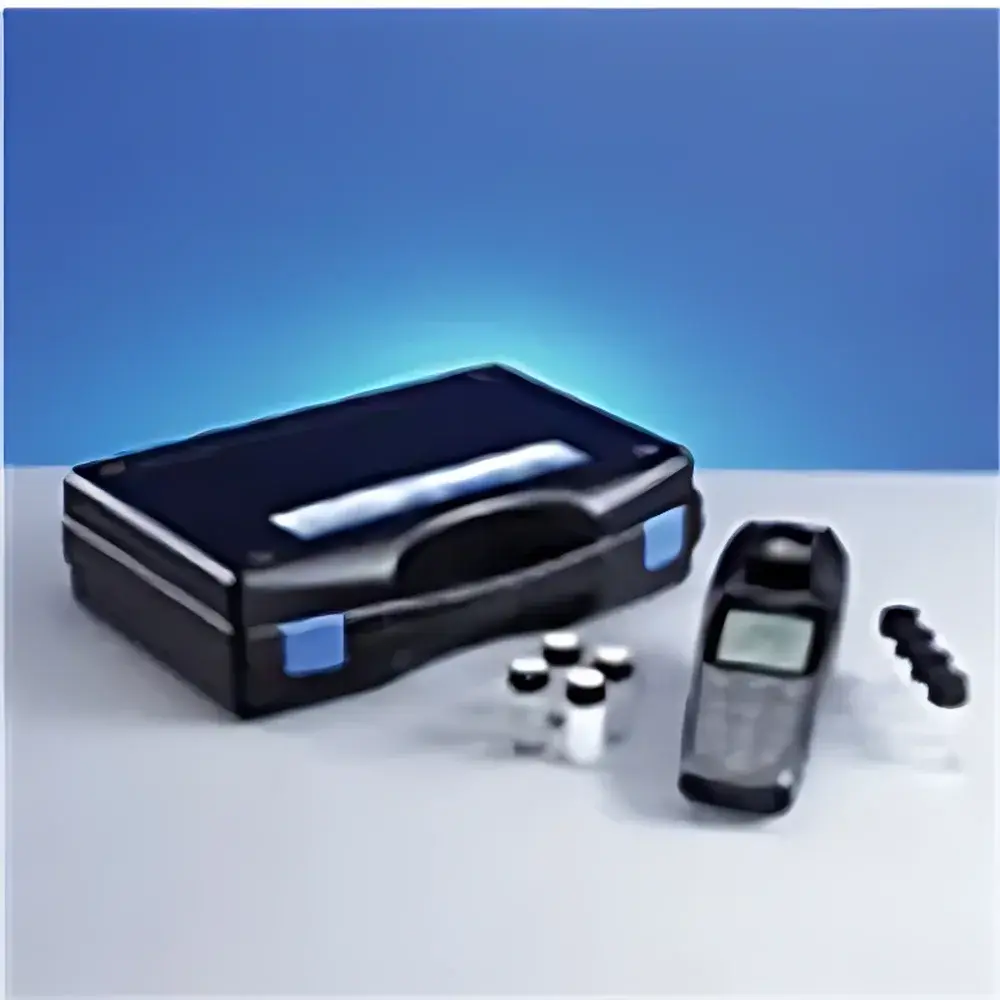
Thermo Scientific Orion AQ4500 Portable Turbidimeter
| Brand | Thermo Scientific Orion |
|---|---|
| Origin | USA |
| Model | AQ4500 |
| Product Type | Portable |
| Measurement Range | 0–4000 NTU |
| Resolution | 0.01 NTU |
| Operating Temperature | −40.0 to +60.0 °C |
| Accuracy | ±2% of reading (0–500 NTU), ±3% (500–1000 NTU), ±5% (1000–2000 NTU) |
| Compliance | EPA Method 180.1, ISO 7027 |
| IP Rating | IP67 |
| Light Source | Dual-wavelength LED (white & infrared) |
| Detector | Silicon photodiode |
| Battery Life | 2500 h (alkaline), 100,000 h (lithium) |
| Data Storage | 100 measurements |
| Interface | RS232 |
| Sample Cell Diameter | 24 mm |
Overview
The Thermo Scientific Orion AQ4500 Portable Turbidimeter is an engineered solution for field- and lab-based turbidity measurement in compliance with globally recognized regulatory standards. It operates on the principle of nephelometric detection—measuring the intensity of light scattered at 90° from a collimated incident beam—as defined in EPA Method 180.1 and ISO 7027. Unlike single-beam instruments, the AQ4500 employs a dual-optical-path architecture: one beam passes through the sample (measurement path), while the other serves as a real-time reference (reference path). This ratio-metric design inherently compensates for color interference, lamp drift, and optical surface contamination—critical for reliable analysis of naturally colored waters (e.g., tannin-rich surface runoff or humic-stained reservoirs). The instrument integrates a temperature-stable, dual-wavelength LED source (white and infrared), eliminating warm-up delays (<1 s), minimizing thermal spectral shift, and extending operational lifetime to 100,000 hours. Its ruggedized, IP67-rated enclosure enables deployment in extreme environmental conditions—from arctic field stations to tropical wastewater outfalls—without compromising optical integrity or metrological performance.
Key Features
- Dual-beam, dual-detector optical system for automatic compensation of sample color, turbidity-induced absorption, and source intensity fluctuations
- Simultaneous compliance with EPA Method 180.1 (NTU) and ISO 7027 (FNU), supporting cross-jurisdictional reporting and method validation
- Multi-scale measurement capability: 0–4000 NTU (EPA), 0–150 FNU (ISO-NEPH), 40–4000 FAU (ISO-ABSB), plus IR-RATIO, EBC, ASBC, %T, and IR%T modes
- Adaptive resolution: 0.01 NTU (0–9.99), 0.1 NTU (10–99.99), 1 NTU (100–1000), optimized for both ultra-low drinking water verification (0–40 NTU per GLI-2) and high-turbidity industrial effluent screening
- 12-key capacitive touch interface with backlit monochrome LCD, engineered for gloved operation and sunlight readability
- Integrated data logging (100 samples) with timestamp and operator ID fields; RS232 serial output for traceable export to LIMS or QA/QC databases
- 24 mm round cell format compatible with standardized glass vials; includes silicone oil and lint-free cloth for refractive index matching and scratch-free optical maintenance
Sample Compatibility & Compliance
The AQ4500 is validated for aqueous suspensions containing suspended solids, colloidal clays, algae, organic particulates, and precipitated metal hydroxides. Its 90° scattering geometry meets the geometric requirements of US EPA 40 CFR Part 136 and ASTM D6508 for wastewater, drinking water, and environmental monitoring. The instrument’s ratio-metric algorithm satisfies ISO/IEC 17025 clause 7.7 on measurement uncertainty management, particularly for low-turbidity applications where color correction directly impacts conformity assessment against WHO and EU Directive 98/83/EC limits (≤1 NTU for treated potable water). Calibration traceability is maintained via NIST-traceable primary standards (0, 1, 10, 100, and 1000 NTU) and a 4000 NTU formazin-equivalent reference suspension (AQ45FZ). All firmware and calibration protocols adhere to FDA 21 CFR Part 11 requirements for electronic records and signatures when paired with compliant data acquisition software.
Software & Data Management
While the AQ4500 operates as a standalone field instrument, its RS232 interface supports bidirectional communication with Thermo Scientific’s optional AQView desktop application (Windows-compatible). This software enables automated calibration curve generation, statistical analysis (mean, SD, CV%), GLP-compliant audit trail logging—including user login, calibration events, and measurement edits—and export to CSV, PDF, or XML formats for integration into enterprise quality systems. Audit trails record timestamps, operator IDs, and instrument serial numbers—fulfilling ALCOA+ principles (Attributable, Legible, Contemporaneous, Original, Accurate) required under GMP and ISO 17025 accreditation. No cloud connectivity or proprietary cloud services are embedded; data sovereignty remains fully under end-user control.
Applications
- Drinking water treatment: Verification of filtration efficiency and coagulant dosing optimization at intake, clarification, and final distribution points
- Wastewater compliance: Effluent discharge monitoring per NPDES permits and ISO 10523 protocols
- Environmental field surveys: Real-time profiling of riverine sediment transport, lake eutrophication status, and stormwater runoff impact assessments
- Pharmaceutical manufacturing: USP clarity testing of parenteral solutions and rinse water qualification per Annex 1
- Food & beverage QC: Monitoring of juice clarification, beer filtration, and dairy processing water reuse loops
- Academic research: Teaching nephelometry fundamentals and validating computational fluid dynamics (CFD) models of particle suspension behavior
FAQ
Does the AQ4500 require annual recalibration by an accredited lab?
No—routine user verification using certified standards (e.g., AC45STA set) satisfies ISO/IEC 17025 clause 7.8.1. Full recalibration is recommended only after physical shock, exposure beyond operating temperature/humidity limits, or deviation >±2% from reference standard during verification.
Can the instrument measure turbidity in highly colored samples like peat leachate or wine?
Yes—the dual-beam ratio-metric design actively corrects for absorbance at both white and infrared wavelengths, minimizing color interference per ISO 7027 Annex B guidance.
Is battery replacement user-serviceable without tools?
Yes—alkaline batteries (4×AA) are accessible via a captive screw cover; lithium battery packs require factory service due to integrated charge management circuitry.
What is the minimum detectable turbidity level under GLI-2 protocol?
The instrument achieves 0.01 NTU resolution in the 0–9.99 NTU range, meeting EPA GLI-2 “low-level precision” criteria for drinking water compliance verification.
How does the IR-RATIO mode improve accuracy in high-turbidity sludge samples?
By comparing scattering intensities at visible and infrared wavelengths, IR-RATIO mode suppresses Mie scattering artifacts caused by large particles (>1 µm), yielding more stable readings in activated sludge or digester supernatant applications.





