
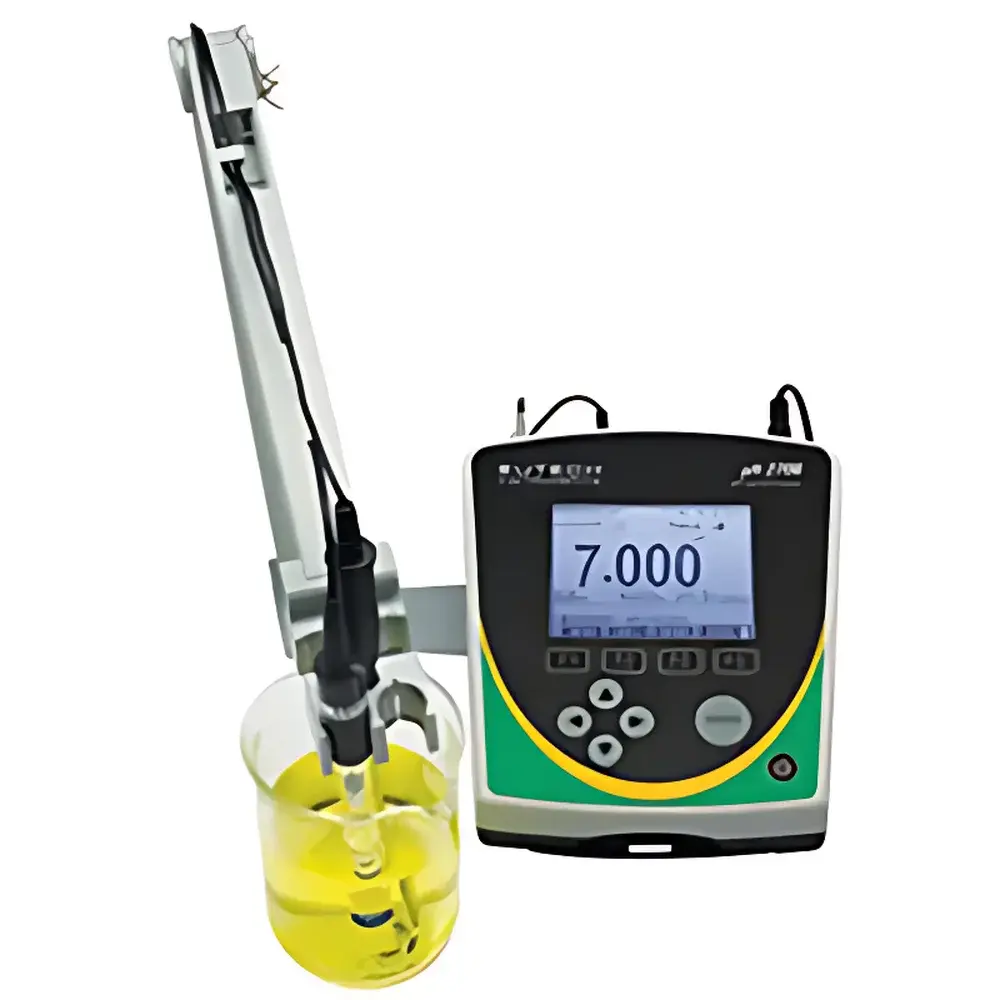
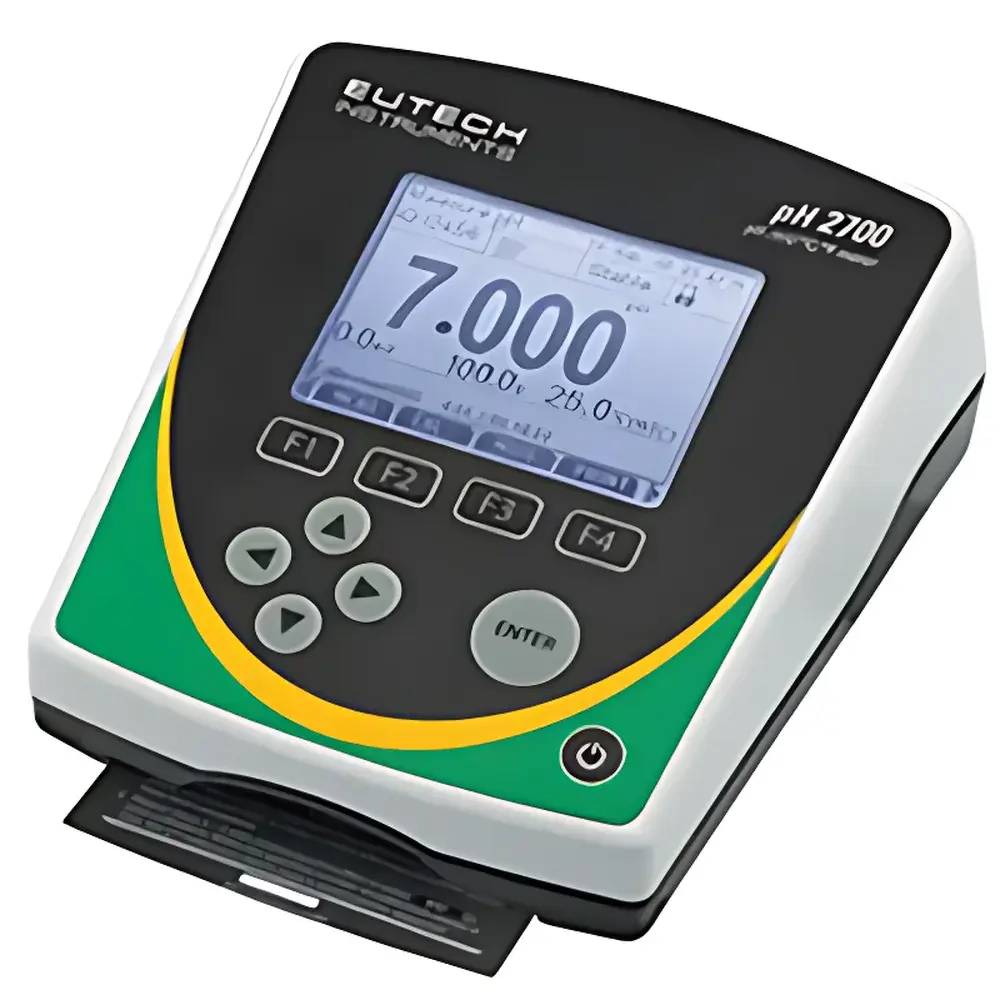
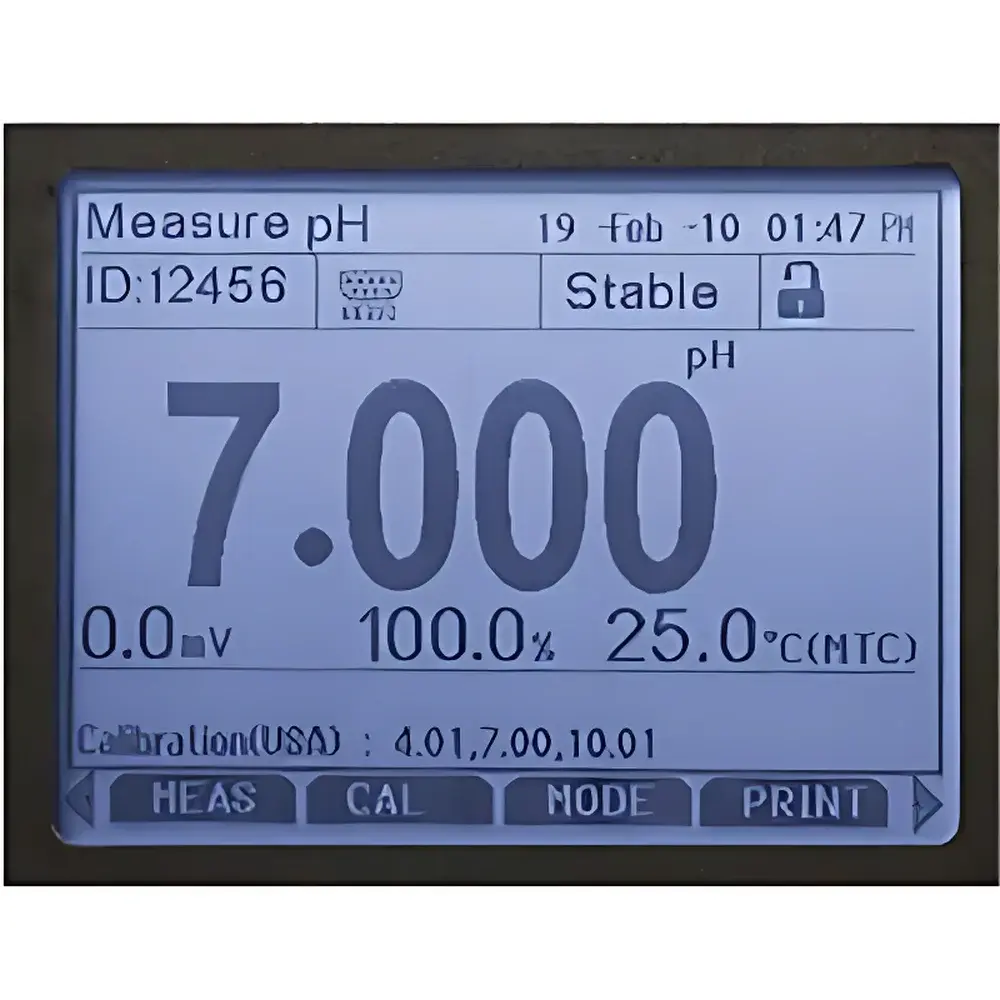
Eutech pH2700 Benchtop pH/ORP/Conductivity Meter
| Brand | Eutech |
|---|---|
| Origin | Singapore |
| Model | pH2700 |
| Instrument Type | Benchtop |
| Parameters Measured | pH, ORP, Temperature, Conductivity/TDS |
| pH Range | −2.000 to 20.000 |
| pH Resolution | 0.1 / 0.01 / 0.001 |
| pH Accuracy | ±0.002 pH + 1 LSD |
| Calibration Points | Up to 6-point (USA, NIST, DIN, User 1, User 2, Custom) |
| Temperature Range | 0.0–100.0 °C |
| Temp. Resolution | 0.1 °C |
| Temp. Accuracy | ±0.3 °C |
| ORP/mV Range | ±2000.0 mV |
| mV Resolution | 0.1 mV |
| mV Accuracy | ±0.2 mV |
| Conductivity Cell Constants | Selectable (0.1, 1.0, 10 cm⁻¹) |
| Conductivity Ranges | 5 auto-ranging scales |
| Data Storage | 500 measurement records |
| GLP Compliance | Yes (audit-trail enabled) |
| Display | Backlit LCD (5.9 × 7.8 cm) |
| Connectivity | BNC (pH/ORP), Phono (ATC, Reference, RS232), DC socket |
| Power | 9 V DC adapter (100–240 VAC SMPS) |
| Dimensions (W×D×H) | 17.5 × 15.5 × 6.9 cm |
| Weight | 0.65 kg |
Overview
The Eutech pH2700 is a high-precision benchtop multiparameter meter engineered for rigorous laboratory and quality control environments requiring traceable, reproducible electrochemical measurements. Built on a robust analog-to-digital architecture with low-noise signal conditioning, it simultaneously measures pH, oxidation-reduction potential (ORP), temperature, and conductivity/TDS—enabling comprehensive aqueous solution characterization without instrument switching. Its core pH measurement circuitry employs high-input-impedance (>1012 Ω) operational amplifiers and digital temperature compensation algorithms compliant with IUPAC and ASTM D1293 standards. The instrument operates on the principle of potentiometric null-balance detection using standardized reference electrodes and glass-sensing electrodes, delivering stable readings even in low-ionic-strength or high-resistivity samples. Designed and manufactured in Singapore under ISO 9001-certified processes, the pH2700 meets fundamental requirements for GLP (Good Laboratory Practice) and supports audit-ready data integrity workflows.
Key Features
- True 6-point pH calibration with selectable standard sets (USA, NIST, DIN, and two user-defined buffers), enabling precise slope and offset verification across extended ranges (−2.000 to 20.000 pH)
- Simultaneous dual-parameter measurement capability: pH/ORP paired with temperature-compensated conductivity or TDS, eliminating manual mode switching
- Selectably configurable conductivity cell constants (0.1, 1.0, 10.0 cm⁻¹) and five auto-ranging conductivity scales (0–200 mS/cm), supporting both low-conductivity ultrapure water and high-salinity industrial effluents
- Backlit graphical LCD (5.9 × 7.8 cm) with dynamic parameter labeling, real-time slope/offset diagnostics, and intuitive icon-driven navigation
- GLP-compliant data management: 500 internal storage slots with timestamp, electrode ID, calibration history, and environmental conditions (temperature, date/time)
- Dual input architecture: BNC for pH/ORP electrodes; dedicated phono connectors for ATC probes, reference electrodes, and RS232 serial output—ensuring electrical isolation and noise immunity
- Stable power delivery via universal-input switched-mode power supply (100–240 VAC), certified to IEC 61010-1 for safety in Class I laboratory environments
Sample Compatibility & Compliance
The pH2700 accommodates a broad spectrum of aqueous matrices—including pharmaceutical buffers, wastewater streams, electroplating baths, food extracts, and semiconductor rinse water—without hardware modification. Its high-impedance input stage minimizes loading errors during measurement of low-conductivity samples (<10 µS/cm), while the adjustable response time filter mitigates drift in viscous or particulate-laden solutions. The instrument conforms to international metrological frameworks: pH accuracy validation follows ASTM E70 and ISO 3696 (Grade 2 water); conductivity traceability aligns with ISO/IEC 17025-accredited calibration protocols. All firmware operations adhere to FDA 21 CFR Part 11 principles for electronic records and signatures when used with compliant data export software. CE marking confirms compliance with EU EMC Directive 2014/30/EU and Low Voltage Directive 2014/35/EU.
Software & Data Management
Data retrieval and report generation are supported via RS232 serial interface using standard ASCII protocol (no proprietary drivers required). Exported datasets include full GLP metadata: measurement ID, calibrated electrode serial number, ambient temperature, calibration buffer IDs and measured mV values, slope (%), offset (mV), and user-entered sample identifiers. Firmware supports configurable auto-log intervals (1–3600 s) and trigger-based storage (e.g., on stability threshold breach). When integrated into validated QC systems, the pH2700 satisfies audit requirements for data integrity, including immutable timestamps, operator authentication fields, and revision-controlled calibration logs—all retained in non-volatile memory with battery-backed retention.
Applications
- Pharmaceutical QC labs performing USP pH testing of injectables and oral suspensions
- Environmental monitoring stations validating EPA Method 150.1 (pH) and 120.1 (conductivity) in surface water analysis
- Food & beverage R&D assessing titratable acidity and brine conductivity in fermentation control
- Academic electrochemistry teaching labs demonstrating Nernst equation derivation and buffer capacity analysis
- Industrial process support for electroplating bath maintenance, boiler water treatment, and RO system performance verification
FAQ
Does the pH2700 support automatic temperature compensation (ATC) for all measured parameters?
Yes—ATC is applied to pH and conductivity measurements using a dedicated thermistor probe connected via phono input; manual temperature entry is also supported.
Can custom calibration buffers be saved and recalled across power cycles?
Yes—up to two user-defined buffer sets (pH and mV values) are stored in non-volatile memory and persist after shutdown.
Is the RS232 interface compatible with modern Windows/macOS systems?
Yes—using a USB-to-serial adapter (FTDI or CP2102 chipset recommended) and terminal emulation software (e.g., PuTTY, Tera Term) configured for 9600 baud, 8N1.
What electrode types are compatible with the BNC input?
Standard single-junction, double-junction, and refillable pH electrodes; combination ORP electrodes with Ag/AgCl reference elements; and general-purpose redox sensors meeting IEC 60746-1 specifications.
How is GLP compliance implemented at the firmware level?
All calibration events and measurements generate immutable entries with date/time stamps, operator ID (if enabled), electrode identification, and raw sensor signals—accessible via serial dump and exportable as CSV for LIMS integration.





