
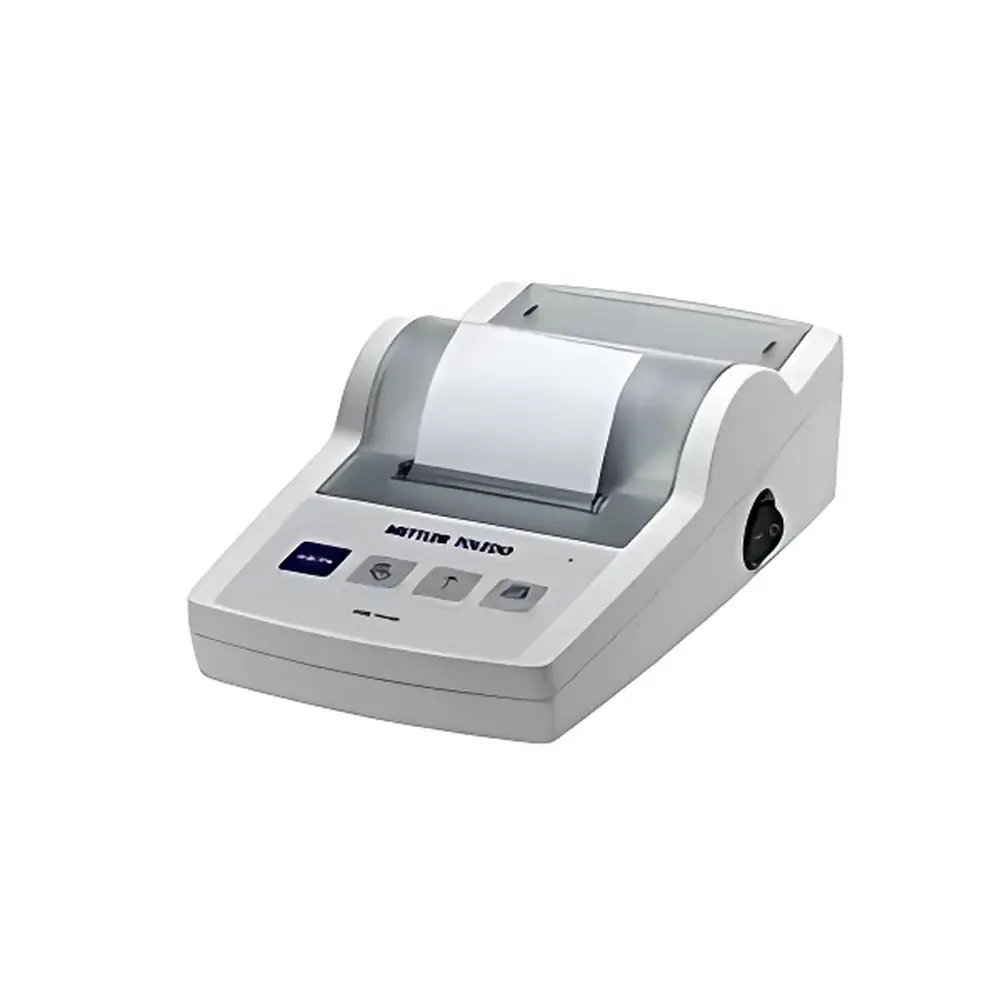
METTLER TOLEDO RS-P28/02 Laboratory Dot-Matrix Printer for Balances and Electrochemical Instruments
| Brand | METTLER TOLEDO |
|---|---|
| Origin | Shanghai, China |
| Model | RS-P28/02 |
| Interface | RS-232 |
| Printing Technology | Dot-matrix |
| Print Speed | 2.3 lines/sec |
| Characters per Line | 24 |
| Built-in Real-Time Clock | Yes |
| Language Support | Multilingual (English, Russian, Chinese, Japanese, Latin-based) |
| GxP Compliance Features | Timestamped audit trail, user-defined print templates, traceable data output |
| Applications | Statistical calculation, summation, tare/zero logging |
| Media | Continuous fanfold paper and label stock |
| Part Number | 11124314 |
Overview
The METTLER TOLEDO RS-P28/02 is a dedicated laboratory dot-matrix printer engineered to interface seamlessly with METTLER TOLEDO analytical balances, precision scales, and electrochemical instruments. Designed specifically for regulated laboratory environments, it captures measurement data—including mass, pH, conductivity, and titration endpoints—with hardware-level timestamping and language-agnostic output capability. Unlike generic office printers, the RS-P28/02 operates as an integrated peripheral: it receives ASCII-formatted data streams directly from instrument firmware via RS-232 serial communication, eliminating intermediate software layers that compromise data integrity. Its core function is to generate permanent, human-readable hardcopy records that satisfy ALCOA+ principles—attributable, legible, contemporaneous, original, and accurate—making it suitable for laboratories operating under GLP, GMP, or ISO/IEC 17025 frameworks.
Key Features
- Dedicated RS-232 serial interface with configurable baud rate (9600–115200 bps), ensuring deterministic, low-latency data transfer without packet loss or buffering delays.
- Built-in real-time clock (RTC) with battery-backed memory, maintaining accurate date/time stamps across power cycles—critical for audit-ready documentation in FDA 21 CFR Part 11–aligned workflows.
- 24-character-per-line dot-matrix printing at 2.3 lines per second, optimized for clarity and durability on standard thermal-sensitive or impact-compatible continuous paper stock.
- Multilingual character set support aligned to host instrument language settings—including English, Russian, Simplified Chinese, Japanese, and Latin-script variants—enabling consistent operator interface across global lab sites.
- On-device statistical functions: automatic summation, count, min/max, and average calculations performed locally on incoming data streams, reducing reliance on external software for basic QA reporting.
- Tare/zero key emulation allows direct hardware-triggered print events corresponding to balance zeroing or tare operations—supporting procedural compliance in weighing SOPs.
Sample Compatibility & Compliance
The RS-P28/02 is validated for use with METTLER TOLEDO’s full portfolio of laboratory balances (e.g., XSR, XS, ME-T, and AB series) and electrochemical platforms (e.g., SevenCompact and SevenExcellence pH/mV/ion meters). It does not process raw sensor signals but rather formats and prints structured data packets generated by instrument firmware. As such, it requires no separate calibration or metrological validation; its compliance derives from adherence to the host instrument’s certified data output protocol. The printer supports GxP-relevant documentation requirements through immutable timestamp embedding, non-editable print formatting, and absence of internal storage—ensuring no post-acquisition data manipulation is possible. Its mechanical design meets IEC 61000-6-3 (EMC emissions) and IEC 61000-6-2 (immunity) standards for laboratory-grade equipment.
Software & Data Management
The RS-P28/02 operates autonomously without driver installation or PC dependency. Configuration is performed via front-panel keys or instrument-initiated command sequences (e.g., ESC/P-style control codes). Print templates—including header/footer fields, unit labels, operator ID placeholders, and statistical result blocks—are defined within the connected instrument’s firmware (e.g., via LabX or built-in menu systems), not on the printer itself. This architecture enforces separation of concerns: the instrument governs data generation and metadata assignment; the printer handles faithful, unaltered reproduction. Audit trails are preserved end-to-end: timestamps originate from the instrument’s RTC (synchronized to NTP where applicable) and are embedded into each printed line prior to transmission. No local data caching, editing, or network connectivity exists—eliminating cybersecurity risks associated with IoT-enabled peripherals.
Applications
- Regulatory-compliant weight recording in pharmaceutical formulation, raw material receipt, and stability testing labs.
- Hardcopy archiving of titration curves, electrode calibration logs, and ion concentration reports in environmental and clinical chemistry labs.
- Production batch record generation in food & beverage QC, where printed weight summaries must accompany finished goods documentation.
- Education and training environments requiring durable, low-cost output for student experiments involving mass, volume, or electrochemical measurements.
- Legacy system integration where USB or Ethernet interfaces are unavailable, and RS-232 remains the sole supported communication channel.
FAQ
Does the RS-P28/02 support USB or Ethernet connectivity?
No. It is exclusively RS-232 serial compatible and requires a null-modem cable or appropriate serial adapter for connection.
Can custom logos or barcodes be printed?
Only static text-based elements defined in the host instrument’s print template; no raster graphics, QR codes, or scalable vector output are supported.
Is the printer validated for use in FDA-regulated environments?
Yes—when used with validated METTLER TOLEDO instruments and configured per documented SOPs, it contributes to compliant data recording per 21 CFR Part 11 Annex 11 requirements.
What paper types are compatible?
Standard 57 mm or 80 mm wide continuous fanfold paper with tractor feed; also supports die-cut label stock with backing removal.
Does it require periodic firmware updates?
No. The device contains no upgradable firmware; functionality is fixed at manufacture to ensure long-term reproducibility and regulatory stability.
Related Products



