
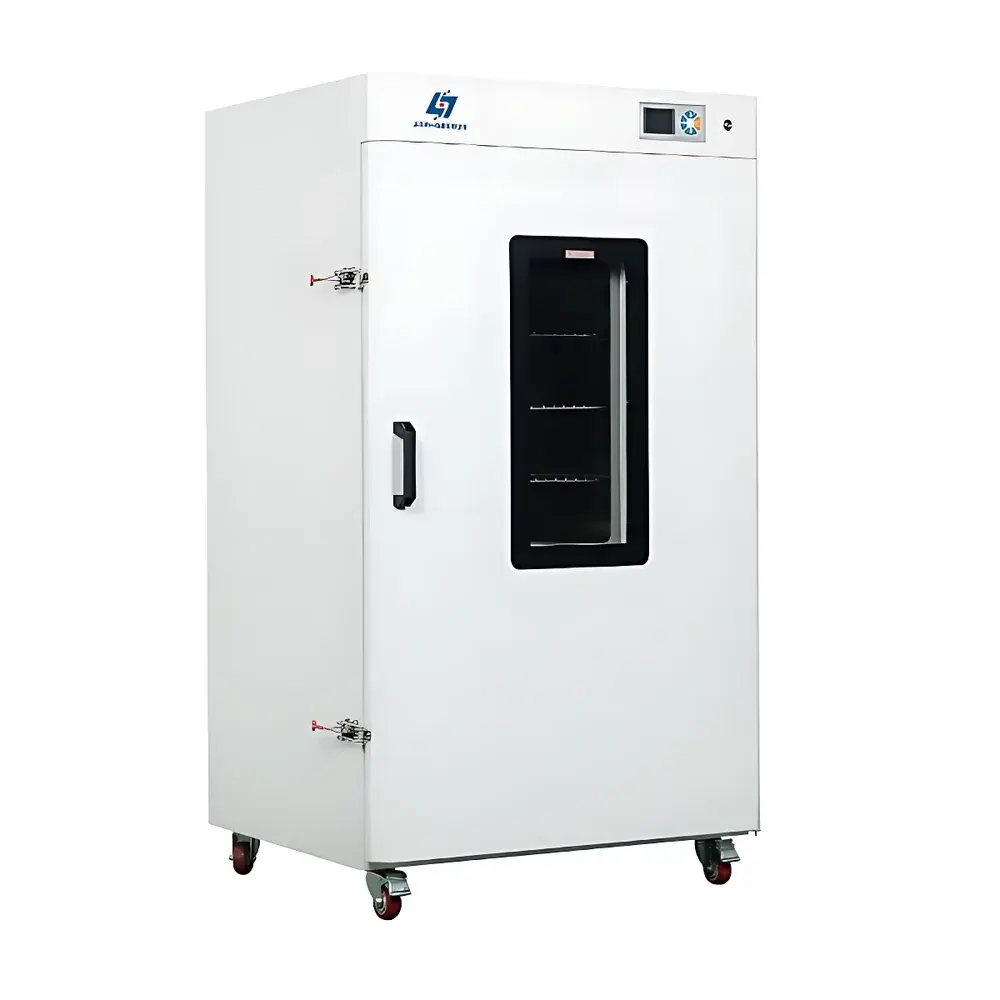
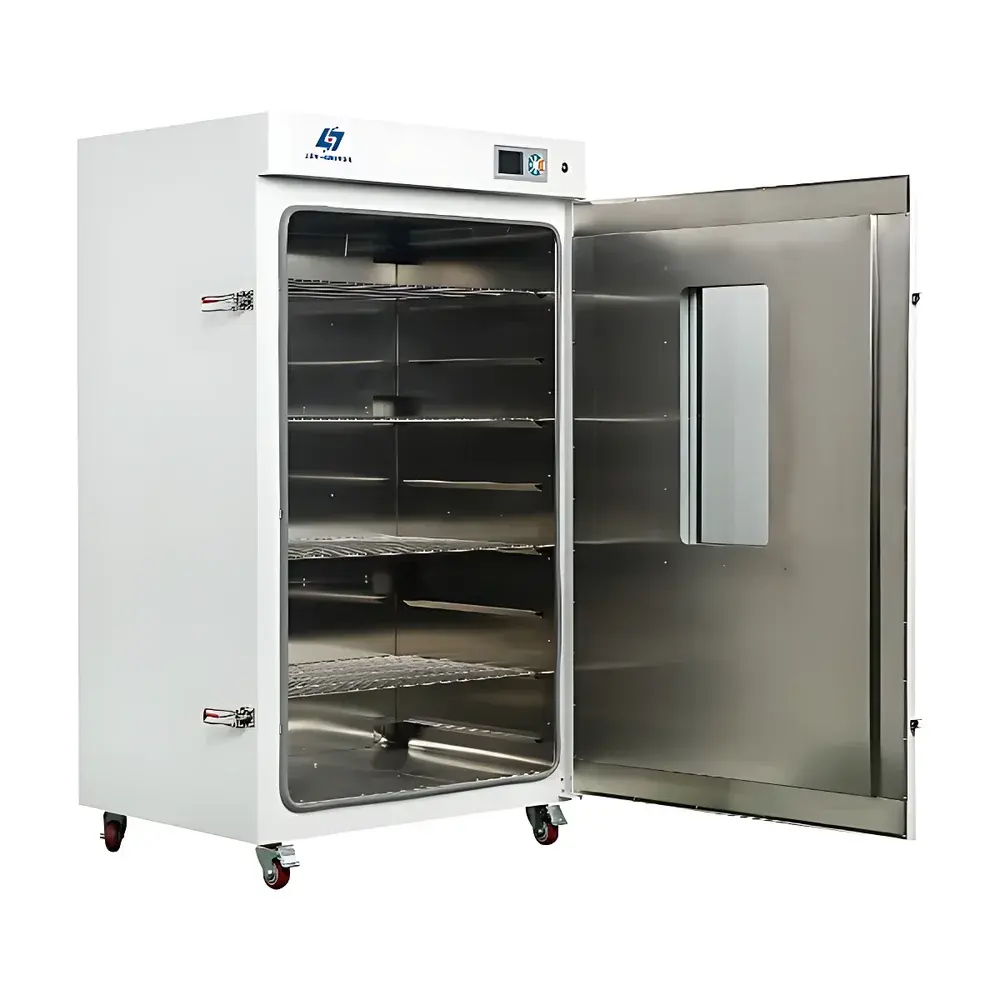
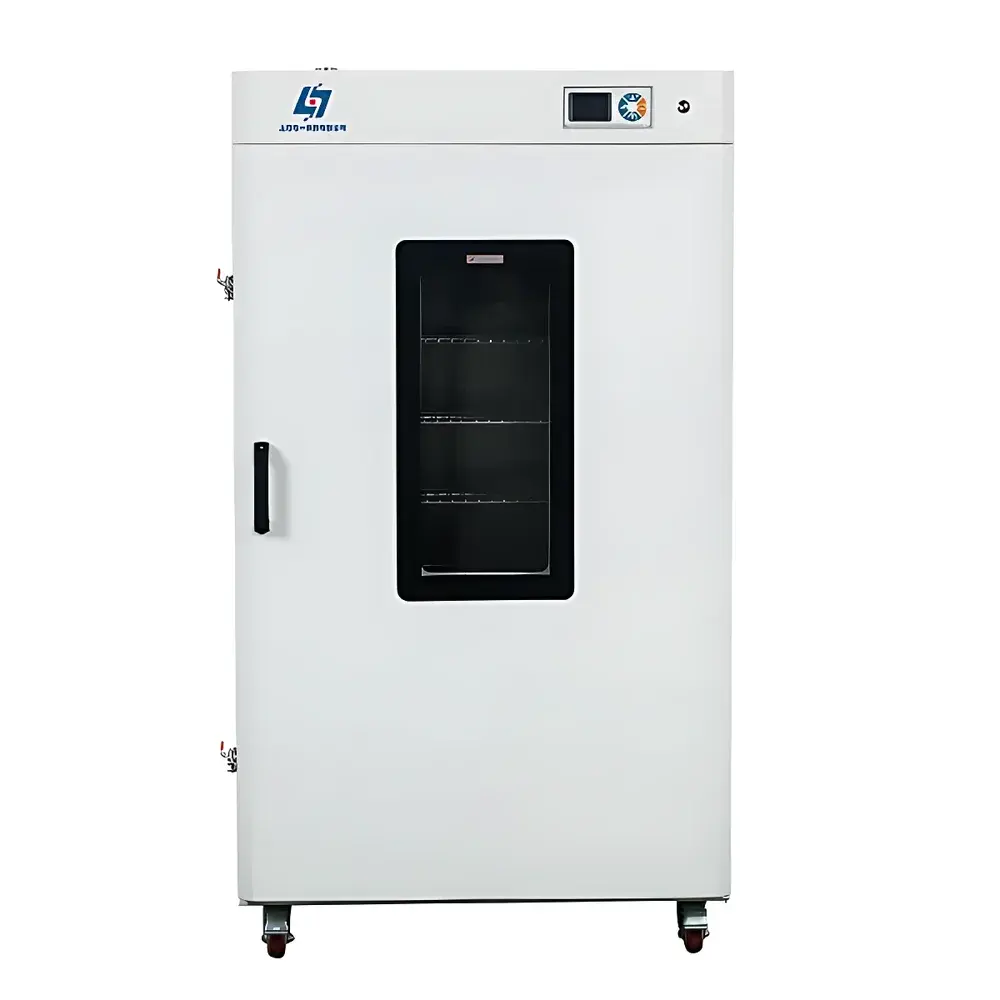
Yoyi DHG-9620C Nitrogen-Purged Forced-Air Drying Oven
| Brand | Yoyi |
|---|---|
| Origin | Shanghai, China |
| Manufacturer | Yes |
| Product Type | Laboratory Drying Oven |
| Model | DHG-9620C |
| Temperature Control Range | RT+10°C to 250°C |
| Temperature Uniformity | ±2.5% (at 100°C, non-purged) |
| Temperature Fluctuation | ±1°C |
| Temperature Resolution | 0.1°C |
| Internal Chamber Dimensions | 800 × 640 × 1300 mm (W×D×H) |
| External Dimensions | 980 × 750 × 1750 mm (W×D×H) |
| Chamber Material | Mirror-Finish Stainless Steel (SUS304) |
| Heating Method | Electric Heaters with Optimized Airflow Distribution |
| Gas Inlet Port | Φ10 mm |
| Nitrogen Flow Control | 0–10 L/min (equipped with precision float flowmeter) |
| Power Supply | AC 220 V / 50 Hz |
| Input Power | 4000 W |
| Working Environment | 5–40°C ambient, ≤80% RH |
| Compliance | Designed for GLP-compliant laboratories |
Overview
The Yoyi DHG-9620C is a vertically oriented, nitrogen-purged forced-air drying oven engineered for applications demanding inert-atmosphere thermal processing, oxidative stability, and high spatial temperature uniformity. Unlike conventional convection ovens, the DHG-9620C integrates a dedicated inert gas management system—featuring a calibrated Φ10 mm inlet port, integrated float-type flowmeter (0–10 L/min), and rear-mounted automatic exhaust ducting—to actively displace ambient air and maintain a controlled low-oxygen environment during operation. Its thermal architecture employs strategically positioned electric heating elements combined with a multi-directional wind tunnel circulation system, ensuring rapid heat transfer and minimizing thermal stratification across the 620 L working chamber (800 × 640 × 1300 mm). The oven operates within a precise control range of RT+10°C to 250°C, with a temperature resolution of 0.1°C and a certified fluctuation of ±1°C under stable load conditions. It is routinely deployed in pharmaceutical stability studies, polymer curing under inert atmosphere, moisture-sensitive material drying, pre-sterilization of glassware, and thermal aging of electronic components where oxygen-induced degradation must be mitigated.
Key Features
- Microprocessor-based PID temperature controller with 4.3-inch LCD touchscreen interface—supports simultaneous display of setpoint, real-time chamber temperature, elapsed time, and remaining hold duration.
- Non-volatile memory retention: All user-defined parameters—including temperature profiles, timer settings, and alarm thresholds—are preserved during power interruption or system reset, enabling seamless recovery upon re-energization.
- Dual-layer tempered glass observation window with reinforced silicone gasket seal—provides unobstructed visual monitoring while maintaining thermal integrity and inert gas containment.
- High-efficiency airflow design featuring rear-mounted blower, optimized baffle geometry, and top-down recirculation path—validated to achieve ±2.5% temperature uniformity at 100°C (per ISO 15502:2016 test protocol, empty chamber).
- Structural construction: Cold-rolled steel outer casing with epoxy-polyester powder coating; interior chamber fabricated from electropolished SUS304 stainless steel for corrosion resistance and ease of decontamination.
- Gas handling system: Quick-connect nitrogen inlet with integrated pressure-relief venting and condensate drainage pathway; exhaust outlet equipped with adjustable damper for dynamic vapor management during extended drying cycles.
- Enhanced safety architecture: Independent mechanical overtemperature cutoff (adjustable up to 280°C), door-open interlock, and audible/visual overtemp alarm compliant with IEC 61010-1 safety standards.
Sample Compatibility & Compliance
The DHG-9620C accommodates a broad spectrum of sample formats including Petri dishes, glass vials, aluminum weighing pans, ceramic crucibles, and custom fixtures up to 600 mm in height. Its large internal volume (620 L) and four-tier adjustable stainless-steel shelving (standard configuration: 4 shelves) support batch processing of heterogeneous loads without compromising thermal homogeneity. The unit meets fundamental requirements for Good Laboratory Practice (GLP) environments, supporting audit-ready operation through configurable event logging (when paired with optional RS485 interface and data acquisition software). While not intrinsically rated for hazardous area use, its inert gas compatibility renders it suitable for drying pyrophoric catalysts, lithium-containing battery materials, and sulfur-sensitive biochemical reagents per ASTM E145-22 Annex A4 guidelines. Chamber surface finish complies with ISO 14644-1 Class 8 cleanroom-compatible cleaning protocols.
Software & Data Management
The DHG-9620C supports optional digital integration via an RS485 serial interface (Modbus RTU protocol), enabling remote monitoring, parameter adjustment, and real-time data streaming to laboratory information management systems (LIMS) or SCADA platforms. When configured with the optional embedded printer module, it generates timestamped thermal event reports—including start/stop times, peak temperatures, dwell durations, and alarm triggers—formatted for traceability under FDA 21 CFR Part 11 requirements. The optional multi-segment programmable controller (up to 30 segments) allows creation of complex thermal profiles (e.g., ramp-hold-cool sequences) essential for accelerated aging studies per ICH Q1A(R2). All logged data are stored in non-volatile memory with configurable retention periods and exportable in CSV format for statistical process control (SPC) analysis.
Applications
- Pharmaceutical: Residual solvent removal from APIs under nitrogen blanket; desiccation of hygroscopic excipients; pre-conditioning of packaging components prior to lyophilization cycle validation.
- Materials Science: Thermal stabilization of conductive polymers; annealing of metal-organic frameworks (MOFs); outgassing of composite laminates prior to vacuum impregnation.
- Electronics: Baking of PCB assemblies to eliminate moisture before conformal coating; stress-relief baking of ceramic substrates used in RF modules.
- Academic Research: Controlled oxidation studies of nanomaterials; thermal decomposition kinetics of organometallic precursors; inert-atmosphere calcination of catalyst supports.
- Quality Control Labs: Moisture content determination per AOAC 950.46; gravimetric ash testing per ASTM D3174; drying of filter papers prior to particulate mass analysis.
FAQ
What inert gases are compatible with the DHG-9620C?
Nitrogen (N₂) is the standard and most commonly used gas; argon (Ar) and helium (He) may also be employed provided system pressure and flow rate remain within the specified 0–10 L/min range and inlet pressure does not exceed 0.3 MPa.
Is the temperature uniformity specification validated under nitrogen purge?
The stated ±2.5% uniformity is measured under standard air convection conditions at 100°C (empty chamber). Under active nitrogen purge, uniformity remains within ±3.0% due to minor convective perturbation—verified per internal qualification protocol IQ-TH-092.
Can the oven be operated continuously at 250°C?
Yes. The DHG-9620C is rated for continuous operation across its full range (RT+10°C to 250°C), with thermal insulation and component derating validated for 72-hour uninterrupted duty cycles.
Does the unit include calibration documentation?
A factory calibration certificate (traceable to NIM China) is supplied with each unit, covering temperature sensor linearity, controller accuracy, and overtemperature cutoff verification.
What maintenance intervals are recommended?
Monthly inspection of door gasket integrity and airflow grilles; quarterly verification of float flowmeter calibration; annual thermocouple recalibration and fan bearing lubrication per maintenance manual section 7.2.



