
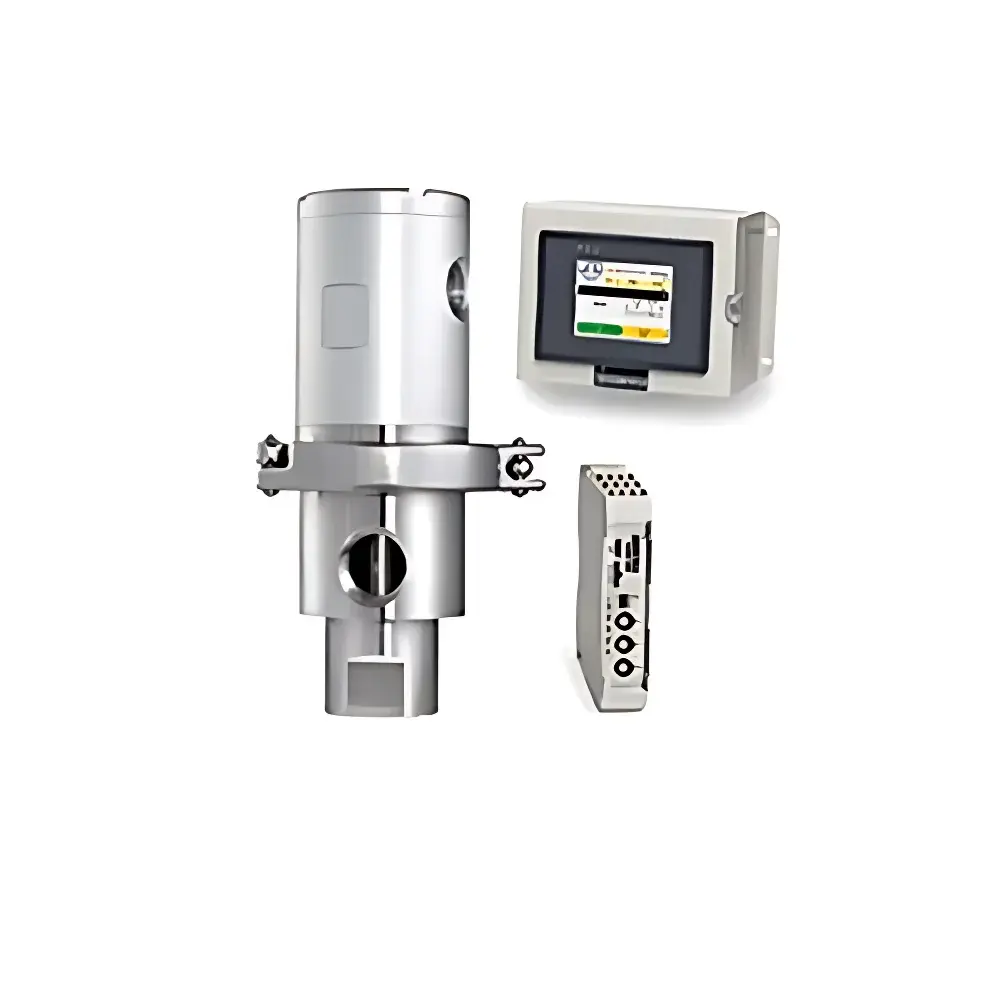
Brookfield FAST-101 Online Viscometer
| Brand | Brookfield |
|---|---|
| Origin | USA |
| Model | FAST-101 |
| Viscosity Range | 0–12,500 cSt |
| Repeatability | ±1.0% of reading |
| Operating Temperature | –20°C to 200°C (–4°F to 392°F) |
| Pressure Rating | Vacuum to 200 psig (400 psig optional) |
| Wetted Materials | 316L stainless steel |
| Sensor Principle | High-frequency torsional resonant vibration |
| Output | Dual 4–20 mA (viscosity + temperature), RS232 & RS485 (Modbus RTU) |
| Enclosure | NEMA-4 (IP65), wall-mounted, 203 × 203 × 152 mm |
| Power | 18–30 VDC or 115/230 VAC (±10%), <1 A |
Overview
The Brookfield FAST-101 Online Viscometer is a robust, maintenance-free process viscometer engineered for continuous, real-time viscosity monitoring in demanding industrial environments. Unlike rotational or capillary-based instruments, the FAST-101 employs a high-frequency torsional resonant vibration principle: a micro-torsion sensing element oscillates at its natural resonant frequency, which shifts predictably with changes in fluid density and shear viscosity. This solid-state, no-moving-parts design eliminates mechanical wear, bearing degradation, and calibration drift—making it uniquely suited for unattended operation in printing, coating, adhesive dispensing, ink formulation, and chemical processing lines where reliability, long-term stability, and minimal downtime are mission-critical.
Key Features
- True solid-state sensor: No rotating shafts, bearings, or motorized components—zero scheduled maintenance required.
- Vibration-immune architecture: Engineered to reject external mechanical noise (e.g., pump pulsation, line vibration) without signal filtering or software compensation.
- Flexible installation: Supports vertical, horizontal, or submerged probe configurations; available with sanitary 3A-compliant flanges or tri-clamp fittings.
- Wide thermal operating range: Integrated Pt100 RTD provides accurate fluid temperature measurement from –20°C to 200°C (–4°F to 392°F), enabling temperature-compensated viscosity output.
- Hazardous area compliance: Optional explosion-proof variants certified to NEMA Class 7 and ATEX II 2G Ex db IIB T4 Gb standards.
- Material compatibility: Wetted surfaces constructed from electropolished 316L stainless steel; O-rings specified in Isolast® (fluoroelastomer) as standard, with EPDM or Kalrez® alternatives for aggressive chemistries.
- Configurable analog and digital outputs: Dual isolated 4–20 mA channels (viscosity and temperature), plus dual serial interfaces—RS232 (read-only diagnostics) and full-duplex RS485 supporting Modbus RTU for integration into DCS, SCADA, or MES platforms.
Sample Compatibility & Compliance
The FAST-101 is validated for Newtonian and mildly non-Newtonian fluids across a broad rheological spectrum—including solvent-based inks, waterborne coatings, hot-melt adhesives, polymer dispersions, and food-grade syrups. Its measurement principle inherently accommodates suspended solids up to ~15% v/v (subject to particle size <50 µm) without clogging or flow restriction. The system meets ASTM D2196 (Standard Test Methods for Rheological Properties of Non-Newtonian Materials) for comparative process viscosity trending and supports GLP/GMP traceability through NIST-traceable factory calibration documentation. Optional 3A sanitary certification enables deployment in FDA-regulated food, beverage, and pharmaceutical manufacturing per 21 CFR Part 11 requirements when paired with compliant data logging systems.
Software & Data Management
While the FAST-101 operates autonomously as a hardwired field instrument, its RS485/Modbus interface enables seamless integration with industry-standard automation infrastructure. Process engineers may configure alarm thresholds, damping filters, and linearization tables via host HMI or PLC logic. All analog and digital outputs support audit-ready timestamped data capture—essential for batch record integrity in regulated environments. When deployed with Brookfield’s optional MXTS transmitter firmware, the unit logs internal diagnostics (sensor resonance amplitude, temperature stability, power supply variance) to support predictive maintenance planning and root-cause analysis during process excursions.
Applications
- Real-time viscosity control in gravure and flexographic ink circulation systems to maintain color consistency and print fidelity.
- In-line monitoring of epoxy resin and polyurethane adhesive blends prior to metering/mixing to prevent gelation or under-cure.
- Continuous quality assurance of latex paints and architectural coatings during blending and letdown stages.
- Process optimization in edible oil refining and syrup concentration—reducing over-processing energy and ensuring target mouthfeel specifications.
- Monitoring of drilling mud rheology in offshore mud logging units where vibration and ambient temperature extremes preclude conventional viscometers.
FAQ
Does the FAST-101 require periodic recalibration?
No—its resonant frequency-based measurement is inherently stable. Factory calibration is NIST-traceable and remains valid for the service life unless subjected to physical damage or extreme thermal shock.
Can it measure non-Newtonian fluids accurately?
It reports apparent viscosity at the effective shear rate imposed by the resonant probe motion (~100–500 s⁻¹). For QC trending and process control, it delivers high reproducibility; for full rheogram generation, pairing with a laboratory rheometer (e.g., Brookfield DVNext) is recommended.
Is the sensor compatible with abrasive slurries?
The 316L stainless steel probe resists erosion in low-abrasion applications (e.g., pigment dispersions). For high-solids slurries (>20% v/v or >100 µm particles), consult engineering for hardened tungsten-carbide tip options.
What is the minimum fluid flow velocity required for reliable measurement?
The FAST-101 functions reliably under static or dynamic conditions. No minimum flow rate is required—ideal for batch reactors, storage tanks, and low-flow transfer lines.
How is temperature compensation applied?
The integrated Pt100 RTD measures bulk fluid temperature in real time; viscosity output is automatically corrected using user-defined or factory-loaded temperature-viscosity correlation curves.



