
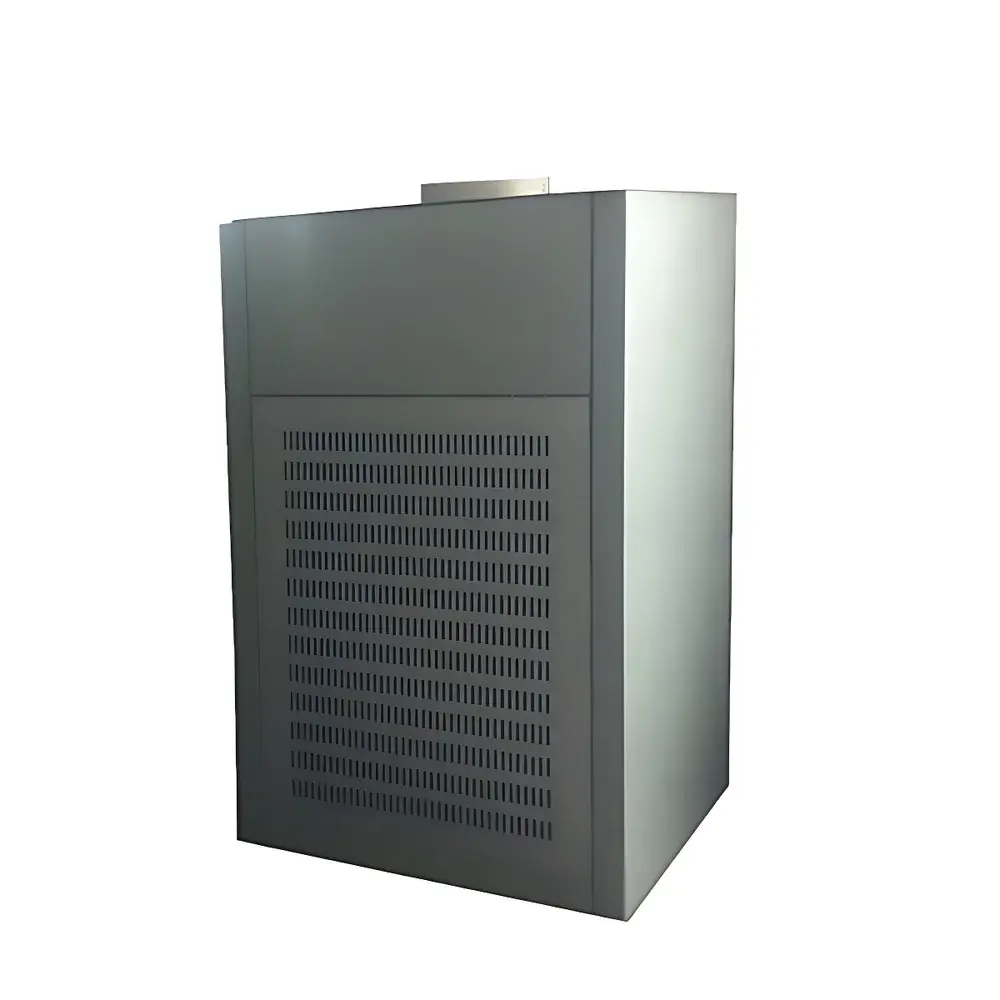
HJ SW-CJ-1K Wall-Mounted Air Purification Unit
| Brand | HJ |
|---|---|
| Origin | Shanghai, China |
| Manufacturer Type | Direct Manufacturer |
| Country of Origin | China |
| Model | SW-CJ-1K |
| Price | USD 295 (approx.) |
| Cleanliness Class | ≤3.5 particles/L (outlet — ISO Class 5 / USP <797> Grade A equivalent) |
| Noise Level | ≤62 dB(A) |
| Airflow Velocity | 0.3–0.6 m/s (dual-speed control) |
| Power Supply | AC 220 V / 50 Hz |
| Power Consumption | 150 W/h |
| Dimensions (W×D×H) | 500 × 350 × 880 mm |
| Airflow Capacity | 500 m³/h (single-unit configuration) |
| UV Germicidal Lamp | Integrated low-pressure mercury lamp (254 nm) |
| Control Interface | Digital LED display with infrared remote & manual panel |
| Timer Function | Programmable 1–6 daily cycles |
| Compliance | Designed for ISO 14644-1 Class 5 environments |
Overview
The HJ SW-CJ-1K Wall-Mounted Air Purification Unit is an engineered solution for localized air quality control in non-ducted or retrofit laboratory environments. It operates on the principle of unidirectional laminar airflow combined with mechanical filtration and ultraviolet germicidal irradiation (UVGI). Air is drawn through a pre-filter (G4 grade), then passes through a high-efficiency particulate air (HEPA) filter rated at H13 (≥99.95% efficiency at 0.3 µm), followed by exposure to a built-in 254 nm UV-C lamp positioned within the recirculation duct to inactivate airborne microorganisms. The unit is designed for continuous operation in ambient laboratory conditions (15–30 °C, RH ≤80%), delivering ISO Class 5 (equivalent to USP Grade A) air quality at the outlet plane under validated installation conditions. Its wall-mounted architecture eliminates floor footprint constraints and enables strategic placement adjacent to critical work zones—such as analytical balance enclosures, microbiological sampling stations, or sterile preparation hoods—without requiring structural ductwork integration.
Key Features
- Wall-integrated design with adjustable mounting height (standard range: 1.8–2.4 m above floor) to optimize vertical airflow alignment with operator breathing zone and process-critical surfaces
- Dual-speed centrifugal blower system (0.3–0.6 m/s nominal face velocity) engineered for low-turbulence delivery and acoustic performance ≤62 dB(A) at 1 m distance
- Programmable digital controller supporting up to six independent daily time slots; retains settings during power interruption
- Self-diagnostic firmware with real-time error logging and LED fault indication (e.g., filter saturation, UV lamp failure, motor overload)
- Infrared remote control with backlit LCD interface enabling manual override, timer reset, and mode selection without physical access
- Modular internal UV-C chamber compliant with IEC 62471 photobiological safety standards; lamp life rated at ≥8,000 hours with intensity monitoring capability
- Optional upgrade path to integrated bipolar ionization or cold plasma modules (upon factory configuration) for enhanced VOC and bioaerosol reduction
Sample Compatibility & Compliance
The SW-CJ-1K is intended for use in non-sterile and semi-restricted laboratory areas where particulate and microbial load mitigation is required—not as a primary barrier device but as a supplementary environmental control measure. It meets mechanical and electrical safety requirements per GB 4706.1 (IEC 60335-1 equivalent) and electromagnetic compatibility per GB 4343.1 (CISPR 14-1). While not certified to ISO 14644-1 as a standalone cleanroom system, its output airflow characteristics are validated per ISO 14644-3 Annex B protocols when installed with appropriate return-air pathways (e.g., perforated ceiling panels or wall grilles). Units deployed in GxP-regulated facilities may be included in facility qualification protocols (IQ/OQ/PQ) and support adherence to FDA 21 CFR Part 11 when paired with audit-trail-capable external data loggers.
Software & Data Management
The embedded microcontroller does not feature network connectivity or cloud-based software. However, operational parameters—including cumulative runtime, UV lamp duty cycle, and fault event timestamps—are stored in non-volatile memory and accessible via diagnostic menu navigation. For laboratories requiring electronic record retention, third-party USB data loggers (e.g., Testo 174H or Omega OM-EL-USB-2-LCD) can be interfaced with the unit’s analog voltage output (0–5 V DC) corresponding to fan speed feedback. All firmware updates must be performed onsite using manufacturer-provided programming hardware; no over-the-air (OTA) functionality is implemented.
Applications
- Supplemental air cleaning in analytical chemistry labs where volatile organic compound (VOC) accumulation near GC-MS or HPLC workstations requires dilution
- Maintenance of low-bioburden environments in QC microbiology labs during media pour plates or environmental monitoring sample handling
- Retrofit installations in legacy buildings lacking centralized HVAC upgrades, particularly in university teaching labs and regional testing centers
- Temporary contamination control during equipment validation studies or post-maintenance requalification of clean benches
- Support of ISO/IEC 17025 clause 6.3.2 (environmental conditions) where localized particle excursions are observed near vibration-sensitive instrumentation
FAQ
Is the SW-CJ-1K suitable for use in ISO Class 5 cleanrooms?
No—it is not a certified cleanroom terminal unit. It delivers ISO Class 5-equivalent air *at the outlet* under ideal installation and maintenance conditions, but cannot guarantee room-wide classification without full HVAC integration and certification.
What is the recommended HEPA filter replacement interval?
Under typical laboratory use (8 h/day, moderate particulate load), replace every 12 months or after 7,000 operating hours—whichever occurs first. Pressure drop across the filter should not exceed 250 Pa (manufacturer-specified limit).
Can the unit operate continuously for 24/7 applications?
Yes. The motor and thermal management system are rated for uninterrupted operation. However, UV lamp irradiance decays over time; annual photometric verification is advised per ISO 15858.
Does it comply with FDA 21 CFR Part 11 for electronic records?
Not natively—the internal controller lacks audit trail, electronic signature, or secure user authentication. Integration with validated external data acquisition systems is required for Part 11 compliance.
Is PVC ducting mandatory for installation?
Yes. Return-air routing via rigid or flexible PVC conduit (minimum Ø100 mm) is required to maintain design airflow balance and prevent short-circuiting of purified air.



