
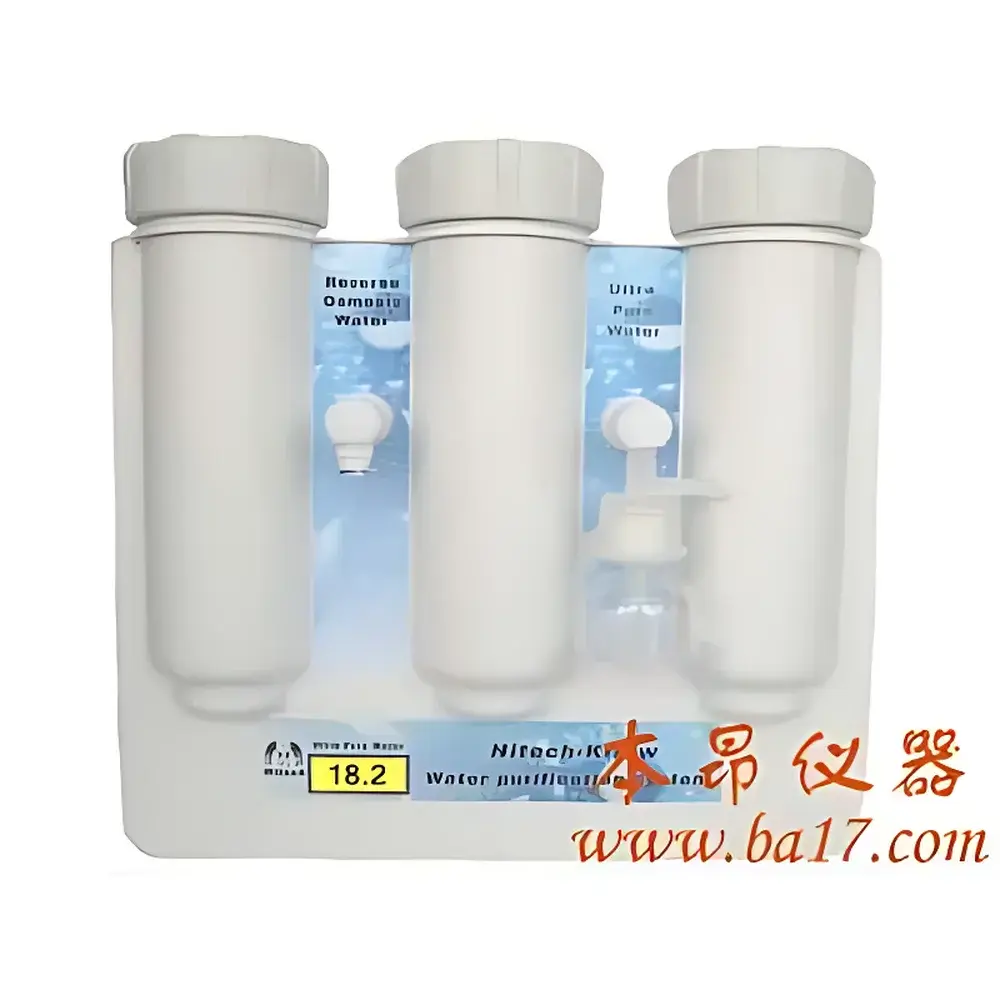
BenAng UP-30 Basic Ultra Pure Water System
| Brand | BenAng |
|---|---|
| Origin | Shanghai, China |
| Model | UP-30 |
| Purified Water Grade | ASTM Type I / ISO 3696 Class 1 / GB/T 6682-2008 Grade I |
| Resistivity | 18.2 MΩ·cm @ 25°C |
| Heavy Metals & Soluble Silica | <0.1 ppb |
| Total Organic Carbon (TOC) | <3 ppb |
| Microbial Count | <0.001 EU/mL |
| Particles (>0.1 µm) | <1 particle/mL |
| Flow Rate | 30 L/h |
| Feed Water | Municipal tap water (TDS < 200 ppm, 5–40 °C, pressure 1.0–3.5 kg/cm²) |
| System Configuration | PF + AC + RO + DI + UV (254/185 nm) + UF + DMF + 0.22 µm final filtration |
Overview
The BenAng UP-30 Basic Ultra Pure Water System is an engineered solution for laboratories requiring continuous, on-demand production of Type I ultrapure water directly from municipal tap water. Utilizing a multi-stage purification architecture grounded in established physical and electrochemical separation principles—including reverse osmosis (RO), mixed-bed deionization (DI), dual-wavelength ultraviolet photooxidation (254 nm germicidal + 185 nm TOC abatement), ultrafiltration (UF), and terminal 0.22 µm membrane filtration—the UP-30 delivers water meeting or exceeding the most stringent international specifications for analytical and life science applications. Its design reflects adherence to core physicochemical water quality paradigms: resistivity serves as a proxy for ionic purity; TOC quantifies non-ionic organic contamination; endotoxin and microbial limits are validated via kinetic chromogenic LAL assays and membrane filtration colony counts; and sub-micron particle counts are determined by light scattering. The system operates fully autonomously, integrating real-time conductivity/resistivity monitoring with programmable safety interlocks—ensuring compliance with GLP-aligned operational discipline without manual intervention.
Key Features
- Integrated dual-wavelength UV chamber (254 nm for microbial inactivation; 185 nm for advanced oxidation of trace organics), reducing TOC to <3 ppb
- High-rejection RO module (≥99% salt rejection, ≥99.5% bacterial removal) using certified Dow FilmTec™ or FCS membranes, with automated anti-scaling flush cycles
- Four-column nuclear-grade mixed-bed ion exchange cartridge assembly for stable 18.2 MΩ·cm resistivity output
- Pall UF membrane (MWCO 5000 Da) for effective endotoxin and pyrogen removal prior to final filtration
- Sartorius™ 0.22 µm hydrophilic polyethersulfone (PES) terminal filter with prefilter layer, installed at point-of-use
- Backlit LCD resistivity monitor with real-time logging capability and user-accessible calibration interface
- Comprehensive safety architecture: auto-shutdown on feed water loss, tank overfill, low-pressure fault, and temperature excursion
- 24-hour unattended operation enabled by intelligent reservoir management and scheduled RO maintenance protocols
Sample Compatibility & Compliance
The UP-30 is validated for use with instrumentation demanding highest-purity water inputs—including HPLC, UHPLC, IC, ICP-MS, AAS, and LC-MS systems—where background interference from ions, organics, particles, or endotoxins compromises detection limits or column longevity. Its output meets ASTM D1193-20 Type I, ISO 3696:1987 Class 1, CLSI EP21-A (formerly NCCLS), GB/T 6682-2008 Grade I, and GB/T 11446.1-1997 Electronic Grade I specifications. While not pre-certified to FDA 21 CFR Part 11, the system supports audit-ready documentation when paired with validated SOPs and periodic third-party water quality verification (e.g., quarterly TOC/endotoxin testing per USP ). It conforms to IEC 61010-1 safety standards for laboratory equipment and incorporates CE-marked electrical components.
Software & Data Management
The UP-30 features embedded microcontroller-based logic with non-volatile memory for event logging (e.g., RO flush timestamps, resistivity excursions, alarm triggers). All resistivity measurements are temperature-compensated to 25 °C using built-in NTC thermistors and comply with ASTM D1125 methodology. Data export is supported via RS-232 serial interface for integration into centralized lab information management systems (LIMS) or electronic lab notebooks (ELN). Audit trails—including operator ID (via optional RFID badge reader), parameter changes, and calibration events—can be generated in CSV format for GLP/GMP traceability. No cloud connectivity or proprietary software installation is required; configuration is managed locally through the front-panel interface.
Applications
- HPLC and UHPLC mobile phase preparation and column equilibration
- ICP-MS and GF-AAS blank matrix generation for sub-ppt elemental analysis
- Cell culture media and reagent preparation in sterile environments (endotoxin-free water critical for mammalian cell viability)
- Protein crystallization, electrophoresis buffer formulation, and next-generation sequencing library prep
- Calibration standard dilution in clinical chemistry and pharmaceutical QC labs
- Wafer rinsing and photomask cleaning in semiconductor R&D cleanrooms
- Preparation of reference materials compliant with ISO Guide 35 requirements
FAQ
What feed water quality is required for optimal UP-30 performance?
Municipal tap water with TDS ≤200 ppm, temperature between 5–40 °C, and inlet pressure of 1.0–3.5 kg/cm² (14–50 psi) is recommended. Pre-treatment with external sediment and carbon filters is advised if chlorine or particulate levels exceed local utility averages.
How often must consumables be replaced?
Under typical usage (30 L/day), the RO membrane lasts 2–3 years; the mixed-bed DI cartridge requires replacement every 6–12 months depending on feed water TDS; the Sartorius terminal filter is single-use and replaced per batch or weekly in high-throughput labs.
Does the UP-30 support remote monitoring or IoT integration?
No native Ethernet/Wi-Fi module is included; however, the RS-232 port enables connection to industrial PLCs or custom SCADA systems via protocol translation gateways.
Is the system suitable for ISO 17025-accredited testing laboratories?
Yes—when operated within documented procedures, maintained per manufacturer guidelines, and verified through periodic third-party water quality testing, the UP-30 satisfies ISO/IEC 17025:2017 clause 6.4.3 (equipment suitability) for water purification systems used in accredited methods.
Can the UP-30 produce water compliant with USP purified water monograph?
No—the UP-30 is designed exclusively for Type I ultrapure water and exceeds USP purified water specifications in all parameters except bacterial endotoxin (which USP does not define for purified water); it meets USP Water for Injection (WFI) *quality* benchmarks for resistivity and TOC, but WFI requires sterile distillation or equivalent validation not provided by this system.



