
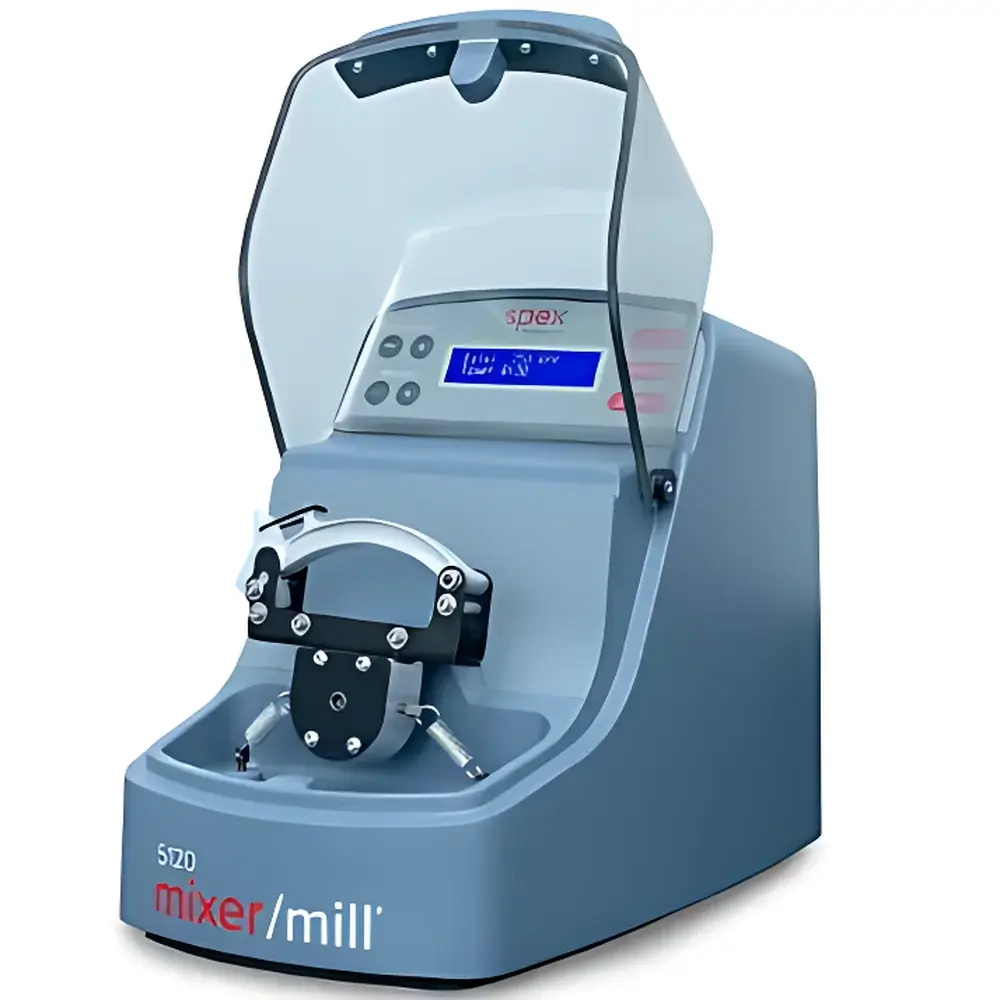
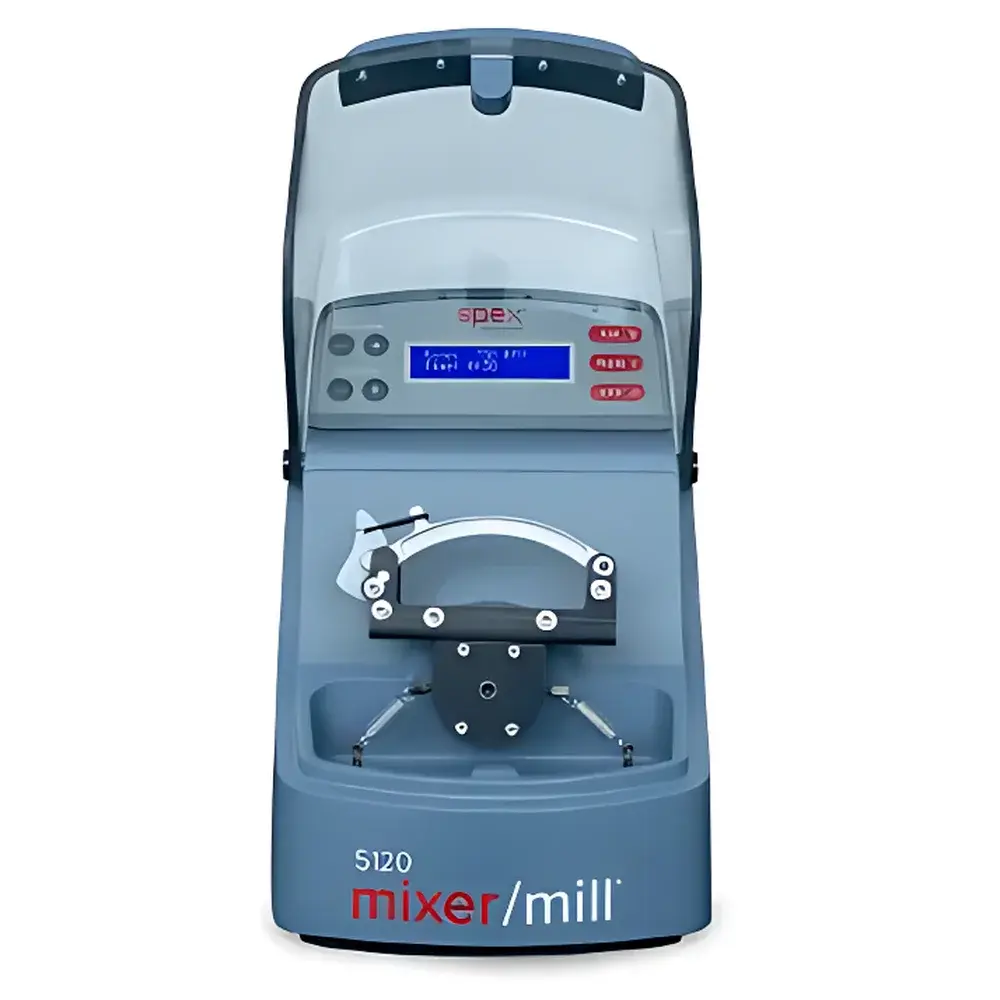
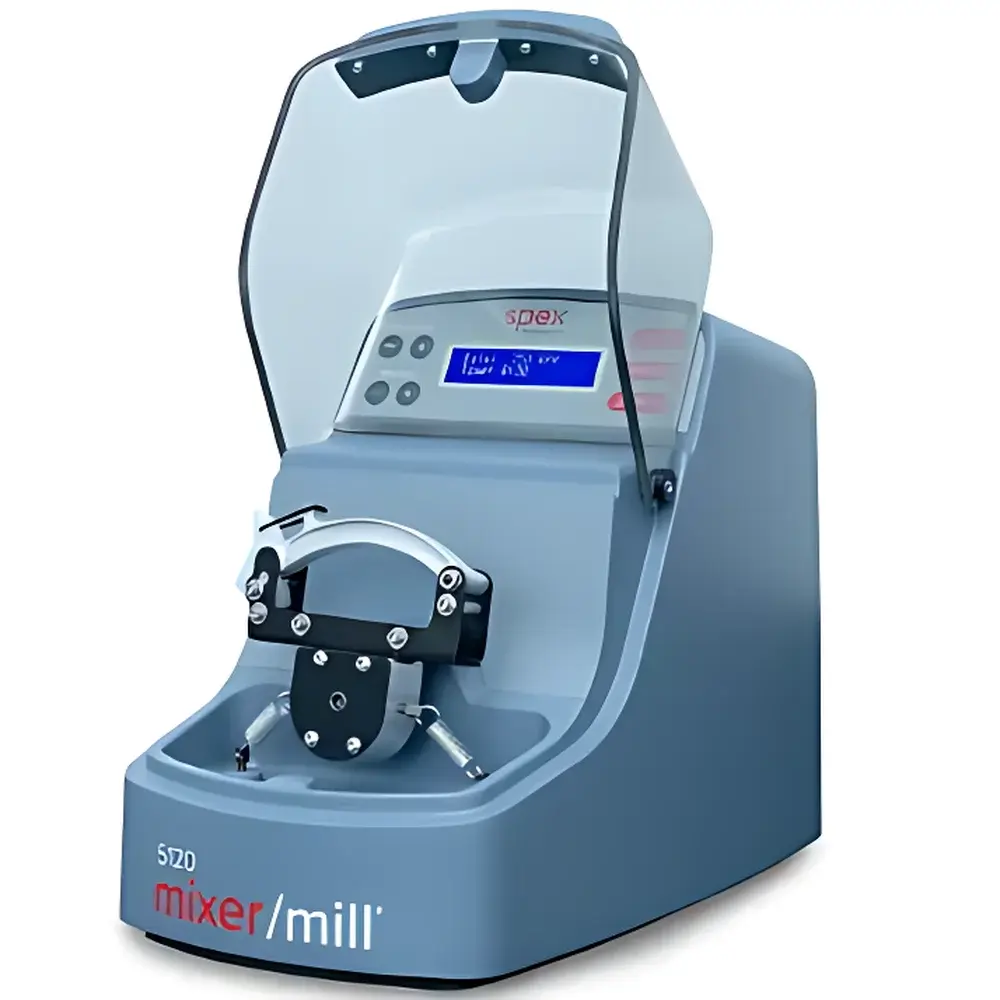
SPEX SamplePrep 5120 MIXER/MILL High-Energy Ball Mill
| Brand | SPEX SamplePrep |
|---|---|
| Origin | USA |
| Model | 5120 MIXER/MILL |
| Dimensions (L×W×H) | 38 cm × 20.5 cm × 30 cm |
| Net Weight | 11 kg |
| Motor Power | 1/7 HP |
| Vibration Speed Options | 750, 2000, 3000, 3500 rpm |
| Timer Resolution | 1 s decrement, adjustable in 5 s increments |
| Sample Vial Compatibility | 5 mL polyethylene (2241R-PEF quad rack), 5 mL stainless steel or tungsten carbide capped vials, 3.5 mL agate vials |
| Safety | Interlocked transparent lid with automatic motor cutoff |
Overview
The SPEX SamplePrep 5120 MIXER/MILL is a high-energy, dual-vial shaker mill engineered for reproducible, cryogenic-capable sample homogenization and comminution in analytical and materials laboratories. Operating on the principle of high-frequency eccentric vibration—often referred to as “shaker milling”—the instrument subjects samples to intense inertial impacts between grinding media (e.g., stainless steel, tungsten carbide, or agate balls) and vessel walls. This mechanical energy transfer enables rapid particle size reduction of hard, brittle, and fibrous materials—including geological specimens (granite, basalt), refractory ceramics, cement clinkers, alloys, and biological tissues—without significant thermal degradation when used with liquid nitrogen cooling. Its compact footprint (38 × 20.5 × 30 cm) and 11 kg mass provide mechanical stability during operation at up to 3500 rpm, minimizing resonance-induced drift and ensuring consistent energy input across replicate runs.
Key Features
- Four discrete vibration speeds (750, 2000, 3000, and 3500 rpm) optimized for distinct processing objectives: gentle mixing at low speed versus aggressive pulverization of refractory materials at maximum frequency.
- Programmable digital control panel with precise timer resolution (1-second decrement, settable in 5-second increments), enabling repeatable process duration from 5 seconds to 99 minutes 55 seconds.
- Interlocked transparent polycarbonate lid that halts motor operation immediately upon opening—ensuring compliance with IEC 61000-6-2 electromagnetic compatibility and laboratory safety best practices.
- Modular vial holder system supporting interchangeable configurations: quad-rack for four 5 mL polyethylene vials (Part No. 2241R-PEF), single-position holders for 5 mL stainless steel or tungsten carbide capped vials, and dedicated 3.5 mL agate vial mounts—each engineered to maintain vial alignment under high-G acceleration.
- Robust 1/7 HP induction motor with reinforced mounting and balanced eccentric drive assembly, delivering sustained torque output without thermal derating during extended duty cycles.
Sample Compatibility & Compliance
The 5120 MIXER/MILL accommodates a broad spectrum of sample matrices requiring micron-scale homogenization prior to elemental or structural analysis. It is routinely employed in preparation workflows aligned with ASTM D5630 (ash content determination), ISO 13320 (laser diffraction particle size analysis), and USP (disintegration testing). When used with cryogenic vials, it supports GLP-compliant tissue disruption per NIH guidelines for proteomic and genomic extraction. All vial materials (stainless steel, WC, agate, PE) are selected to minimize elemental leaching—critical for trace-metal analysis by ICP-MS or XRF. The instrument’s mechanical design conforms to UL 61010-1 and CE safety directives; no software-based regulatory validation (e.g., FDA 21 CFR Part 11) is required due to its non-data-generating, analog-timed architecture.
Software & Data Management
The 5120 operates via a standalone electromechanical timer and rotary speed selector—no embedded firmware, USB interface, or data logging capability is present. This architecture eliminates cybersecurity vulnerabilities, ensures long-term operational continuity without software obsolescence, and simplifies IQ/OQ validation in regulated environments. Users record run parameters (speed, time, vial type, cooling method) manually in lab notebooks or LIMS-integrated worksheets. For laboratories requiring electronic audit trails, external time-stamped video recording of the transparent lid operation or integration with programmable power controllers (e.g., IEEE 1394-enabled relays) may be implemented as supplementary controls.
Applications
- Pre-analytical sample conditioning for XRF pressed pellet and fused bead preparation—achieving sub-75 µm particle distributions essential for matrix homogeneity and fluorescence yield consistency.
- Rapid digestion enhancement for ICP-OES/MS: fine grinding increases surface area-to-volume ratio, accelerating acid dissolution kinetics of silicates and oxides.
- Homogenization of heterogeneous environmental samples (soils, sediments, fly ash) prior to TCLP or SPLP leaching protocols (EPA Method 1311/1312).
- Cryogenic grinding of plant tissues, bone, and frozen biopsies for RNA integrity preservation and downstream qPCR or NGS library prep.
- Blending of pharmaceutical excipients and active ingredients in early-stage formulation development, adhering to ICH Q5C stability guidelines.
FAQ
Can the 5120 MIXER/MILL be operated continuously for extended durations?
Yes—its thermally managed motor and sealed bearing assembly support uninterrupted operation up to 99 minutes 55 seconds per cycle. For multi-hour protocols, manual restart after cooldown intervals is recommended to maintain peak mechanical efficiency.
Is liquid nitrogen cooling compatible with all vial types?
Liquid nitrogen immersion is validated for stainless steel and tungsten carbide vials only. Agate and polyethylene vials must not be subjected to cryogenic quenching due to thermal shock fracture risk.
What maintenance is required to ensure long-term accuracy?
Annual verification of vibration amplitude (using calibrated accelerometer) and timer calibration against a NIST-traceable stopwatch is advised. No lubrication or internal servicing is required under normal use conditions.
Does SPEX provide application-specific method development support?
Yes—SPEX SamplePrep offers free technical consultation, including vial/media selection guides, speed/time optimization matrices for >200 material classes, and peer-reviewed protocol references for ASTM/ISO-compliant workflows.



