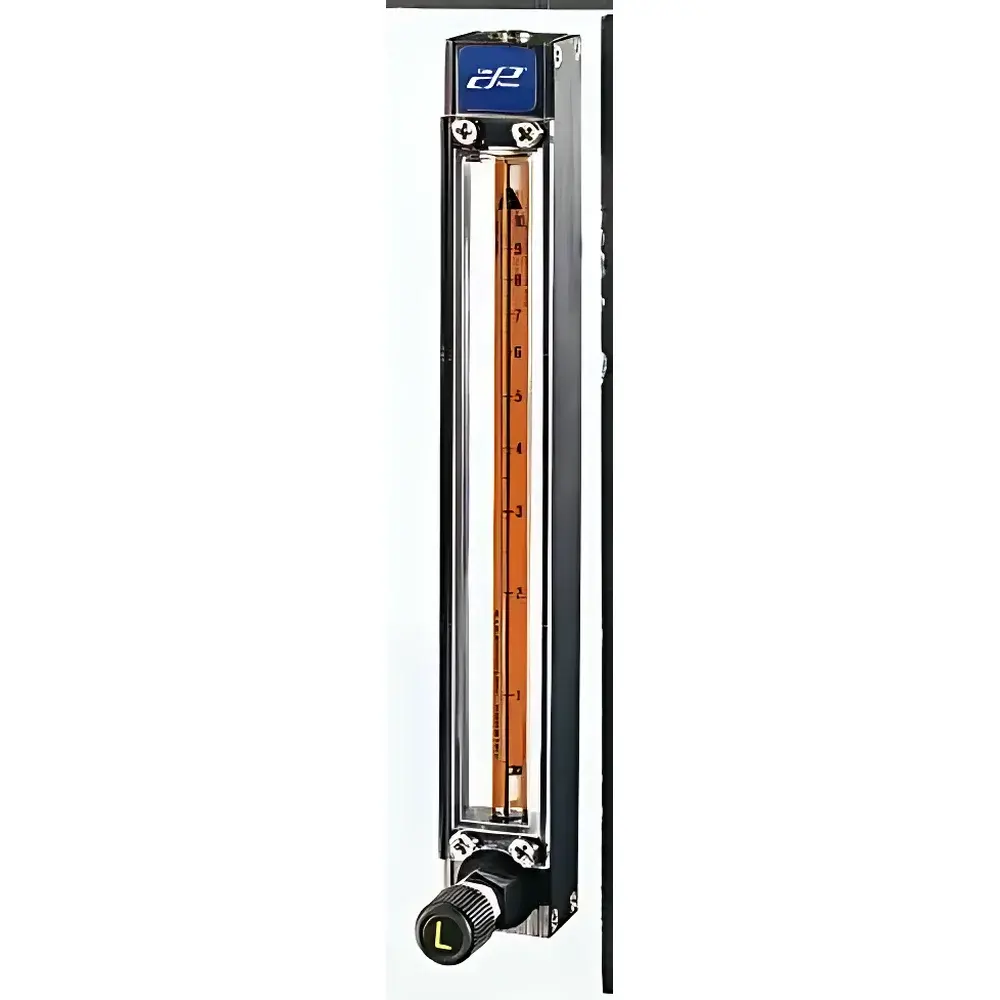
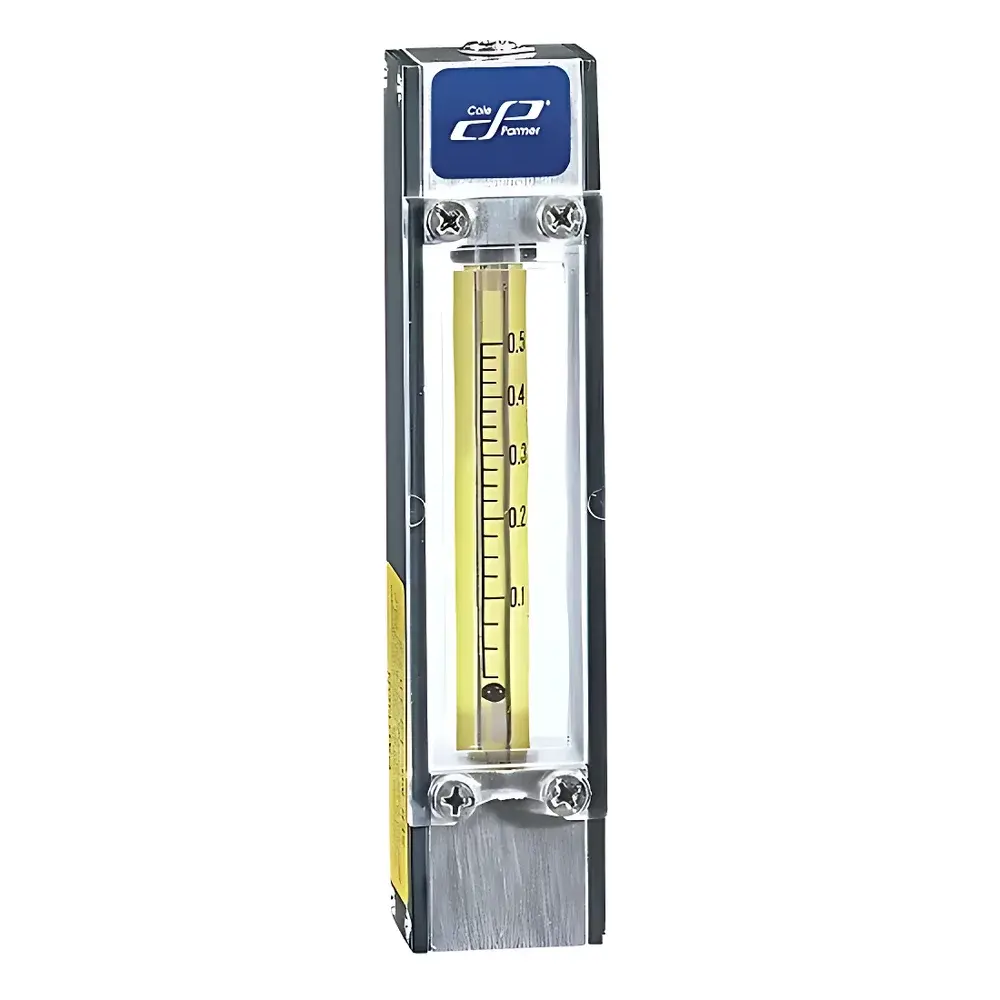
Cole-Parmer® Model 32005-14 Panel-Mount Variable-Area Flowmeter (Rotameter)
| Brand | Cole-Parmer |
|---|---|
| Origin | USA |
| Type | Differential Pressure Flowmeter |
| Housing Material Options | Aluminum, Brass, or 316 Stainless Steel |
| Float Materials | Sapphire (Sa), Tungsten Carbide (C), 316 SS (SS), or Glass (G) |
| Inlet Screen | 150-mesh |
| Mounting | Front-panel installation |
| Calibration | Air- or water-referenced, factory-calibrated per ANSI/ISA-75.01.01 |
| Compliance | Designed for use in general laboratory and industrial gas/liquid flow monitoring per ISO 5167–derived differential pressure principles |
Overview
The Cole-Parmer® Model 32005-14 is a precision-engineered, panel-mount variable-area flowmeter—commonly referred to as a rotameter—that operates on the fundamental principle of differential pressure-induced float displacement within a vertically oriented, tapered glass or metal tube. As fluid flows upward through the annular gap between the float and tube wall, the resulting pressure differential lifts the float until gravitational, buoyant, and drag forces reach equilibrium. The float’s stable vertical position corresponds directly to volumetric flow rate, indicated by a calibrated scale visible through the front-mounted optical lens. This mechanical, analog measurement method requires no external power, offers immediate visual readout, and delivers high repeatability across a wide dynamic range—making it ideal for continuous, real-time monitoring of non-corrosive gases and low-viscosity liquids in laboratories, pilot plants, and OEM equipment integration.
Key Features
- Optically enhanced front-panel viewing: Integrated acrylic magnifying shield increases scale readability by 16%, reducing operator eye strain during prolonged observation.
- Durable fused-ceramic scale: Laser-scribed markings are permanently fused into the substrate, eliminating ink abrasion or fading under routine handling or cleaning.
- High-precision alignment system: Vertical centerline scribing ensures sub-millimeter float positioning accuracy—critical for trace-level flow verification where ±1% full-scale repeatability is required.
- Modular wetted-material configuration: Selectable body materials include anodized aluminum (cost-effective for dry air and inert gases), brass (broad compatibility with compressed air and light hydrocarbons), and 316 stainless steel (validated for elevated temperature/pressure service up to 10 bar and 200 °C, plus resistance to chlorinated solvents and mild acids).
- Standard 150-mesh inlet strainer: Prevents particulate ingress that could impede float movement or damage the tapered orifice, supporting long-term metrological stability.
- Valve-integrated and valve-free variants: Available with integrated needle valve for fine manual flow regulation or without for fixed-flow bypass or calibration reference applications.
Sample Compatibility & Compliance
The Model 32005-14 is validated for use with non-corrosive, non-abrasive, low-viscosity fluids—including compressed air, nitrogen, argon, helium, CO₂, water, and alcohols—within its specified pressure and temperature limits. Float selection (sapphire, tungsten carbide, 316 SS, or borosilicate glass) is determined by fluid density, viscosity, and chemical compatibility per ASTM D1250 and ISO 4064 Annex C guidelines. Units calibrated for air are traceable to NIST standards; water-calibrated versions comply with ISO 4064-2:2014 for liquid metering accuracy class R100. While not certified for hazardous area use (e.g., ATEX or IECEx), the device meets general-purpose industrial safety requirements under UL 61010-1 and is suitable for GLP-compliant environments when installed per manufacturer torque specifications and maintained with documented calibration intervals.
Software & Data Management
As a purely analog, self-indicating instrument, the Model 32005-14 does not incorporate embedded electronics, firmware, or digital communication protocols. Its operation requires no software interface, drivers, or cybersecurity controls—eliminating validation overhead in regulated settings. For integration into automated systems, optional analog output transducers (e.g., 4–20 mA current loop adapters) may be field-installed upstream of the flowmeter body; such configurations fall outside the base unit’s scope but support FDA 21 CFR Part 11–compliant data acquisition when paired with validated SCADA or LIMS platforms. Calibration records—including date, standard gas/liquid used, reference flow standard serial number, and as-found/as-left deviations—are maintained manually per ISO/IEC 17025 documentation practices.
Applications
- Laboratory gas supply monitoring for GC carrier gases, purge lines, and reactor sparging systems.
- OEM integration into environmental test chambers, anesthesia delivery units, and fuel cell test benches.
- Process validation support for cleanroom HVAC airflow balancing and compressed air distribution networks.
- Educational demonstration of laminar vs. turbulent flow regimes and Bernoulli’s principle in undergraduate fluid mechanics labs.
- QA/QC verification of peristaltic pump output consistency in bioprocessing skids prior to inline sensor deployment.
FAQ
What fluids are compatible with the Model 32005-14?
Air, nitrogen, argon, helium, carbon dioxide, water, ethanol, and isopropanol are routinely measured. Avoid use with strong oxidizers (e.g., chlorine, ozone), halogenated solvents, or slurries containing suspended solids >50 µm.
Can this flowmeter be recalibrated in-house?
Yes—provided certified reference standards (e.g., bell prover, laminar flow element traceable to NIST) and trained personnel are available. Recalibration must follow ISO 4064-4 procedures and document all deviations from original factory calibration.
Is the 150-mesh inlet screen replaceable?
Yes—the stainless-steel screen is threaded and serviceable using standard 2.5 mm hex tools; replacement kits (P/N 32000-99) are stocked separately.
Does the flowmeter require vertical orientation?
Yes—deviation >±2° from true vertical introduces measurable parallax and buoyancy errors; mounting brackets include bubble-level indicators for alignment verification.
How often should verification be performed?
Per ISO/IEC 17025, verification frequency depends on usage intensity and criticality—typically every 6–12 months for lab-grade applications, or after any mechanical shock, seal replacement, or process fluid change.