
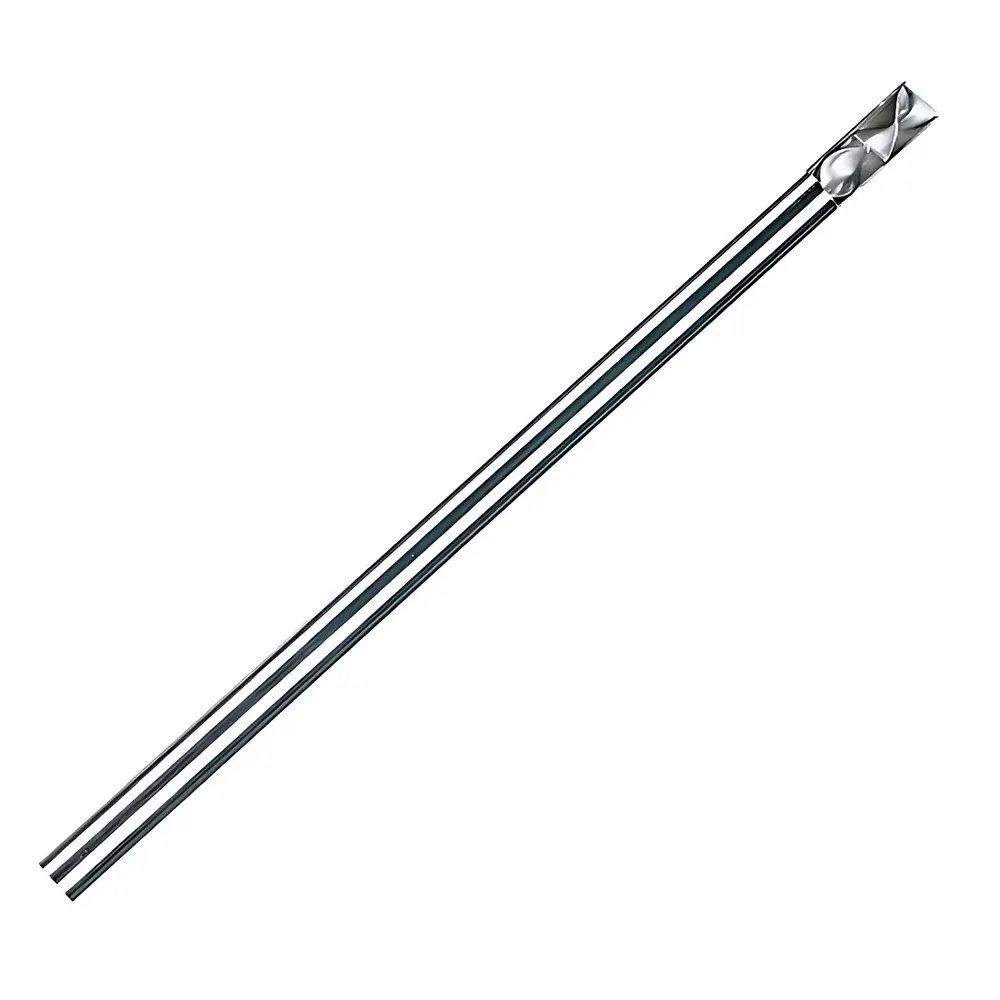
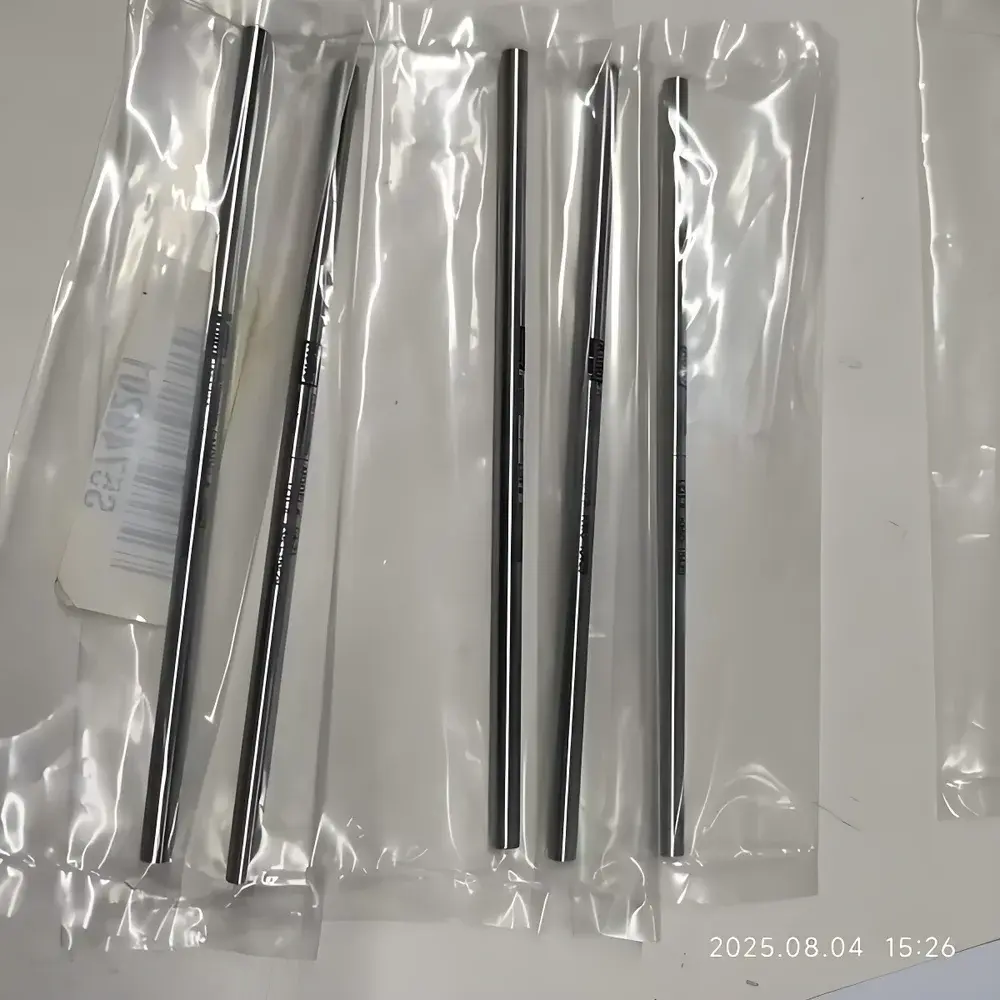
Koflo 316 Stainless Steel Tubular Static Mixer
| Brand | Koflo |
|---|---|
| Origin | USA |
| Model | 3/16-21 04669-52 |
| Material | ASTM A276 Type 316 Stainless Steel |
| Tube OD | 0.187 in (4.75 mm) |
| Tube ID | 0.132 in (3.35 mm) |
| Length | 6.0 in (152.4 mm) |
| Weight | 0.03 lb (13.6 g) |
| Max Working Pressure | 5000 PSI at 75°F (35°C) |
| Element Count | 21 |
| End Configuration | Plain (Square-Cut), Compatible with Standard Compression Fittings |
| Compliance | Designed for ISO 8502-4, ASTM D1200, and USP <1058> Analytical Instrument Qualification (AIQ) environments |
Overview
Koflo 316 Stainless Steel Tubular Static Mixers are precision-engineered passive mixing devices designed for continuous, in-line homogenization of high-viscosity, shear-sensitive, or chemically aggressive fluid streams. Unlike dynamic mixers requiring external power or moving parts, these static mixers operate on the principle of controlled laminar flow division, radial reorientation, and axial redistribution—achieved through a fixed helical geometry of alternating right- and left-handed elements welded into the tube wall. Constructed entirely from ASTM A276 Type 316 stainless steel, they deliver exceptional corrosion resistance, non-reactivity with epoxies, polyurethanes, adhesives, and solvent-based resins, and full compatibility with clean-in-place (CIP) and steam-in-place (SIP) protocols. Their compact, zero-maintenance architecture supports integration into pressurized fluidic systems up to 5000 PSI at ambient temperature, making them suitable for R&D scale-up, pilot-line validation, and GMP-compliant manufacturing workflows.
Key Features
- Fully passive operation—no motors, seals, or wear components; eliminates risk of contamination and downtime
- High-pressure rated construction: 5000 PSI maximum working pressure at 75°F (35°C), validated per ASME B31.3 process piping standards
- Consistent element count (21 helical elements) ensures repeatable residence time distribution (RTD) and coefficient of variation (CoV) <5% across batch-to-batch operations
- Plain-end configuration enables direct integration with Swagelok®-style compression fittings (e.g., SS-400 series), facilitating rapid installation and leak-tight connections without welding
- Surface finish: Ra ≤ 0.8 µm (electropolished option available per ASTM B912); supports USP Category II instrument qualification for regulated applications
- Thermal stability range: –40°F to +450°F (–40°C to +232°C), maintaining structural integrity under thermal cycling
Sample Compatibility & Compliance
This mixer is validated for use with Newtonian and non-Newtonian fluids exhibiting viscosities from 100 cP to >1,000,000 cP—including two-part epoxy systems, silicone elastomers, UV-curable acrylates, and pharmaceutical suspensions. Its 316 stainless steel composition meets FDA 21 CFR Part 113 and EU Regulation (EC) No. 1935/2004 requirements for food-contact and pharma-grade fluid handling. The device is compatible with IQ/OQ/PQ documentation frameworks and supports audit-ready traceability when paired with Koflo’s certified calibration reports (NIST-traceable dimensional verification). It conforms to ISO 8502-4 for surface cleanliness assessment and ASTM D1200 for viscosity measurement consistency in mixed resin formulations.
Software & Data Management
As a purely mechanical component, this static mixer does not incorporate embedded electronics or firmware. However, it is fully interoperable with third-party process monitoring systems—including Emerson DeltaV®, Honeywell Experion®, and Siemens Desigo CC—via integration into upstream/downstream pressure, temperature, and flow sensors. When deployed within a qualified analytical workflow, its performance parameters (e.g., pressure drop vs. flow rate curves, mixing efficiency metrics derived from inline NIR or Raman spectroscopy) can be logged, trended, and archived in compliance with 21 CFR Part 11 electronic record requirements. Koflo provides application-specific engineering support for defining critical quality attributes (CQAs) and establishing design space boundaries during Process Analytical Technology (PAT) implementation.
Applications
- In-line metering and mixing of dual-component adhesives prior to dispensing in automated assembly cells
- Homogenization of thermally stable polymer precursors in continuous-flow microreactor systems
- Pre-mixing of radiopaque contrast agents prior to sterile filtration in medical device manufacturing
- Blending of catalysts and crosslinkers into base resins for aerospace composite layup processes
- Continuous dilution and dispersion of nanomaterial suspensions in semiconductor slurry preparation lines
- Final-stage mixing of API-containing suspensions prior to vial filling in aseptic processing suites
FAQ
What is the recommended Reynolds number range for optimal mixing performance?
For this 3/16-inch model, laminar flow dominance (Re < 2000) is maintained across typical operating ranges; peak mixing efficiency occurs between Re = 100–800, consistent with Couette-type flow regimes in helical static mixers.
Can this mixer be sterilized using autoclave cycles?
Yes—Type 316 stainless steel withstands repeated exposure to saturated steam at 121°C for 30 minutes per ISO 17665-1; electropolished variants further reduce bioburden retention risk.
Is computational fluid dynamics (CFD) modeling data available for this geometry?
Koflo provides validated ANSYS Fluent® simulation datasets (including velocity vector fields, scalar concentration contours, and pressure loss coefficients) upon request for engineering due diligence and regulatory submission support.
How does element count correlate with mixing efficiency for high-viscosity fluids?
Empirical testing shows that 21 elements achieve ≥95% homogeneity (measured by fluorescence intensity variance) for 50,000 cP epoxy blends at 0.5 mL/min flow rate—exceeding the minimum requirement defined in ASTM D1200 Annex A4.
Are custom lengths or port configurations available?
Yes—Koflo offers OEM configuration services including laser-marked serialization, bespoke end finishes (e.g., VCR® or NPT), and ASME BPE-compliant sanitary versions upon formal engineering review.



