
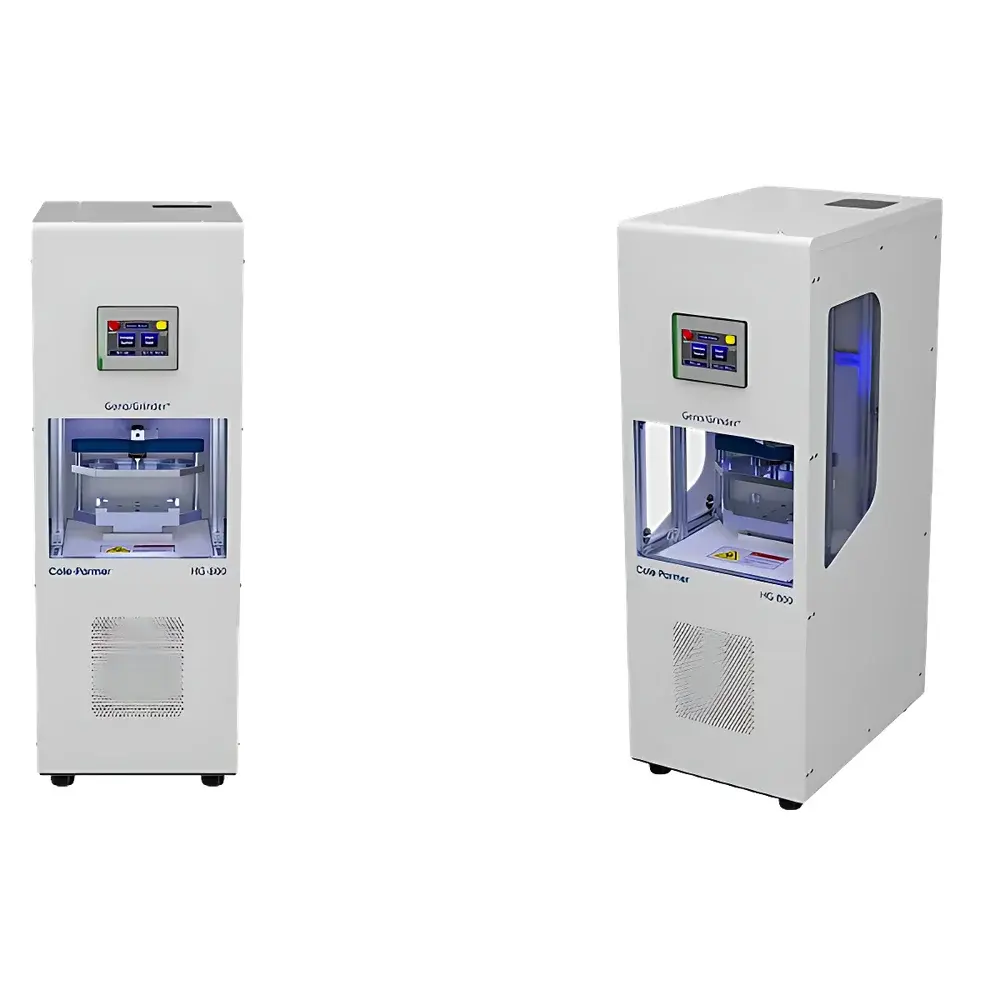
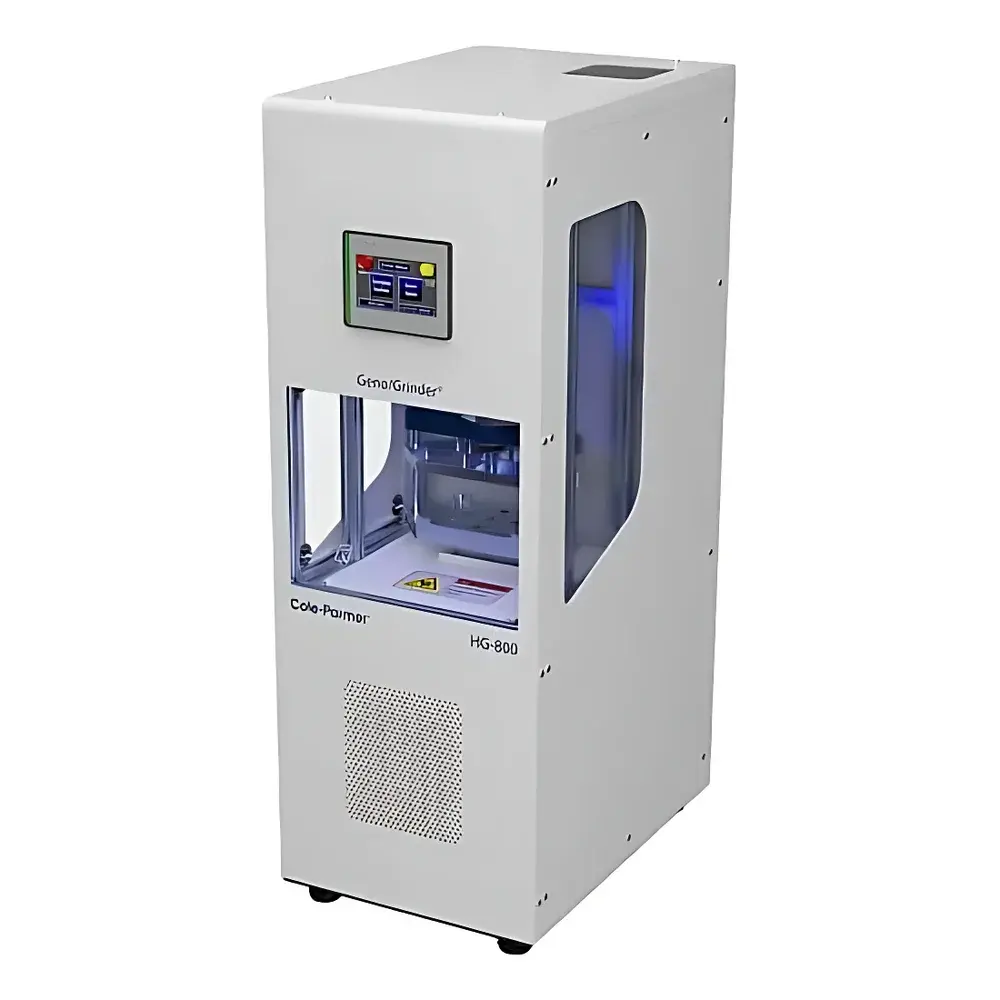
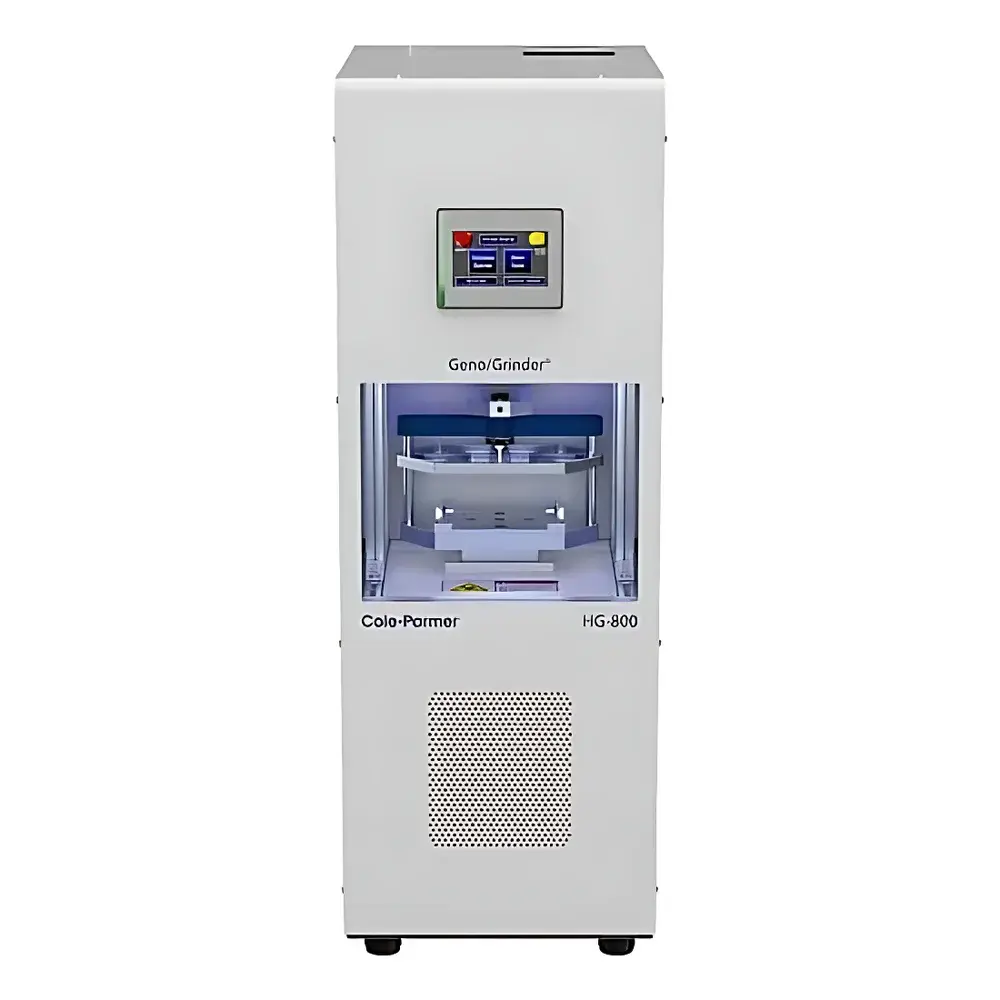
Cole-Parmer HG-800 Automated Tissue Grinder (Formerly Model 2030)
| Brand | Cole-Parmer |
|---|---|
| Origin | USA |
| Manufacturer Type | Authorized Distributor |
| Origin Category | Imported |
| Model | HG-800 |
| Price | Upon Request |
| Dimensions (L×D×H) | 33 × 47 × 92 cm |
| Weight | 58.51 kg |
| Power Supply | 230 V AC |
| Clamp Amplitude | 3.2 cm |
| Oscillation Frequency | 500–1750 cycles/min |
| Motion Type | Vertical reciprocating oscillation |
| Plate Capacity | One or two stacked 96-well plates or compatible grinding vessels (e.g., 2–750 mL tubes, SPE plates) |
| Cycle Time | ≤2 minutes per run |
Overview
The Cole-Parmer HG-800 Automated Tissue Grinder (formerly Spex Geno/Grinder Model 2030) is an industrial-grade, vertically oscillating high-throughput homogenization system engineered for unattended, reproducible mechanical lysis of biological samples. It operates on the principle of high-frequency vertical reciprocating motion—applying controlled kinetic energy to sample containers via steel, zirconia, or silica beads—to disrupt cellular and subcellular structures through bead-beating mechanics. Unlike manual mortar-and-pestle methods or low-throughput rotor-stator homogenizers, the HG-800 delivers scalable, contamination-minimized lysis across hundreds of samples per hour while maintaining sample integrity for downstream molecular applications. Its architecture supports integration into fully automated laboratory workflows via open RESTful API, enabling bidirectional communication with robotic arms for sample loading/unloading, plate staging, and process logging—making it a core module in modern GLP-compliant biobanking, clinical diagnostics, and agricultural genomics facilities.
Key Features
- Vertical reciprocating oscillation with adjustable frequency (500–1750 cycles/min) and fixed 3.2 cm amplitude for consistent mechanical energy transfer
- Simultaneous processing of one or two stacked standard 96-well microplates—or interchangeable fixtures for 2 mL to 750 mL tubes, SPE plates, and custom grinding vessels
- Open API interface compliant with common laboratory automation standards (e.g., ANSI/SLAS footprint protocols), enabling seamless integration with third-party robotic handlers (e.g., Hamilton STAR, Tecan Freedom EVO)
- Robust stainless-steel frame and vibration-dampened base designed for continuous operation in shared core facilities without transmission of resonance to adjacent instrumentation
- No internal refrigeration unit; compatible with optional cryogenic accessories—including liquid nitrogen–capable cold blocks and dry ice–compatible低温 modules—for temperature-sensitive nucleic acid or protein extraction
- Pre-configured method templates for common applications: DNA/RNA isolation, microbial lysis, yeast cell wall disruption, viral capsid release, and QuEChERS-based environmental residue extraction
Sample Compatibility & Compliance
The HG-800 accommodates a broad spectrum of sample matrices—including fresh/frozen animal tissues, plant leaves and seeds, cultured cells, bacterial pellets, fungal mycelia, and clinical specimens (e.g., blood clots, FFPE sections). It supports both wet and dry grinding protocols using validated consumables: stainless-steel beads (1.0–6.0 mm), yttria-stabilized zirconia (YSZ) beads (0.1–2.0 mm), silica glass beads, and ceramic grinding columns optimized for QuEChERS workflows. All hardware and firmware comply with IEC 61000-6-2 (EMC immunity) and IEC 61000-6-4 (EMC emission) standards. While not FDA-cleared as a medical device, the system meets ISO 13485-aligned design controls for research-use-only (RUO) instrumentation and supports audit-ready electronic records when paired with 21 CFR Part 11–compliant LIMS or ELN platforms.
Software & Data Management
The HG-800 operates via embedded microcontroller firmware with local touchscreen interface for immediate method execution. For integrated environments, its REST API exposes endpoints for run initiation, status polling, cycle count logging, and error reporting—including thermal anomaly detection and clamp misalignment alerts. Method parameters (frequency, duration, pause intervals, plate orientation) are stored in JSON format and can be version-controlled alongside SOP documentation. When deployed in regulated settings, raw execution logs—including timestamped start/stop events, motor current draw profiles, and user authentication IDs—are exportable in CSV or XML for inclusion in GxP audit trails. No proprietary cloud service is required; all data remains on-premises unless explicitly routed through customer-managed middleware.
Applications
- High-throughput genomic DNA and total RNA extraction from mammalian tissues prior to qPCR, NGS library prep, or microarray analysis
- Rapid lysis of Gram-positive bacteria (e.g., Staphylococcus aureus, Bacillus subtilis) and yeast (e.g., Saccharomyces cerevisiae) for metagenomic profiling
- Homogenization of fibrous plant material (e.g., maize kernels, soybean roots) for metabolite extraction and pesticide residue analysis per AOAC 2007.01 and EN 15662
- Preparation of viral lysates from clinical swabs or cell culture supernatants for RT-qPCR-based pathogen detection
- Protein extraction under denaturing conditions for western blotting or mass spectrometry—particularly for membrane-bound or aggregated targets requiring mechanical shearing
- Support of ISO/IEC 17025-accredited environmental testing labs performing soil and sediment analysis per EPA Method 3545A (accelerated solvent extraction prep)
FAQ
Does the HG-800 include built-in cooling?
No—the HG-800 is a room-temperature-only platform. Cryopreservation requires external accessories: liquid nitrogen–compatible cold blocks or dry ice–rated低温 modules, both sold separately.
Can the HG-800 process 384-well plates?
Not natively. It is engineered for 96-well formats and tube-based vessels. Custom fixture adaptation for 384-well plates is not supported by Cole-Parmer and may compromise mechanical stability or reproducibility.
Is validation documentation available for GMP environments?
Yes—IQ/OQ protocol templates, calibration certificates for frequency control, and mechanical performance verification reports are provided upon request for qualified customers. PQ must be conducted in situ per organizational SOPs.
What maintenance is required?
Annual inspection of drive belt tension, clamp alignment, and motor brush wear is recommended. No routine lubrication is required; all bearings are sealed for life.
How does the HG-800 differ from the HG-600 (Geno/Grinder 2010)?
The HG-800 adds full robotic integration capability (API + physical I/O ports), dual-plate stacking support, enhanced vibration isolation, and firmware-level audit logging—while retaining identical oscillation kinematics and consumable compatibility.



