
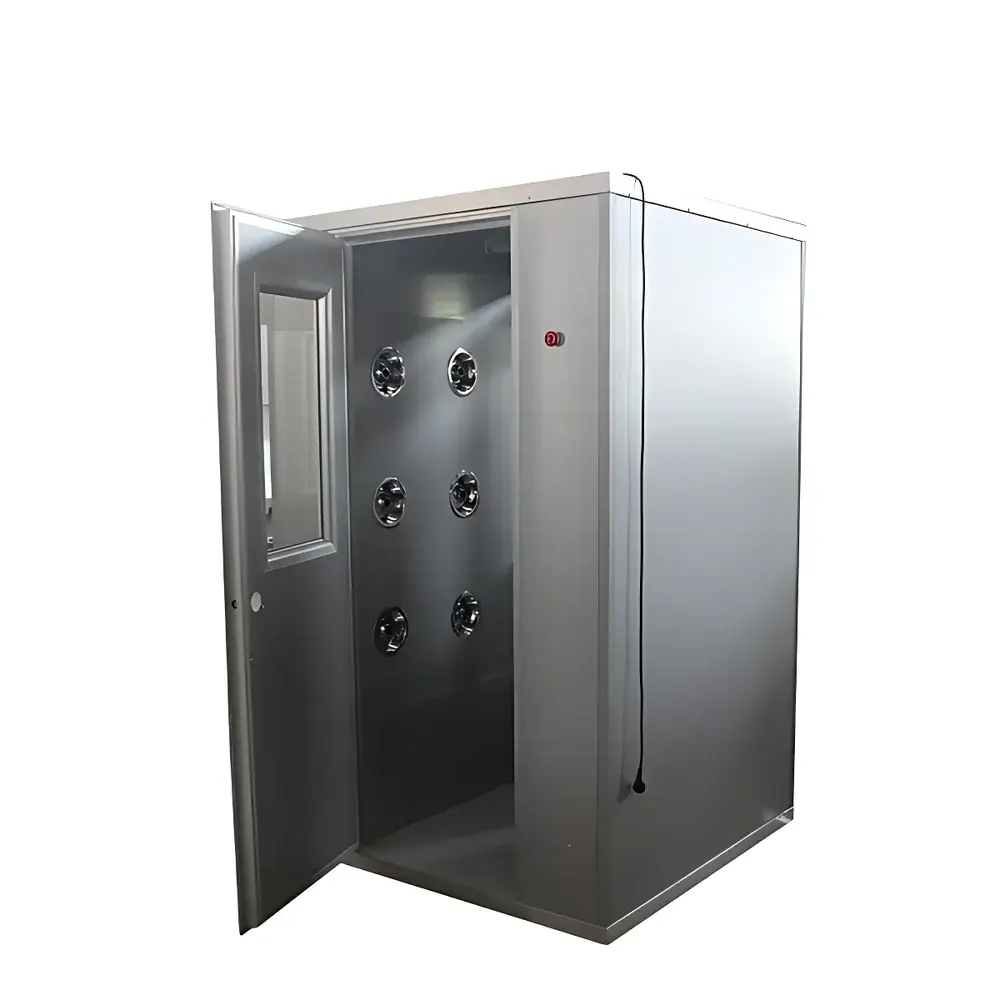
Shanghai Hujing FLB-3600 Triple-Person Dual-Blow Air Shower
| Brand | Hujing Purification (HJ) |
|---|---|
| Origin | Shanghai, China |
| Manufacturer Type | OEM Manufacturer |
| Region of Origin | Domestic (China) |
| Model | FLB-3600 |
| Price | USD 2,500 (FOB Shanghai) |
| Filter Efficiency | ≥99.7% @ ≥0.5 µm (Sodium Flame Test) |
| Interlock Option | Available |
| Control Interface | LCD Panel with Infrared Sensor, Voice Prompt & Timer |
| Blowing Duration | 0–99 s (adjustable) |
| Nozzle Count | 48 |
| Nozzle Diameter | Φ30 mm |
| Air Velocity at Nozzle | 15–20 m/s |
| Power Supply | AC 220 V, 50 Hz, Single Phase |
| Max. Power Consumption | 3,000 W |
| Personnel Capacity | 3 persons simultaneously |
| Internal Chamber Dimensions (W×D×H) | 700 × 3600 × 1900 mm |
| External Dimensions (W×D×H) | 1300 × 3600 × 2050 mm |
| Construction Material | Prefinished Color-Coated Steel Panels (Standard) |
| Installation Type | Integral Unit (for compact site integration) |
Overview
The Shanghai Hujing FLB-3600 Triple-Person Dual-Blow Air Shower is an engineered entry-level personnel airlock system designed for controlled transition between non-classified and ISO Class 5–8 cleanroom environments. It operates on the principle of high-velocity, HEPA-filtered laminar airflow directed tangentially across personnel surfaces to dislodge and remove airborne particulates ≥0.5 µm—primarily skin flakes, textile fibers, and ambient dust—before entry into critical processing zones. Unlike single-blow configurations, the FLB-3600 employs two opposing banks of nozzles (24 per side), enabling simultaneous frontal and dorsal decontamination without requiring user rotation. Its integral structural design eliminates field-assembled joints that may compromise gasket integrity or airflow uniformity—a common failure point in modular units. The unit complies with fundamental cleanroom behavioral protocols defined in ISO 14644-3 Annex B and supports facility compliance with GMP Annex 1 (2022) requirements for personnel gowning and airlock validation.
Key Features
- Dual-bank nozzle array (48 total, Φ30 mm stainless steel) delivering 15–20 m/s laminar airflow with ≥99.7% filtration efficiency at 0.5 µm (validated per sodium flame test per ISO 14644-3)
- Intelligent infrared presence detection with zero-contact activation—eliminates mechanical wear and cross-contamination risk from push-button interfaces
- Programmable blow time (0–99 seconds) via backlit LCD control panel, supporting process-specific dwell durations aligned with particle shedding kinetics
- Voice-guided operational feedback (English language default) confirming cycle start, duration countdown, and completion—critical for multilingual cleanroom staff
- Integral construction with pre-finished color-coated steel housing (standard); optional electropolished stainless steel cladding available for pharmaceutical wet-process areas
- Factory-configured interlock interface compatible with door position sensors and PLC-based cleanroom monitoring systems (e.g., Siemens Desigo, Honeywell Experion)
- Compact external footprint (1300 × 3600 × 2050 mm) optimized for retrofit installation in existing corridor layouts without structural modification
Sample Compatibility & Compliance
The FLB-3600 is not intended for material or equipment decontamination; it is certified exclusively for personnel ingress/egress. Its validated performance applies only to human subjects wearing standard cleanroom garments (e.g., bouffant caps, coveralls, boot covers). The unit does not meet ISO 14644-7 requirements for “air shower for equipment” due to lack of internal turntable or extended dwell-time programming. Regulatory alignment includes support for FDA 21 CFR Part 211 Subpart C (personnel hygiene controls), EU GMP Annex 1 §5.32 (airlock functionality), and ISO 14644-1:2015 Class 5–8 transitional zone specifications. Optional audit-trail logging modules (via RS485/Modbus RTU) enable traceability of cycle timestamps and duration settings for GLP/GMP documentation.
Software & Data Management
The embedded microcontroller firmware (v3.2+) provides non-volatile storage of up to 10,000 cycle logs, including timestamp, duration setting, and sensor activation status. Data export is supported via USB-C port (CSV format) for integration into LIMS or MES platforms. Remote parameter adjustment requires physical access—no cloud connectivity or Wi-Fi interface is implemented, preserving network isolation per IEC 62443-3-3 security guidelines. Firmware updates are performed offline using signed binary files delivered on encrypted USB drives, ensuring integrity verification prior to installation.
Applications
- Microelectronics fabrication facilities requiring ISO Class 5 gowning checkpoints prior to photolithography bays
- Biopharmaceutical aseptic filling suites where operator particulate shedding must be minimized before Grade A/B barrier entry
- Medical device cleanrooms (ISO 13485-certified) performing final assembly of implantables
- Research laboratories operating under NIH biosafety level 2+ containment protocols
- Food-grade packaging lines subject to SQF Edition 9 Section 9.5.2 airlock validation requirements
FAQ
Does the FLB-3600 comply with FDA 21 CFR Part 11 for electronic records?
No—the unit does not generate or store regulated electronic records. Cycle logs are considered operational metadata, not audit-relevant data; full Part 11 compliance requires integration with a validated third-party SCADA or MES system.
Can the unit be installed in an ISO Class 4 environment?
Not recommended. The FLB-3600’s internal airflow uniformity and recovery time have not been validated below ISO Class 5. Use in higher-grade spaces requires supplemental localized laminar flow hoods and formal requalification.
Is HEPA filter replacement documented in the manual?
Yes—Section 4.2 specifies filter change intervals (12 months nominal, or after 6,000 operational hours), pressure differential alarm thresholds (≥250 Pa), and certification requirements for replacement filters (EN 1822-1:2019 H13 class).
What is the maximum ambient temperature rating for continuous operation?
40 °C ambient, per IEC 60068-2-2. Operation above this threshold requires derating of fan speed and may reduce filter service life by up to 40%.



