
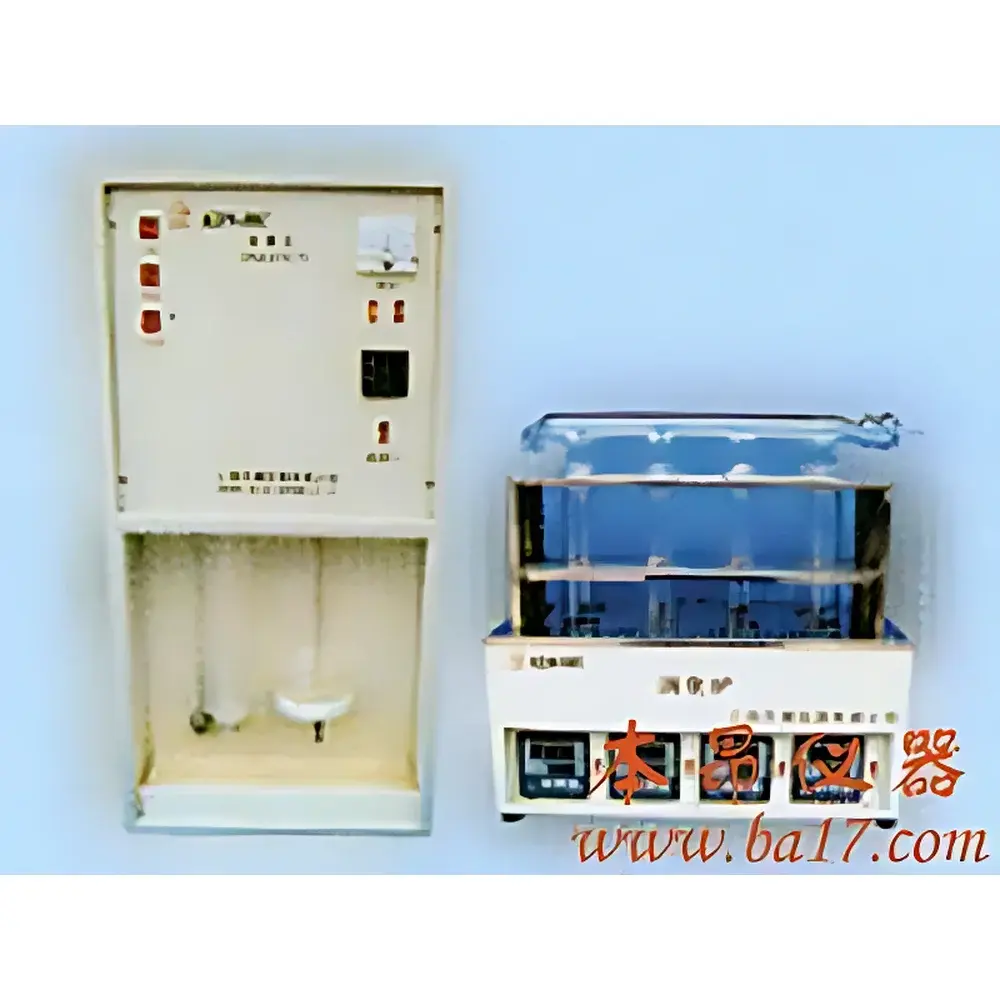
KDN-08C Kjeldahl Nitrogen Determinator
| Origin | Shanghai, China |
|---|---|
| Manufacturer Type | Authorized Distributor |
| Origin Category | Domestic (PRC) |
| Model | KDN-08C |
| Price | USD 1,280 (FOB Shanghai) |
| Sample Throughput | 8 samples per digestion cycle |
| Digestion Time | ~40 min (typical for organic matrices) |
| Nitrogen Range | 0.02–95% w/w (or 0.1–200 mg N per sample) |
| Power Supply | AC 220 V, 50 Hz |
| Digestion Unit Power | 2400 W |
| Distillation Unit Power | 800 W |
| Dimensions (Digestion Unit) | 730 × 300 × 150 mm |
| Dimensions (Distillation Unit) | 380 × 330 × 820 mm |
| Construction | Corrosion-resistant ABS baseplate (distiller), stainless steel and high-temp ceramic insulation (digestion block) |
| Safety Features | Integrated fume extraction via water-trap pump system |
| Control Interface | Digital LED temperature display & timer (digestion) |
Overview
The KDN-08C Kjeldahl Nitrogen Determinator is a benchtop dual-unit system engineered for reliable, standardized total nitrogen quantification in accordance with AOAC 984.27, ISO 8968-1, and ASTM D1122 methodologies. It implements the classical Kjeldahl principle—acid digestion followed by alkaline distillation and titrimetric or colorimetric detection—to convert organic nitrogen into ammonium sulfate, liberate ammonia under controlled alkaline conditions, and trap it quantitatively in boric acid solution. Designed for routine QC/QA laboratories in food, feed, agricultural, environmental, and pharmaceutical sectors, the KDN-08C delivers reproducible results across heterogeneous sample matrices without requiring inert gas purging or external fume hoods.
Key Features
- Integrated 8-position digestion unit with well-type electric heating architecture—optimized thermal coupling ensures uniform heat transfer to digestion tubes, reducing typical digestion time to approximately 40 minutes for standard biological samples (e.g., cereals, soybean meal, dairy powders).
- Digital temperature control (LED display) with ±2 °C stability over 0–450 °C range; programmable ramp-and-hold profiles support method-specific thermal protocols.
- On-board fume management system: SO₂, NOₓ, and H₂S generated during digestion are drawn through a dedicated exhaust port, passed through a water-seal trap, and discharged to municipal drainage—eliminating need for ducted ventilation or external scrubbers.
- Distillation unit equipped with automatic water-level sensing, self-regulating steam generation, and adjustable distillation timing (0–60 min), ensuring consistent steam flow and complete ammonia transfer.
- Chemically resistant ABS baseplate and sealed electrical compartments prevent corrosion from condensate and alkali splashes; all wetted parts comply with USP Class VI and FDA 21 CFR 177.2400 material requirements.
Sample Compatibility & Compliance
The KDN-08C accommodates solid, semi-solid, and liquid samples within defined mass/volume limits: 0.1–2.0 g solids or 1–10 mL liquids per digestion tube. Validated applications include cereal grains (AOAC 991.20), animal feed (ISO 5983-1), milk powder (ISO 8968-1), soil extracts (EPA Method 350.1), and pharmaceutical excipients (USP ). All operational parameters—including digestion temperature ramping, alkali addition volume, steam duration, and condensate collection volume—are configurable to meet GLP documentation requirements. The system supports audit-ready operation when paired with compliant titration workstations (e.g., Metrohm 809 Titrando) and meets mechanical safety standards IEC 61010-1 and electromagnetic compatibility EN 61326-1.
Software & Data Management
While the KDN-08C operates as a standalone hardware platform with manual endpoint detection (titration or photometric), its timed and temperature-stamped operational logs—recorded via front-panel digital displays—can be transcribed into LIMS-compatible spreadsheets or integrated into validated laboratory informatics systems (e.g., LabWare LIMS, Thermo Fisher SampleManager) using CSV export protocols. Optional RS-232/USB interface modules enable automated data capture of digestion start/stop times, peak temperature events, and distillation duration—supporting 21 CFR Part 11-compliant electronic records when deployed with appropriate audit trail configuration and user access controls.
Applications
- Protein content estimation in food and feed via nitrogen-to-protein conversion factors (e.g., 6.25 for cereals, 5.70 for wheat gluten, 6.38 for dairy).
- Regulatory compliance testing for crude protein labeling under FDA 21 CFR 101.9 and EU Regulation (EC) No 1169/2011.
- Soil fertility assessment and fertilizer efficiency studies per ISO 11261 and USDA NRCS methods.
- Pharmaceutical raw material qualification where nitrogen content serves as identity or purity indicator (e.g., gelatin, casein, amino acid blends).
- Environmental monitoring of wastewater sludge and composted biosolids per APHA Standard Methods 4500-Norg.
FAQ
What sample types require pre-dilution or homogenization prior to digestion?
Liquid samples with high sugar or fat content (e.g., fruit juices, cream) should be diluted 1:2 with deionized water to prevent frothing and bumping. Solid samples exceeding 1.5 g or containing >15% fat must be ground to ≤0.5 mm particle size and mixed thoroughly before weighing.
Is the KDN-08C compatible with automated titration systems?
Yes—the distillate output is delivered at standard 10–15 mL/min flow rate into 250 mL Erlenmeyer flasks or autosampler cups; compatibility confirmed with Metrohm 809/905 Titrando, Hanna HI84532, and TitraLab AT1000 series.
Can digestion temperature profiles be saved and recalled?
No—the unit features fixed-setpoint digital control only; multi-step ramp programming requires external PID controllers or upgraded models (e.g., KDN-20C with microprocessor-based module).
What maintenance intervals are recommended for the water-trap fume system?
The water trap reservoir should be emptied and rinsed daily; the silicone tubing connecting the digestion unit to the trap must be inspected weekly for swelling or cracking and replaced every 6 months under continuous use.
Does the system meet ISO/IEC 17025 calibration traceability requirements?
Yes—temperature sensors are factory-calibrated against NIST-traceable reference thermocouples (Type K, ±0.5 °C accuracy); users may perform in-house verification using calibrated dry-block calibrators per ISO/IEC 17025 Clause 6.4.6.





