
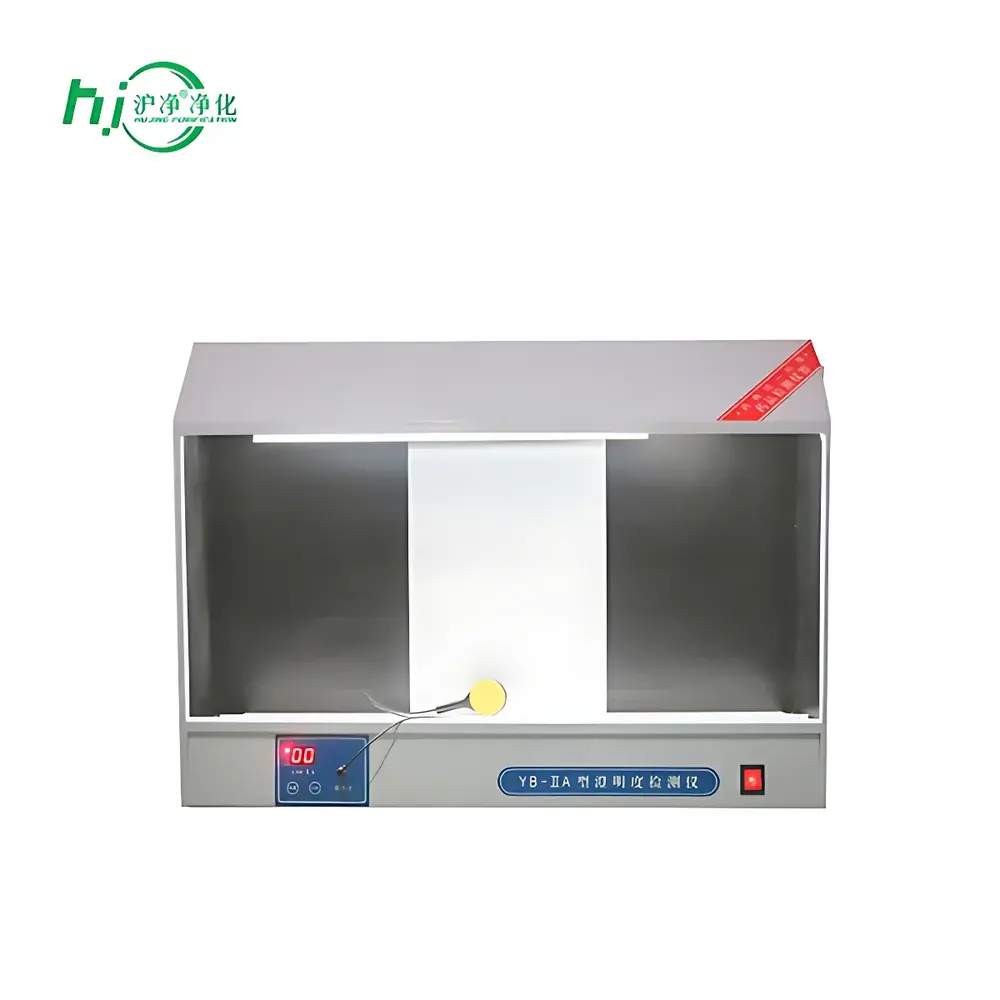
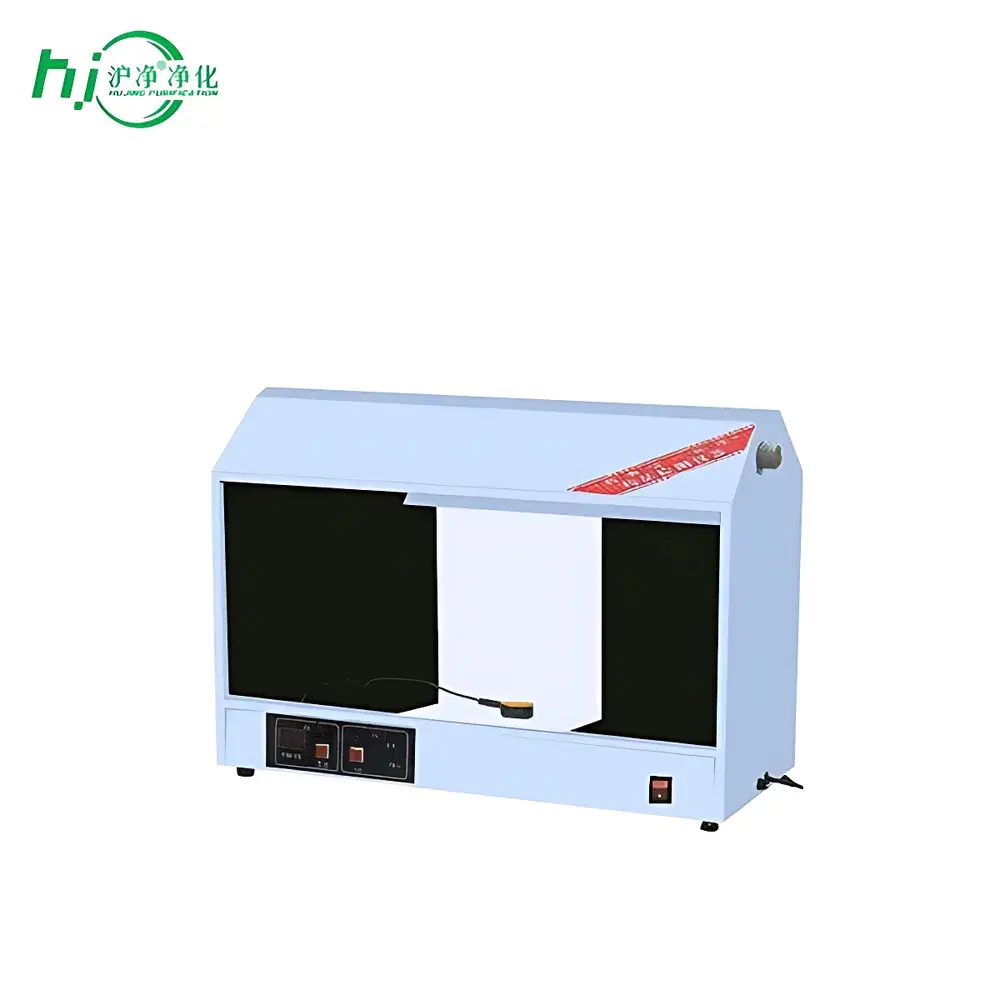
HJ YB-2/YB-3 Pharmaceutical Clarity Tester
| Brand | HJ Purification |
|---|---|
| Origin | Shanghai, China |
| Manufacturer Type | Direct Manufacturer |
| Country of Origin | China |
| Model | YB-2 / YB-3 |
| Power Consumption | 20 W (YB-2) / 22 W (YB-3) |
| Light Source | 20 W A-grade pharmaceutical-grade tri-phosphor fluorescent lamp with electronic ballast |
| Illuminance Range | 1000–6000 lx |
| Timing Range | 1–99 s (adjustable) |
| Dimensions (YB-2) | 703 mm × 175 mm × 513 mm |
| Dimensions (YB-3) | 703 mm × 345 mm × 513 mm |
| Weight (YB-3) | ~25 kg |
| Compliance | Designed for USP <790>, EP 2.9.20, and ChP Appendix XIX F (Clarity of Solutions) |
| Control System | Integrated microcontroller-based digital control |
| Illuminance Calibration | User-accessible calibration via external standard lux meter |
| Detection Surface | Extended white diffusing plate (dual-side illumination for YB-3) |
| Visual Ergonomics | Flicker-free optical path, adjustable illuminance, integrated audio-visual alarm |
| Display | Digital lux readout with real-time stability indication |
Overview
The HJ YB-2 and YB-3 Pharmaceutical Clarity Testers are precision-engineered instruments designed to assess the visual clarity of parenteral solutions, ophthalmic preparations, and other transparent liquid pharmaceuticals in accordance with internationally recognized pharmacopoeial standards—including United States Pharmacopeia , European Pharmacopoeia 2.9.20, and Chinese Pharmacopoeia Appendix XIX F. These devices operate on the principle of controlled transmitted-light inspection under standardized illuminance conditions, enabling trained observers to detect suspended particles or turbidity that exceed permissible thresholds. Unlike conventional visual inspection systems relying on mechanical timers and analog controls, the YB-2/YB-3 series employs a fully digitized control architecture—eliminating mechanical dials and integrating solid-state timing, real-time illuminance monitoring, and programmable exposure duration. The optical system is optimized to minimize photopic fatigue during prolonged QC workflows, incorporating flicker-free illumination, adjustable brightness within the pharmacopoeia-specified range (1000–6000 lx), and a high-diffusion white background plate engineered for uniform luminance distribution across both single- and dual-vial configurations.
Key Features
- Digital microcontroller-based operation with full electronic (YB-2) or capacitive touch (YB-3) interface—no moving parts, no mechanical timer degradation
- User-accessible illuminance calibration protocol compliant with ISO/IEC 17025 traceability requirements; enables verification and adjustment using an externally certified lux meter
- Extended white diffusing plate (standard on YB-3, optional upgrade for YB-2) supporting side-by-side evaluation of IV bags or multiple vials under identical optical conditions
- A-grade pharmaceutical tri-phosphor fluorescent lamps with electronic ballasts—rated for ≥12,000 hours service life, delivering stable chromaticity (CCT ≈ 4000 K) and minimal UV emission per ICH Q5C guidelines
- Flicker-free optical path achieved via regulated DC-powered lamp drivers and optimized reflector geometry—reducing observer visual fatigue during extended batch testing
- Integrated digital lux meter with ±3% accuracy (calibrated at 2000 lx and 4000 lx reference points), displaying real-time illuminance during setup and verification
- Configurable exposure time (1–99 seconds) with audible beep and LED indicator upon completion—supports SOP-driven manual inspection protocols
Sample Compatibility & Compliance
The YB-2/YB-3 accommodates standard pharmaceutical containers including 2–25 mL ampoules, 5–100 mL vials, and polyolefin IV bags (up to 1000 mL) placed upright on the illuminated stage. Dual-side illumination (YB-3 only) permits simultaneous front/back assessment without repositioning—critical for detecting low-contrast particulates in high-viscosity or colored solutions. All operational parameters align with regulatory expectations for visual particle inspection: illuminance uniformity ≥85% across the viewing area (measured per ASTM E308-22), spectral power distribution matching CIE Standard Illuminant D65 (±15% in 400–700 nm band), and temporal stability <±2% over 30-minute continuous operation. The instrument’s design supports GLP-compliant documentation workflows, with timestamped calibration logs and operator ID fields configurable in associated QC software (when interfaced via RS-232).
Software & Data Management
While the YB-2/YB-3 operate as standalone hardware units, they feature RS-232 serial output for integration with laboratory information management systems (LIMS) or custom QC databases. The communication protocol transmits calibrated illuminance values, elapsed test time, pass/fail status (via external footswitch or manual input), and instrument identification—enabling automated audit trails required under FDA 21 CFR Part 11 for electronic records. Optional firmware updates provide enhanced data logging intervals and CSV export capability. No proprietary software is bundled; instead, the device adheres to industry-standard ASCII-based command sets compatible with LabVIEW, Python pySerial, or Excel VBA automation frameworks—ensuring long-term interoperability and avoiding vendor lock-in.
Applications
- Final container inspection of sterile injectables (e.g., monoclonal antibodies, small-molecule APIs in saline/glucose vehicles)
- Stability study assessments tracking clarity changes across accelerated and real-time storage conditions
- In-process quality checks during filtration validation and final fill operations
- Training and qualification of visual inspectors per PDA Technical Report No. 29 (Visual Inspection of Parenterals)
- Method transfer between QC labs where standardized illuminance and timing are critical for inter-site comparability
- Supporting root cause analysis of particulate contamination incidents through repeatable, documented inspection parameters
FAQ
Does the YB-3 support dual-vial inspection simultaneously?
Yes—the extended 345 mm width and dual-sided illumination allow two standard 20 mL vials or one 1000 mL IV bag to be assessed under identical optical conditions without repositioning.
Can the illuminance calibration be performed in-house without third-party service?
Yes—users may perform field calibration using any NIST-traceable lux meter; the procedure is documented in the operator manual and requires no tools or disassembly.
Is the lamp spectral output compliant with pharmacopoeial requirements for color rendering?
Yes—the A-grade tri-phosphor lamp delivers CRI ≥85 and CCT 4000±200 K, satisfying USP and EP 2.9.20 spectral recommendations for particle detection sensitivity.
What electrical safety certifications does the instrument carry?
The YB-2/YB-3 comply with GB 4793.1-2019 (equivalent to IEC 61010-1:2010) for laboratory electrical equipment, including dielectric strength, leakage current, and protective earth continuity testing.
How is compliance with 21 CFR Part 11 ensured during data export?
When connected to validated LIMS or ELN systems, the RS-232 output provides immutable timestamps and operator identifiers; full Part 11 compliance depends on the receiving system’s audit trail and electronic signature implementation.





