
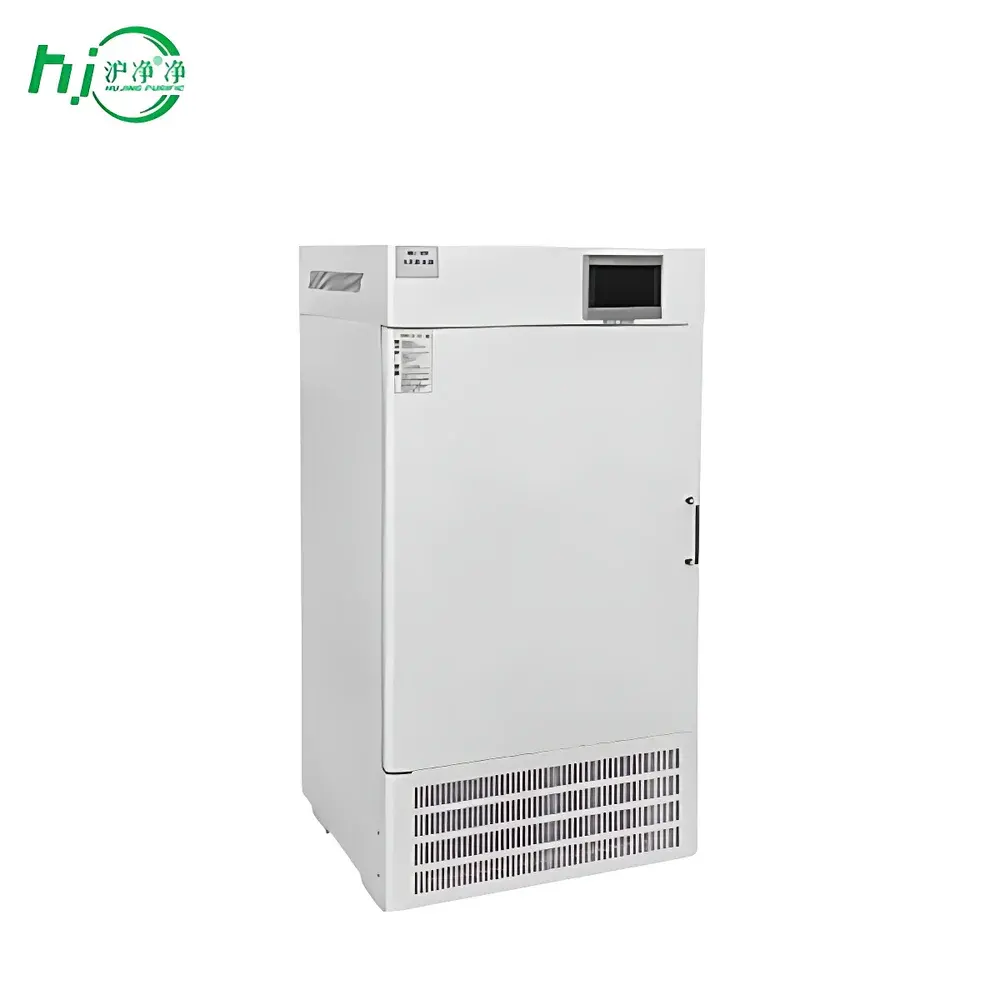
HJ FX-CO2 Series CO₂ Incubator Shaker
| Brand | HJ Purification |
|---|---|
| Origin | Zhejiang, China |
| Manufacturer Type | Direct Manufacturer |
| Instrument Type | CO₂ Incubator Shaker |
| Model | FX-CO2 Series (e.g., FX-1102C(CO₂), FX-2102C(CO₂)) |
| Temperature Control Range | 4–60 °C |
| CO₂ Concentration Range | 0–20% (v/v) |
| CO₂ Recovery Time | ≤1.2 × setpoint (min) |
| Rotation Frequency | 30–300 rpm |
| Speed Accuracy | ±1 rpm |
| Orbit Diameter | φ26 mm |
| Temperature Uniformity | ±1 °C |
| Temperature Resolution | 0.1 °C |
| Temp. Fluctuation | ±0.1 °C |
| Display | 7-inch TFT touch screen |
| Refrigeration | Compressor-based with auto-defrost |
| Power Supply | AC 220 V, 50 Hz |
| Input Power | 800–1300 W |
| Chamber Volume | 208–350 L |
| Internal Dimensions (W×D×H) | 580×480×750 mm to 880×530×750 mm |
| External Dimensions (W×D×H) | 840×750×1250 mm to 950×700×1600 mm |
| Net Weight | 150–240 kg |
| Timer Range | 0–999 h |
| Compliance | CE-marked for export to EU |
| Interface | RS-485 port for PC connectivity and remote monitoring |
Overview
The HJ FX-CO2 Series CO₂ Incubator Shaker is an integrated benchtop platform engineered for simultaneous temperature control, CO₂ regulation, and orbital shaking—designed specifically for mammalian cell culture, suspension bioreactor development, hybridoma expansion, and CO₂-dependent biochemical assays. Unlike conventional incubators or shakers used in isolation, this instrument employs a dual-chamber architecture with independent PID-controlled refrigeration and gas blending systems to maintain precise environmental conditions during dynamic agitation. The system operates on the principle of forced convection air circulation combined with electrochemical CO₂ sensing and proportional solenoid valve actuation, enabling stable CO₂ concentration maintenance across varying ambient temperatures and load conditions. Its compressor-based cooling system features automatic defrost cycling—a critical function often omitted in entry-level units—to prevent evaporator icing and ensure long-term thermal stability. This design supports uninterrupted operation over extended cultivation periods, meeting core requirements for GLP-compliant cell banking, monoclonal antibody production, and stem cell differentiation studies.
Key Features
- Integrated incubation and orbital shaking in a single compact footprint—eliminates need for separate CO₂ incubators and shakers, reducing lab space and cross-contamination risk.
- 7-inch high-resolution TFT capacitive touch screen with intuitive menu navigation, real-time parameter visualization (temperature, CO₂ %, rpm, time remaining), and multi-segment programmable scheduling (up to 10 user-defined stages).
- High-fidelity CO₂ control using imported Finnish electrochemical sensors (±0.1% accuracy), microprocessor-driven PID algorithm, and fail-safe alarm logic for over-concentration, slow-rise detection, and gas supply interruption.
- Stainless steel 304 interior chamber with electropolished trays, spring-loaded clamps, and removable platforms—resistant to corrosion, compatible with alcohol and mild alkaline decontamination protocols.
- Brushless AC induction motor with constant torque delivery across full speed range (30–300 rpm); soft-start acceleration profile minimizes shear stress on sensitive cells and prevents flask slippage.
- Compressor cooling system with adaptive defrost cycle, startup delay protection, and ambient-independent temperature control (4–60 °C), ensuring reproducible performance regardless of room temperature fluctuations.
- Comprehensive safety architecture: independent over-temperature cut-off, door-open interlock shutdown, power-loss recovery, sensor fault diagnostics, current overload protection, and UV sterilization lamp with timer.
Sample Compatibility & Compliance
The FX-CO2 Series accommodates standard culture vessels including Erlenmeyer flasks (100–1000 mL), roller bottles, multi-well plates, and custom bioreactor bags via configurable tray layouts. Its uniform airflow distribution and low-vibration mechanical design support high-density suspension cultures without foaming or pellet disruption. The unit complies with IEC 61010-1:2010 for electrical safety in laboratory environments and carries CE marking for unrestricted placement in EU research facilities. While not certified under FDA 21 CFR Part 11, its RS-485 interface enables integration into validated data acquisition systems supporting ALCOA+ principles. The built-in audit trail functionality—including timestamped event logging for alarms, parameter changes, and door openings—facilitates adherence to ISO/IEC 17025 and GLP documentation standards.
Software & Data Management
Data handling is facilitated through a local embedded controller with non-volatile memory storing up to 10,000 historical records (temperature, CO₂, rpm, alarms). The RS-485 serial interface supports Modbus RTU protocol for connection to third-party SCADA or LIMS platforms. Optional software packages enable remote configuration, real-time graphing, CSV export, and automated report generation. All parameter modifications are subject to password protection, and calibration offsets (temperature, CO₂) can be applied independently per sensor channel—ensuring traceability during instrument qualification (IQ/OQ/PQ). Firmware updates are performed via USB drive, preserving user settings and log history.
Applications
This instrument serves as a primary tool in academic and industrial life science workflows requiring controlled gaseous and thermal environments during agitation. Typical use cases include: transient transfection of HEK293 and CHO-S cells; serum-free adaptation of hybridoma lines; microbial co-culture under defined pH/CO₂ conditions; enzymatic kinetic assays sensitive to carbonate buffering; and organoid maturation protocols requiring rhythmic mechanical stimulation. It is also employed in food microbiology labs for accelerated shelf-life modeling and in environmental toxicology for algal growth rate assessments under elevated CO₂ scenarios.
FAQ
Does the FX-CO2 Series support validation documentation for GMP environments?
Yes—while the base unit is not pre-certified for GMP, it provides all necessary technical specifications, calibration traceability options, and electronic record capabilities required for user-led IQ/OQ/PQ execution.
Can CO₂ concentration be maintained while operating at 4 °C?
No—CO₂ control is disabled below 15 °C to prevent condensation-related sensor drift and inaccurate readings; temperature-only mode is active in that range.
Is the UV lamp intensity calibrated or serviceable?
The UV-C lamp (254 nm) includes a fixed-intensity emitter with 10,000-hour rated lifetime; no field recalibration is supported, but replacement modules are available through HJ authorized distributors.
What is the maximum allowable ambient temperature for continuous operation?
The specified operating ambient range is 5–40 °C; sustained exposure above 35 °C may reduce compressor duty cycle efficiency and extend CO₂ recovery times.
Are third-party flask clamps compatible with the standard trays?
Yes—the 500 × 350 mm and 740 × 460 mm trays follow ISO 8573-1 mounting conventions; users may install DIN-standard universal clamps or custom fixtures using M4 threaded inserts.




