
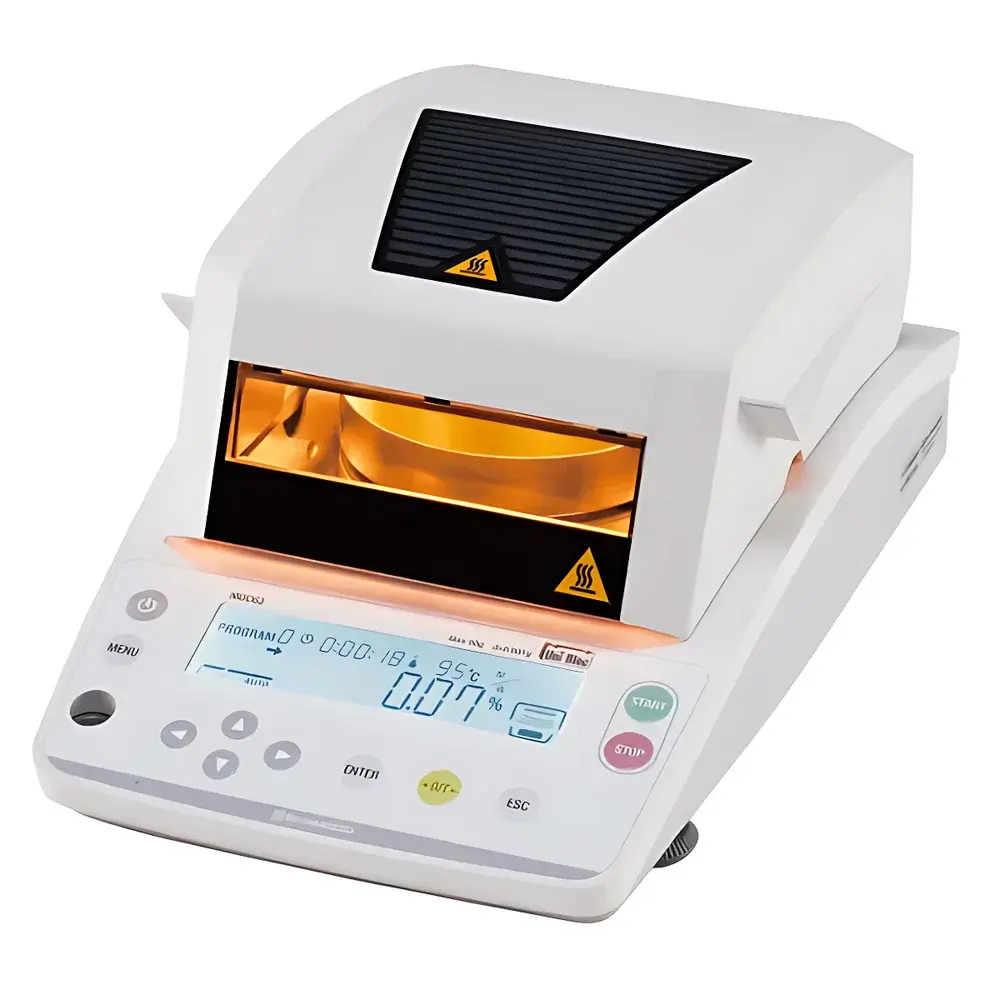
Shimadzu MOC63u Halogen Moisture Analyzer
| Brand | Shimadzu |
|---|---|
| Origin | Japan |
| Model | MOC63u |
| Heating Source | Halogen Lamp |
| Maximum Capacity | 60 g |
| Minimum Display | 0.001 g |
| Moisture Resolution | 0.01% / 0.1% (selectable) |
| Repeatability | ±0.15% (2 g sample), ±0.05% (5 g sample), ±0.02% (10 g sample) |
| Heating Power | 400 W |
| Temperature Range | 50–200 °C (1 °C increments) |
| Sample Pan Diameter | 95 mm |
| Dimensions (W×D×H) | 202 × 336 × 157 mm |
| Weight | 4 kg |
| Operating Environment | 5–40 °C, ≤85% RH |
| Measurement Modes | Standard, Rapid Drying, Slow Drying, Stepwise Drying |
| Auto-Stop Criteria | Moisture change ≤ threshold for 30 s |
| Timer Range | 1–120 min (extendable to 12 h) |
| Interfaces | RS-232C (9-pin), DATA I/O, USB |
| Internal Memory | 10 methods, 100 measurement records |
| Display | Backlit LCD |
Overview
The Shimadzu MOC63u Halogen Moisture Analyzer is a precision laboratory instrument engineered for rapid, gravimetric moisture determination in solid and semi-solid samples. It operates on the principle of loss-on-drying (LOD), wherein sample mass is continuously monitored during controlled thermal drying using a high-intensity halogen lamp as the heating source. Unlike conventional infrared or convection-based systems, the MOC63u delivers uniform, directional radiant heat—enabling faster energy transfer, improved temperature responsiveness, and enhanced reproducibility across diverse matrices including pharmaceuticals, foodstuffs, polymers, chemicals, and agricultural products. Its compact footprint (202 mm width) and integrated analytical balance (60 g capacity, 0.001 g readability) make it suitable for space-constrained QC labs while maintaining compliance with standard test methodologies referenced in ASTM E1064, ISO 11875, USP <921>, and JP 2022 General Tests for Moisture Content.
Key Features
- Halogen lamp heating system (400 W) with precise digital temperature control (50–200 °C, 1 °C resolution) ensures rapid thermal response and consistent energy delivery across the 95 mm diameter stainless-steel sample pan.
- Dual moisture resolution modes (0.01% and 0.1%) allow flexible selection based on regulatory requirements and sample heterogeneity without compromising data integrity.
- Four programmable drying profiles—Standard, Rapid, Slow, and Stepwise—support method development for thermally sensitive, hygroscopic, or high-moisture-content materials (e.g., wet biomass, slurries, or excipients).
- Intelligent auto-stop logic monitors real-time mass loss rate; termination occurs when moisture change falls below user-defined thresholds for ≥30 seconds—or at preset time limits (1–120 min, extendable to 12 h).
- Backlit LCD interface with intuitive keypad navigation enables one-handed operation, automatic lid-triggered start, and immediate access to stored methods and recent results.
- Robust mechanical architecture (4 kg mass, vibration-damped base) minimizes drift under ambient lab conditions (5–40 °C, ≤85% RH), supporting GLP-compliant daily verification and routine calibration.
Sample Compatibility & Compliance
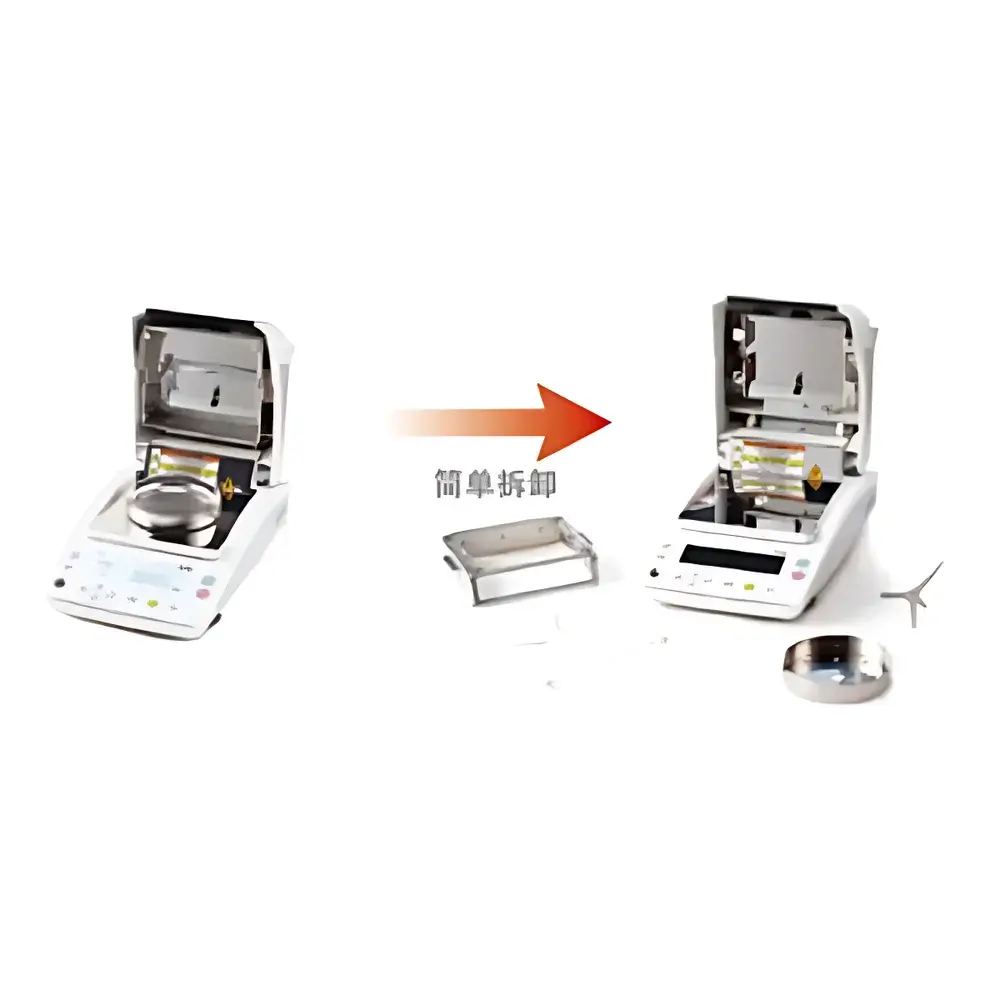
The MOC63u accommodates a broad range of sample types—including powders, granules, pellets, pastes, and thin films—without requiring pre-grinding or homogenization in most cases. Its open-pan design facilitates easy loading and residue removal, while the halogen lamp’s spectral output (peak ~1100 nm) provides efficient absorption by water molecules without excessive charring of organic matrices. The instrument meets essential regulatory expectations for moisture analysis workflows: audit-trail-capable data logging (via optional PC software), method parameter traceability, and compatibility with FDA 21 CFR Part 11–compliant validation packages when deployed with Shimadzu’s LabSolutions DA platform. Routine performance verification aligns with ISO/IEC 17025 requirements for testing laboratories.
Software & Data Management
Data acquisition and reporting are streamlined through native connectivity options: RS-232C (9-pin), USB 2.0, and dedicated DATA I/O port for direct thermal printer output. Up to 10 drying protocols and 100 complete measurement records—including timestamp, initial/final mass, moisture %, drying curve, and stop condition—are retained onboard. When interfaced with Windows-based systems, raw data exports natively to Excel, CSV, or text formats without proprietary drivers. Optional Shimadzu LabSolutions DA software enables advanced curve analysis, statistical evaluation (RSD, confidence intervals), PDF report generation with electronic signatures, and integration into LIMS environments via ODBC or HL7 protocols—ensuring full traceability from measurement to documentation.
Applications
- Pharmaceutical QA/QC: Residual solvent quantification in active pharmaceutical ingredients (APIs), moisture content verification of tablet granules per USP <921>, and stability-indicating assays for hygroscopic formulations.
- Food & Beverage: Water activity correlation studies, shelf-life prediction modeling, and compliance verification against Codex Alimentarius moisture limits for flour, dairy powders, and snack foods.
- Chemical & Polymer Manufacturing: Monitoring drying efficiency of resins, catalysts, and monomers; validating moisture specifications for lithium-ion battery cathode materials (e.g., NMC, LFP).
- Agricultural & Feed Testing: Rapid field-lab screening of grain moisture (corn, soybean, rice) aligned with AOAC 952.06 and ISO 6540 protocols.
- Academic Research: Method development for novel biomaterials, lyophilized biologics characterization, and comparative thermal degradation kinetics across drying regimes.
FAQ
What calibration standards are recommended for routine verification?
Shimadzu recommends certified anhydrous sodium tartrate (15.66% H₂O) and sodium chloride-saturated solution (75% RH) for moisture recovery and humidity chamber validation, respectively. Daily zero and span checks using certified weights (e.g., 10 g Class M1) are advised prior to batch analysis.
Can the MOC63u be validated for GMP environments?
Yes—the instrument supports IQ/OQ/PQ documentation templates, electronic audit trails (when paired with LabSolutions DA), and configurable user access levels. Full 21 CFR Part 11 compliance requires server-based software deployment with digital signature enforcement and encrypted database storage.
How often should the halogen lamp be replaced?
Lamp lifetime exceeds 5,000 hours under typical usage (≤150 °C, intermittent operation). Replacement is indicated by inconsistent drying curves, prolonged measurement times, or visible filament discoloration. No recalibration is required post-replacement due to factory-aligned thermal profile mapping.
Is external desiccant or purge gas required?
No. The MOC63u relies on ambient air convection and does not require nitrogen purging or desiccant traps. However, for highly volatile or oxidation-prone samples, optional inert gas adapters (sold separately) can be integrated via the rear vent port.






