
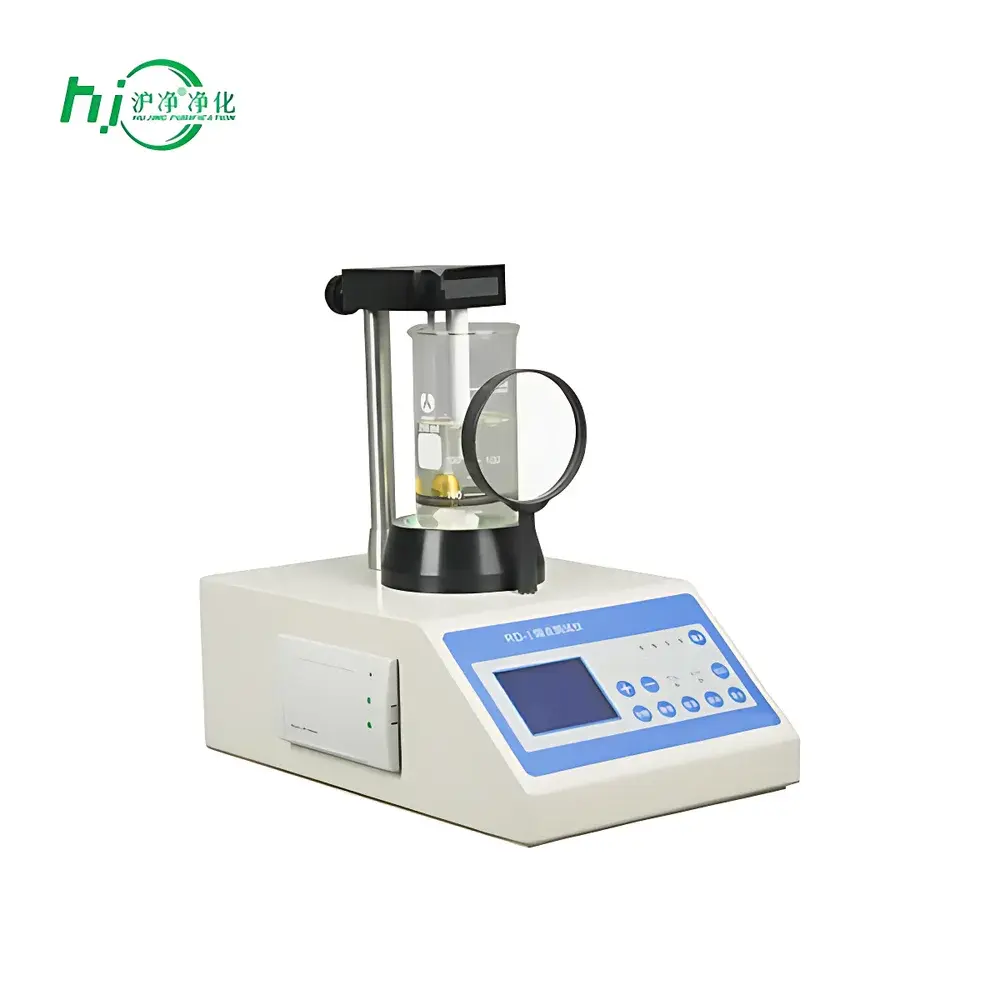
HJ RD-1 Capillary Melting Point Apparatus
| Brand | HJ |
|---|---|
| Origin | Shanghai, China |
| Manufacturer Type | Direct Manufacturer |
| Country of Origin | China |
| Model | RD-1 |
| Melting Point Range | Ambient to 270 °C |
| Heating Rates | 0.5 °C/min, 1.0 °C/min, 1.5 °C/min, 3.0 °C/min (selectable) |
| Linearity Deviation of Heating Rate | < 5% |
| Temperature Accuracy | ±0.5 °C ≤ 200 °C |
| Temperature Resolution | 0.1 °C |
| Thermal Medium | Methyl Silicone Oil |
| Bath Vessel | 250 mL Tall-Form Beaker |
| Operating Ambient Temperature | 18–28 °C |
| Interface | RS-232 Serial Port with Integrated Thermal Microprinter |
| Power Supply | AC 220 V ±10%, 50 Hz, 200 W |
| Dimensions (L×W×H) | 200 mm × 320 mm × 305 mm |
| Control Modes | Reset / Temperature Hold / Auto Test Initiation |
| Pre-set Temperature Memory | Non-volatile retention across power cycles |
| Equilibration Delay | ~60 s after target temperature reached, confirmed by audible alert |
| Endpoints | Manual initiation of onset (initial melt) and offset (complete melt) recording via dedicated front-panel keys |
Overview
The HJ RD-1 Capillary Melting Point Apparatus is a precision thermal analysis instrument engineered for the accurate determination of melting point ranges in crystalline organic compounds. It operates on the classical capillary tube method standardized in pharmacopoeial guidelines—including USP <741>, EP 2.2.17, and ChP IV—where solid samples are loaded into sealed glass capillaries and immersed in a thermally stable silicone oil bath. Temperature is measured via a calibrated platinum resistance sensor (PT100-class equivalent), and controlled using a closed-loop, variable-frequency heating algorithm that ensures minimal overshoot and high repeatability across defined ramp rates. Unlike differential scanning calorimeters (DSC), the RD-1 delivers rapid, cost-effective, and regulatory-compliant endpoint characterization ideal for routine QC labs, API release testing, and synthetic chemistry workflows where strict adherence to monograph-based methods is required.
Key Features
- Four selectable linear heating rates (0.5, 1.0, 1.5, and 3.0 °C/min) with verified linearity deviation < 5%, enabling method flexibility per compendial requirements.
- Integrated magnetic stirring system ensures uniform thermal distribution throughout the 250 mL methyl silicone oil bath, minimizing axial and radial temperature gradients.
- High-resolution 0.1 °C digital display with automatic nonlinearity compensation derived from sensor calibration curves.
- Dedicated front-panel controls for manual capture of onset (initial melt) and offset (clear melt) temperatures—critical for reporting full melting ranges in compliance with ICH Q5A and pharmacopeial definitions.
- Non-volatile memory retains user-defined setpoints across power cycles, eliminating reconfiguration between batches.
- Onboard thermal microprinter (front-loading paper path) provides immediate hardcopy output of test parameters, timestamps, and recorded endpoints—supporting ALCOA+ data integrity principles when paired with lab notebook documentation.
- Acoustic alert signals thermal equilibration (~60 s dwell at target temperature), reducing operator dependency in timing-critical observations.
Sample Compatibility & Compliance
The RD-1 accommodates standard 1.0 mm OD × 100 mm length capillary tubes filled with 1–3 mg of dry, finely powdered crystalline material—compatible with APIs, intermediates, dyes, fragrances, and fine chemical standards. Its design conforms to the physical configuration and procedural logic outlined in USP General Chapter <741> “Melting Points and Melting Ranges” and EP 2.2.17. While not a GLP-certified system per se, its deterministic control architecture, auditable print output, and stable thermal performance support use in GMP-regulated environments when operated under documented SOPs. The apparatus does not require external calibration certificates for routine operation but recommends annual verification against NIST-traceable reference standards (e.g., caffeine, phenacetin, indomethacin).
Software & Data Management
The RD-1 operates as a standalone instrument with no embedded PC software or cloud connectivity. All data generation and storage occur locally via the integrated RS-232 serial interface and thermal printer. Raw output includes: date/time stamp, selected heating rate, setpoint temperature, observed onset/offset values, and operator ID field (manually entered via keypad). For laboratories requiring electronic records, the serial port supports connection to validated LIMS or ELN systems compliant with FDA 21 CFR Part 11—provided appropriate audit trail configuration, electronic signature implementation, and output validation protocols are in place. No proprietary drivers or firmware updates are distributed; device behavior remains static post-manufacture to ensure method consistency.
Applications
- Quality control release testing of active pharmaceutical ingredients (APIs) and excipients per pharmacopeial monographs.
- Purity assessment of synthetic intermediates during route scouting and process optimization.
- Batch-to-batch consistency verification for dyes, pigments, and specialty organic chemicals.
- Educational use in university chemistry labs for teaching fundamental thermal behavior of solids.
- Stability-indicating method development where melting point depression correlates with degradation or polymorphic transition.
FAQ
Is the RD-1 compliant with USP <741>?
Yes—the instrument implements the capillary immersion method, specified heating rate options, and visual endpoint detection protocol aligned with USP <741> requirements.
Can it be used for polymorph identification?
No—it does not provide dynamic thermal profiling or phase transition discrimination; it reports discrete melting endpoints only. Polymorph screening requires DSC or hot-stage microscopy.
What maintenance is required for long-term accuracy?
Annual verification using certified reference materials and periodic replacement of silicone oil (recommended every 12 months or after 200 tests) to prevent oxidative degradation and viscosity drift.
Does it support automated data export to Excel or LIMS?
Via RS-232, yes—but integration requires third-party serial-to-CSV middleware or custom LIMS driver development; no native USB or Ethernet interface is provided.
Is calibration traceable to national standards?
The unit itself is not supplied with a calibration certificate; however, users may perform in-house calibration using NIST-traceable reference standards and document results per ISO/IEC 17025 requirements.



