
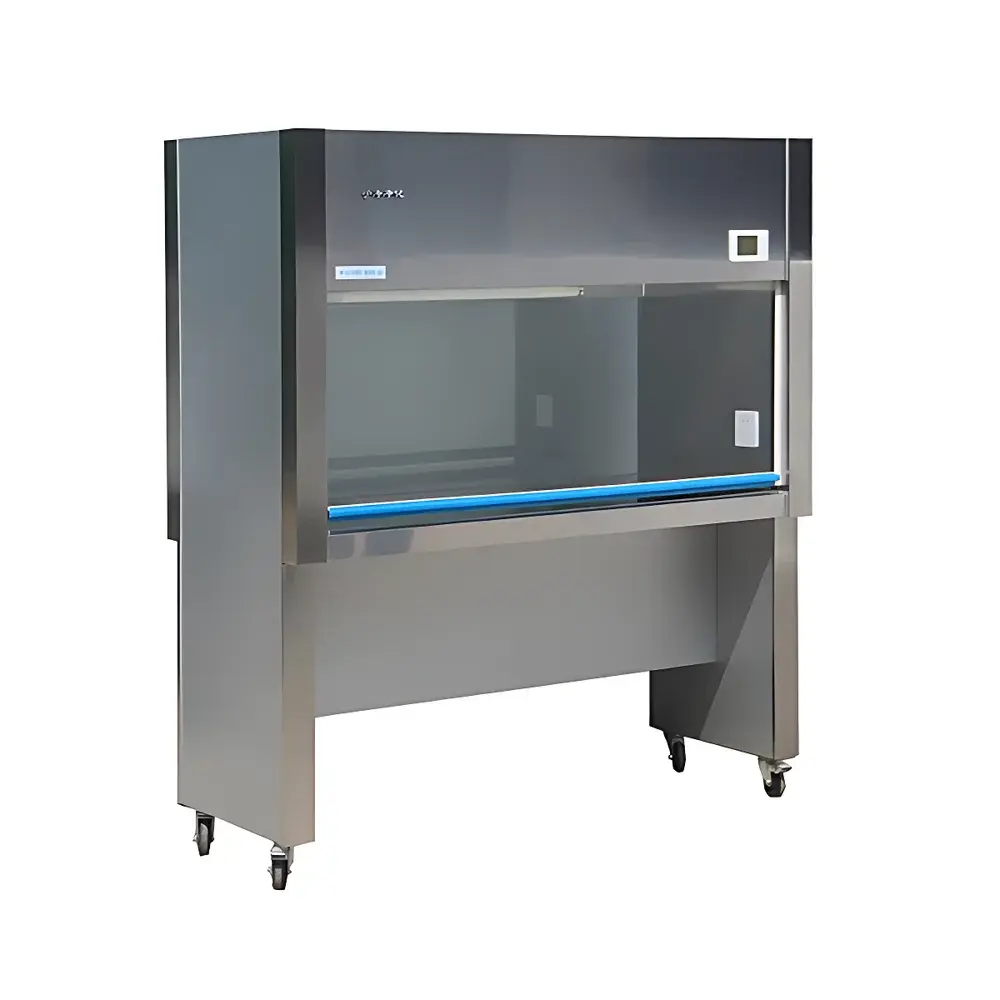
HJ SW-CJ-3F Triple-User Vertical Laminar Flow Clean Bench
| Brand | HJ |
|---|---|
| Origin | Shanghai, China |
| Manufacturer Type | Direct Manufacturer |
| Product Category | Domestic |
| Model | SW-CJ-3F |
| Instrument Type | Vertical Laminar Flow Clean Bench |
| Cleanliness Class | ISO Class 5 (100 @ ≥0.5 µm, Fed. Std. 209E) |
| Noise Level | ≤62 dB(A) |
| User Capacity | 3 operators |
| Airflow Pattern | Vertical Downflow |
| Average Air Velocity | 0.25–0.45 m/s (dual-speed control) |
| Microbial Contamination | ≤0.5 CFU/plate·hour (Φ90 mm settle plate) |
| Vibration | ≤5 µm half-amplitude (X/Y/Z axes) |
| Illuminance | ≥300 lx |
| Power Supply | AC 220 V, 50 Hz |
| Max. Power Consumption | 1000 W |
| Net Weight | 280 kg |
| Work Area Dimensions (W×D×H) | 1800 × 580 × 515 mm |
| Overall Dimensions (W×D×H) | 1960 × 645 × 1625 mm |
| HEPA Filter Specification | 1795 × 555 × 38 mm (1 unit) |
| Fluorescent Lamp | 50 W (1 unit) |
| UV Lamp | 50 W (1 unit) |
Overview
The HJ SW-CJ-3F Triple-User Vertical Laminar Flow Clean Bench is an ISO Class 5-certified laminar airflow workstation engineered for high-reliability aseptic operations in pharmaceutical QC labs, biotechnology research facilities, and academic microbiology laboratories. It employs a vertical downflow architecture—where air is drawn through a prefilter, conditioned, and then forced downward through a single large-format HEPA filter (1795 × 555 × 38 mm) at a precisely regulated velocity of 0.25–0.45 m/s. This unidirectional, particle-free airflow establishes a continuous protective barrier over the work surface, minimizing turbulent mixing and preventing cross-contamination between adjacent users. Designed for simultaneous use by three personnel operating from both front and rear access sides, the unit integrates a quasi-enclosed tempered glass sash that suppresses external infiltration while mitigating operator exposure to volatile compounds or bioaerosols during open-vessel manipulations.
Key Features
- Vertical laminar airflow system compliant with ISO 14644-1 Class 5 (equivalent to Fed. Std. 209E Class 100) for particles ≥0.5 µm
- Dual-speed electronically controlled centrifugal blower with LCD interface for real-time airflow adjustment and operational feedback
- Quasi-enclosed tempered glass sash with optimized height and sealing geometry to limit ambient air intrusion and reduce operator inhalation risk
- Integrated dual lighting system: 50 W fluorescent lamp for task illumination (≥300 lx at work surface) and 50 W UV-C germicidal lamp (254 nm) for pre-use decontamination
- Structural vibration isolation: half-amplitude ≤5 µm across X/Y/Z axes, ensuring stability during precision pipetting or weighing procedures
- Robust steel frame with epoxy-coated finish and stainless-steel work surface (304 grade), supporting repeated disinfection with ethanol, isopropanol, or quaternary ammonium agents
Sample Compatibility & Compliance
The SW-CJ-3F accommodates standard laboratory vessels—including Petri dishes, test tubes, flasks, and multiwell plates—within its 1800 mm wide work area. Its vertical flow design ensures uniform protection across the full width, making it suitable for concurrent microbial inoculation, cell culture passaging, and sterile reagent preparation. The unit meets baseline requirements for non-sterile compounding environments per USP Annex (ambient air quality monitoring), and supports GLP-compliant documentation when integrated with lab-wide environmental monitoring programs. While not classified as a biosafety cabinet (BSC), its performance aligns with ISO 14644-1 verification protocols for cleanroom support equipment. Routine validation includes particle count testing (ISO 21501-4), airflow uniformity mapping (ISO 14644-3), and microbial settle plate assessment (≤0.5 CFU/plate·hour using Φ90 mm TSA plates incubated at 30–35 °C for 48 h).
Software & Data Management
This clean bench operates as a standalone mechanical system without embedded firmware or network connectivity. All operational parameters—including fan speed selection, UV timer activation, and lighting control—are managed via tactile push-button interface with LCD status display. For audit readiness in regulated environments, users are advised to log operational parameters manually or integrate the unit into facility-wide environmental monitoring systems via external data loggers (e.g., calibrated anemometers, particle counters, or temperature/humidity sensors). The absence of digital control architecture eliminates concerns related to FDA 21 CFR Part 11 compliance for electronic records—making it suitable for laboratories maintaining paper-based SOPs or those deploying validated analog workflows under GMP/GLP frameworks.
Applications
- Aseptic handling of bacterial and fungal cultures in teaching and research microbiology labs
- Preparation of media, diluents, and standards in pharmaceutical quality control laboratories
- Non-hazardous cell line maintenance and transfection procedures where containment is not required
- Electronics assembly and optical component handling requiring particulate-free environments
- Supporting ISO/IEC 17025-accredited testing activities where background contamination must remain below detection thresholds
FAQ
Does this unit provide personnel or environmental protection?
No. The SW-CJ-3F is a clean bench—not a biosafety cabinet—and provides product protection only. It does not protect the operator from hazardous aerosols or shield the environment from process emissions.
Can the HEPA filter be replaced in-house?
Yes. The filter is accessible via rear service panel and designed for field replacement using standard torque tools; replacement intervals depend on usage intensity and ambient air quality, typically every 12–24 months.
Is UV irradiation time programmable?
The UV lamp features a manual on/off switch with a fixed 15-minute auto-shutoff timer; extended exposure requires manual reset.
What electrical infrastructure is required?
A dedicated 220 V AC, 50 Hz, 16 A circuit with grounded outlet is mandatory; voltage fluctuations >±10% may affect blower motor longevity.
How is airflow velocity verified during routine qualification?
Using a traceable hot-wire anemometer at nine standardized points across the work surface per ISO 14644-3 Annex B, with mean velocity within ±20% of setpoint and uniformity ≤±15% across grid points.



