
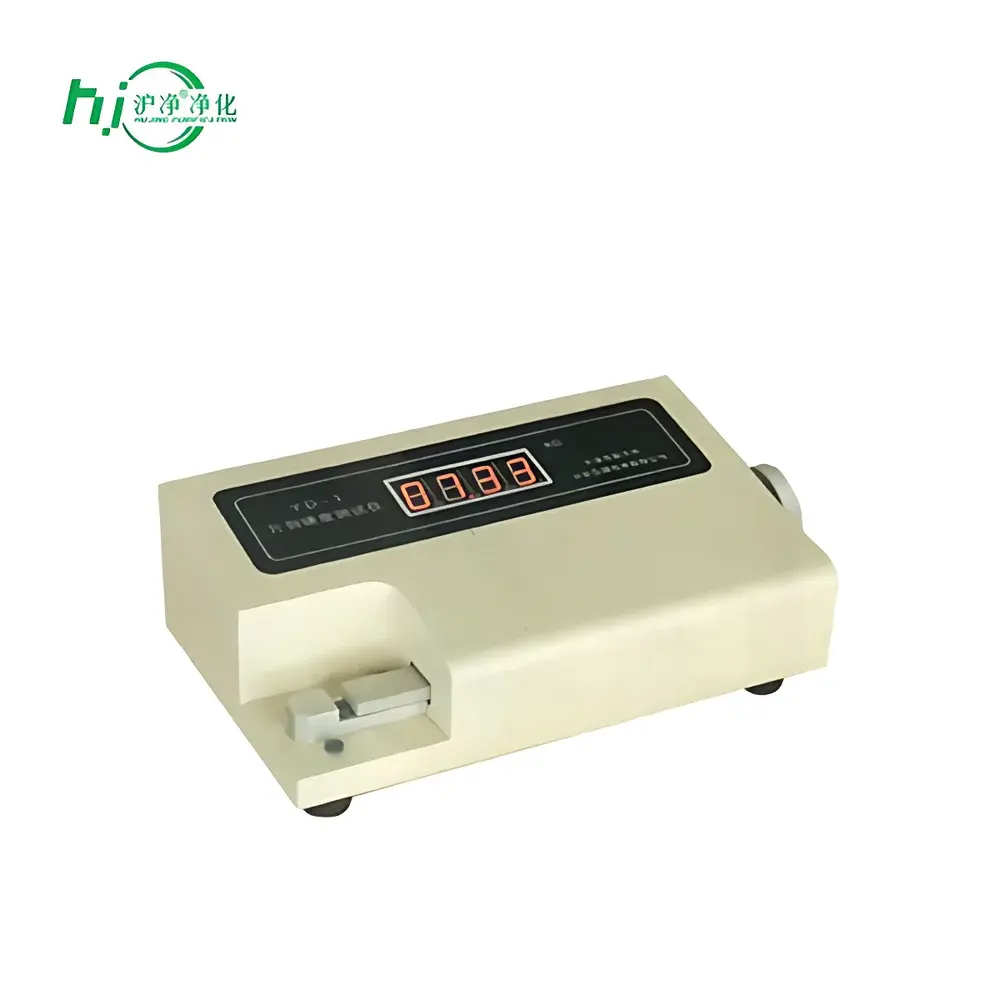
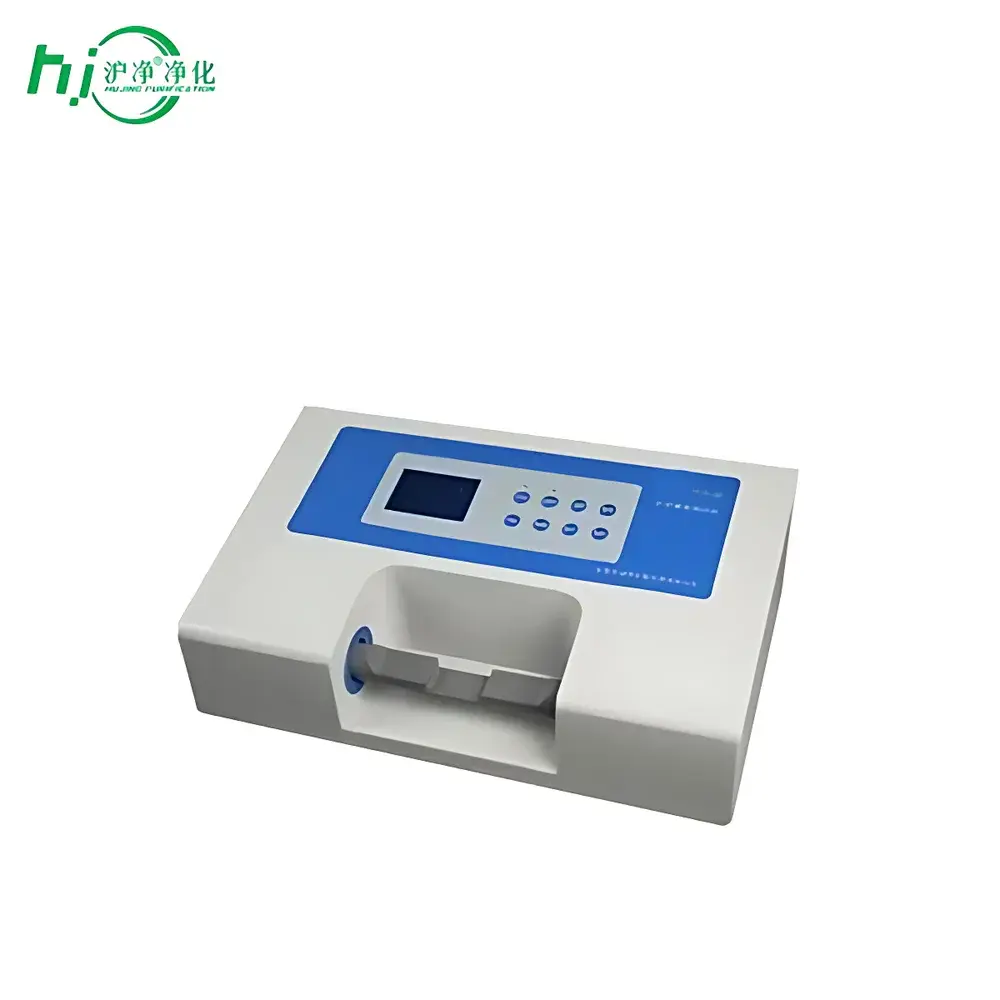
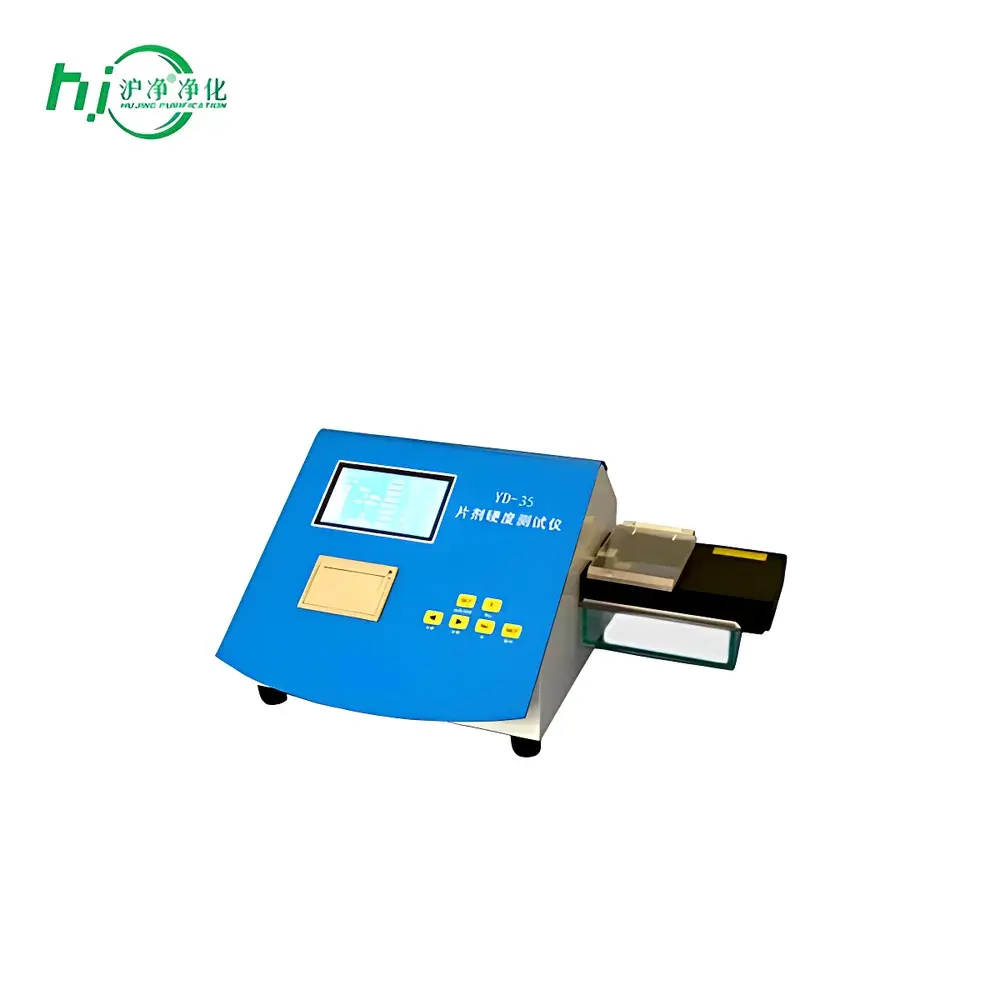
HJ YD-1/2/35 Series Tablet Hardness Tester
| Brand | HJ Purification |
|---|---|
| Origin | Shanghai, China |
| Manufacturer Type | Direct Manufacturer |
| Country of Origin | China |
| Model | YD-1 / YD-2 / YD-35 |
| Test Range (YD-1) | 0–20 kg (0–196.2 N) |
| Test Range (YD-2) | 2–200 N (0.2–20 kg) |
| Test Range (YD-35) | 1–350 N |
| Resolution | 0.1 N (YD-2/YD-35), 0.01 kg |
| Accuracy | ±0.03 kg or ±0.5% FS (full scale), whichever is greater |
| Tablet Diameter Range | 2.0–40.0 mm (YD-2), 2.0–30.0 mm (YD-35) |
| Diameter Accuracy | ±0.01 mm (YD-35) |
| Power Supply | 220 V AC, 50 Hz |
| Power Consumption | 10 W (YD-1), 40 W (YD-2), not specified (YD-35) |
| Dimensions (YD-2) | 400 × 240 × 140 mm (L×W×H) |
| Display | LED (YD-1), LCD with bilingual interface (YD-2/YD-35) |
| Measurement Modes | Manual single-tablet, automatic batch testing (up to 100 tablets for YD-2 |
| Data Output | Auto-lock, auto-reset, statistical analysis, time-stamped reporting, calibration traceability, unit conversion (N/kg/Sc, mm/inch) |
Overview
The HJ YD-1/2/35 Series Tablet Hardness Tester is a precision mechanical compression instrument engineered for quantitative assessment of tablet mechanical integrity in pharmaceutical development, quality control, and regulatory compliance laboratories. It operates on the principle of controlled axial compression between two parallel platens—applying calibrated force until fracture—and measuring the peak load required to break a tablet. This value, expressed in newtons (N) or kilograms-force (kgf), serves as a critical physical attribute correlating with tablet friability, disintegration behavior, and manufacturability. The series comprises three variants differentiated by measurement range, automation level, and data handling capability: the manually actuated YD-1 for basic QC screening; the semi-automated YD-2 featuring programmable batch testing and real-time error correction; and the fully integrated YD-35, which embeds microprocessor-based control, statistical process functionality, and audit-ready reporting aligned with GLP and GMP expectations.
Key Features
- High-accuracy load cell technology: All models integrate strain-gauge-based transducers calibrated to ISO 7500-1 Class 1 standards, ensuring long-term stability and repeatability within ±1% RSD across repeated measurements under identical conditions.
- Multi-mode operation: Supports manual single-tablet testing for rapid verification, as well as automated sequential testing—enabling unattended execution of up to 160 tablets per session (YD-35) with automatic platen retraction, force reset, and result logging.
- Bilingual, context-aware interface: YD-2 and YD-35 feature backlit LCD displays with switchable Chinese/English menus, step-by-step guidance, and real-time parameter feedback—including dynamic load curve visualization during compression (YD-35).
- Integrated diameter measurement: Dual-function probe design allows simultaneous hardness and tablet diameter acquisition, eliminating secondary instrumentation and reducing operator-induced variability.
- Comprehensive calibration management: Built-in calibration routines support multi-point verification using certified reference weights; calibration history—including date, operator ID, and deviation values—is stored and printable per 21 CFR Part 11 requirements (YD-35).
- Thermal and mechanical robustness: Housing constructed from reinforced ABS polymer with ESD-safe surface treatment; optimized heat dissipation ensures stable sensor performance over extended duty cycles at ambient temperatures of 15–30°C.
Sample Compatibility & Compliance
The YD series accommodates standard convex, flat-faced, and beveled tablets ranging from 2.0 mm to 40.0 mm in diameter (YD-2) or 2.0–30.0 mm (YD-35), including coated, film-coated, and enteric-coated formulations. Its platen geometry conforms to USP uniformity of dosage units and EP 2.9.40 tablet hardness testing guidelines. All models comply with ISO 8503-2 surface roughness specifications for contact surfaces and meet electromagnetic compatibility (EMC) requirements per IEC 61326-1 for laboratory equipment. The YD-35 further supports audit trails, electronic signatures, and data export in CSV/PDF formats compatible with LIMS integration—facilitating alignment with FDA 21 CFR Part 11, EU Annex 11, and WHO TRS 992 Annex 6 documentation standards.
Software & Data Management
While the YD-1 relies on local LED readout and manual recording, the YD-2 introduces on-device data retention for up to 99 test sequences, each storing mean, SD, min/max, and individual values. The YD-35 expands this into a full embedded data management system: internal memory retains ≥10,000 test records with timestamped metadata (date, time, operator code, calibration status); statistical summaries include Cp/Cpk, histogram generation, and trend analysis; reports are exportable via USB port and include digital signatures, calibration certificate references, and configurable headers for site-specific QA templates. All firmware versions undergo version-controlled validation, and software updates are delivered via encrypted USB key with SHA-256 checksum verification.
Applications
- Pre-formulation studies: Correlating binder concentration, granulation method, and compaction pressure with mechanical strength profiles.
- In-process control: Monitoring tablet hardness during rotary press runs to maintain target ranges (e.g., 80–150 N for immediate-release formulations).
- Stability testing: Tracking hardness drift across accelerated and long-term storage conditions per ICH Q1 guidelines.
- Supplier qualification: Objective evaluation of contract manufacturer tablet batches against release specifications.
- Regulatory submission support: Generating raw data packages compliant with Module 3.2.P.5.3 of CTD format for health authority review.
- Educational use: Teaching core principles of powder compaction mechanics and solid dosage form performance in university pharmacy labs.
FAQ
What is the recommended calibration frequency for routine QC use?
Calibration should be performed daily prior to first use using at least two certified reference loads spanning 20% and 80% of full scale, with documented verification recorded in the instrument logbook.
Can the YD-35 interface directly with our LIMS system?
Yes—the YD-35 supports ASCII-based serial communication (RS-232) and USB virtual COM port protocols; configuration files and API documentation are provided for custom integration with major LIMS platforms including LabWare, STARLIMS, and Thermo Fisher SampleManager.
Does the instrument meet pharmacopoeial requirements for hardness testing?
Yes—its platen alignment tolerance (<±0.1°), compression speed control (0.5–1.0 mm/s, adjustable on YD-35), and force resolution satisfy USP , Ph. Eur. 2.9.40, and JP 17 General Test 2.07 criteria.
How is mechanical wear mitigated in high-throughput environments?
Platens are hardened stainless steel (HV 600+) with replaceable tungsten-carbide inserts; maintenance intervals are defined by cumulative actuation count, with service alerts triggered at 50,000 cycles.
Is training provided for operators and QA personnel?
HJ offers factory-certified on-site or remote training covering operational procedures, calibration protocol execution, data integrity practices, and 21 CFR Part 11 compliance workflows—delivered by ISO 17025-accredited trainers.





