
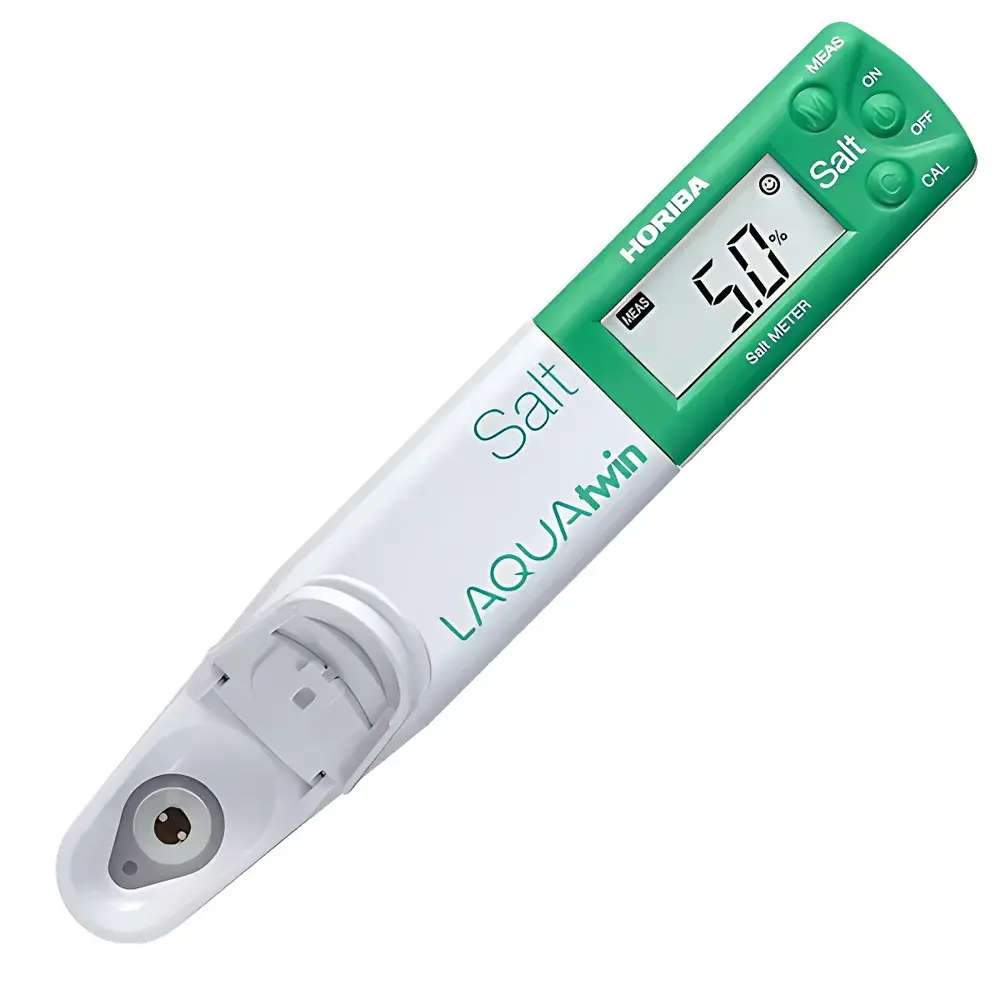
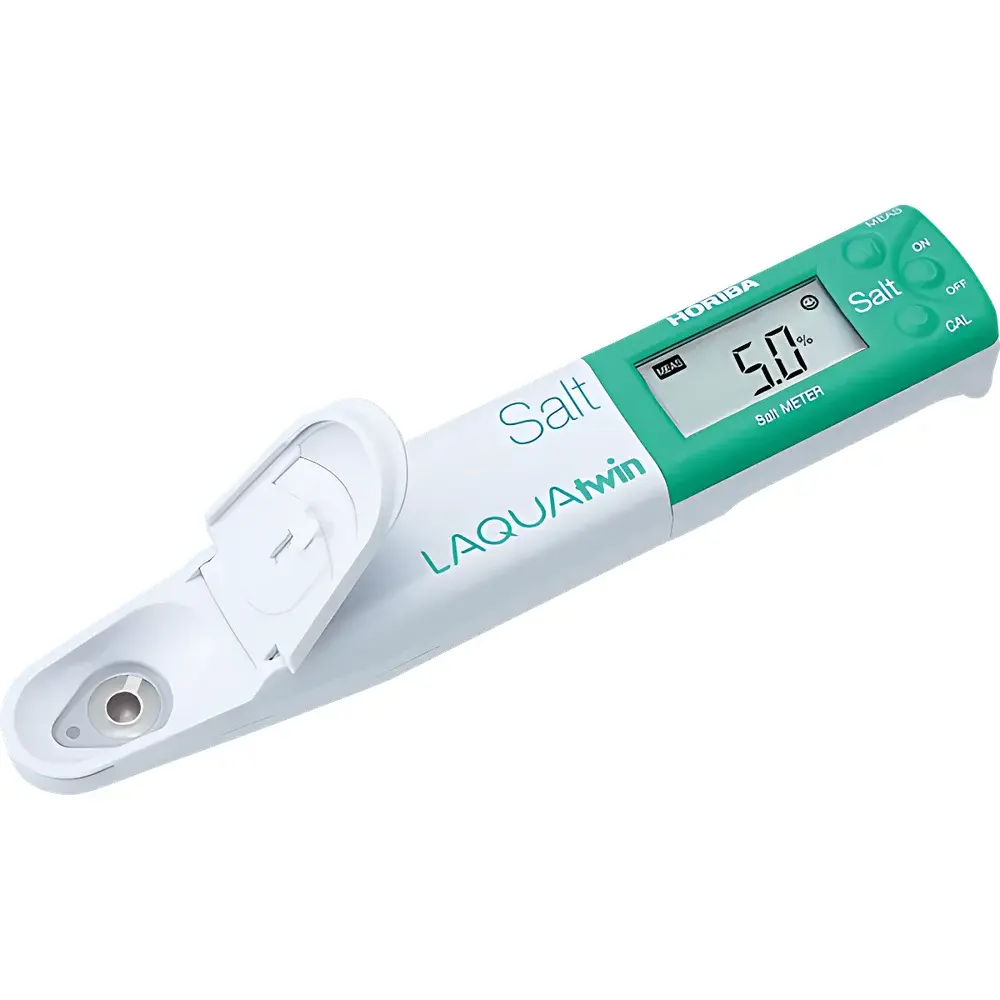
HORIBA LAQUAtwin Salt-22 Pocket-Sized Salinity Meter
| Brand | HORIBA |
|---|---|
| Origin | Singapore |
| Model | Salt-22 |
| Detection Parameter | Single (NaCl mass %) |
| Portability | Pen-type |
| Salinity Range | 0.01–25 wt% |
| Measurement Principle | Sodium Ion-Selective Electrode (ISE) |
| Minimum Sample Volume | 0.3 mL (0.05 mL with Sampling Sheet B) |
| Resolution | 0.01% (0.00–0.99%), 0.1% (1.0–9.9%), 1% (10–25%) |
| Accuracy | ±10% of reading |
| Temperature Range (Measurement) | 0–50.0 °C |
| Temperature Calibration Range | 5–40.0 °C |
| Display | Backlit monochrome digital LCD |
| Operating Environment | 5–40.0 °C, ≤85% RH (non-condensing) |
| Power | Two CR2032 batteries |
| Battery Life | ~400 hours (backlight off) |
| Dimensions | 164 × 29 × 20 mm (excl. protrusions) |
| Weight | ~55 g (incl. sensor & batteries) |
| Ingress Protection | IP67 |
| Sensor | Replaceable sodium ISE module |
| Auto-Hold / Auto-Stabilize | Yes |
| Auto-Off | 30 min |
| Low-Battery Indicator | Yes |
| Calibration Points | Up to 2 |
| Auto-Standard Recognition | Pre-configured for 0.5% and 5.0% NaCl (user-adjustable high/low values) |
| Included Accessories | 14 mL each of 0.5% and 5.0% NaCl standards, 5 × Sampling Sheets B, 2 × CR2032 batteries, dropper, quick guide, and instruction manual |
Overview
The HORIBA LAQUAtwin Salt-22 is a compact, field-deployable salinity meter engineered for rapid, on-site quantification of sodium chloride concentration in aqueous samples—expressed as mass percentage (wt%). Unlike conventional benchtop conductivity-based salinometers, the Salt-22 employs a solid-state sodium ion-selective electrode (ISE) to directly measure Na+ activity and convert it to NaCl-equivalent concentration using built-in calibration algorithms. This electrochemical approach delivers improved selectivity in complex matrices where conductivity methods may overestimate salinity due to interference from other ions (e.g., K+, Ca2+, Mg2+). Designed for precision micro-volume analysis, the instrument requires only 0.3 mL of sample for standard operation—or as little as 0.05 mL when used with HORIBA’s proprietary Sampling Sheet B—eliminating the need for volumetric glassware, rinsing cycles, or sample dilution. Its pen-form factor, IP67-rated enclosure, and battery-powered architecture make it suitable for use in food processing lines, aquaculture monitoring, environmental field surveys, and QC labs where space, portability, and sample conservation are critical constraints.
Key Features
- Direct Na+-selective electrochemical measurement with automatic conversion to NaCl wt%—no assumptions about ionic composition required.
- Ultra-low sample consumption: 0.3 mL standard mode; 0.05 mL with Sampling Sheet B—ideal for precious, viscous, or limited-volume samples.
- Dual-point calibration with auto-standard recognition for 0.5% and 5.0% NaCl solutions; user-definable high/low calibration points support method-specific validation protocols.
- Integrated temperature sensor with automatic temperature compensation (ATC) across 5–40.0 °C, ensuring thermally stable readings without external probes.
- IP67-rated housing provides full dust ingress protection and immersion resistance up to 1 m for 30 minutes—enabling reliable operation in humid, splash-prone, or outdoor environments.
- Replaceable sodium ISE sensor module extends instrument service life and maintains metrological traceability through periodic sensor renewal.
- Auto-hold and auto-stabilize functions lock readings once electrochemical equilibrium is reached—reducing operator dependency and improving inter-user reproducibility.
- Backlit monochrome LCD display ensures legibility under low-light conditions; configurable backlight duration optimizes battery longevity.
Sample Compatibility & Compliance
The Salt-22 is validated for use with aqueous solutions containing dissolved NaCl as the dominant ionic species, including brines, seawater dilutions, food extracts (e.g., soy sauce, pickling brines), hydroponic nutrient solutions, and process water streams. It is not intended for non-aqueous solvents, highly acidic/basic media (pH 12), or samples containing >100 mg/L suspended solids without filtration. While not certified to ISO/IEC 17025, the device supports GLP-aligned workflows through its dual-point calibration log, automatic timestamping of measurements (when paired with optional PC software), and compliance-ready documentation (included calibration certificates for supplied standards). Its measurement principle aligns with ASTM D1125 (Standard Test Methods for Electrical Conductivity and Resistivity of Water) in intent—though it operates via ISE rather than conductivity—and meets typical internal QC requirements for salt content verification per USP Water for Pharmaceutical Purposes and FDA 21 CFR Part 11–compliant data handling when integrated with HORIBA’s optional LAQUA Connect software suite.
Software & Data Management
The Salt-22 operates as a standalone instrument with no onboard memory or Bluetooth/Wi-Fi connectivity. However, it is fully compatible with HORIBA’s LAQUA Connect PC software (Windows only), which enables USB-cabled data export of measurement records—including date/time stamp, temperature, salinity value, and stability status—for integration into LIMS or Excel-based QA databases. When used with this software, the instrument supports audit-trail generation, user-defined report templates, and electronic signature capability—facilitating compliance with 21 CFR Part 11 for regulated industries. All calibration events are retained in volatile memory until power loss; users are advised to document calibration parameters manually or via software synchronization for formal audit readiness.
Applications
- Food & Beverage: Rapid verification of salt concentration in sauces, cured meats, dairy products, and beverage formulations during production and incoming raw material inspection.
- Aquaculture & Marine Biology: Field assessment of salinity gradients in hatcheries, coral reef monitoring, and estuarine studies—without requiring lab transport or sample preservation.
- Pharmaceutical Manufacturing: In-process testing of saline-based parenteral solutions and buffer preparations where NaCl mass% must conform to pharmacopeial specifications.
- Environmental Monitoring: On-site screening of groundwater, surface water, and wastewater effluents for chloride contamination or desalination plant performance evaluation.
- Education & Training: Pedagogical tool for teaching ion-selective electrode theory, calibration methodology, and micro-volume analytical technique fundamentals.
FAQ
What is the measurement principle of the Salt-22?
It uses a solid-state sodium ion-selective electrode (ISE) to detect Na+ activity and converts the signal to NaCl mass percentage using factory-calibrated algorithms.
Can the Salt-22 measure seawater directly?
Yes—it covers the full natural seawater range (≈3.5 wt%) and extends to hypersaline conditions up to 25 wt%, provided the sample is filtered to remove particulates.
Is temperature compensation automatic?
Yes—the integrated NTC thermistor performs real-time ATC across 5–40.0 °C; manual temperature entry is not required.
How often should the sensor be replaced?
Sensor lifetime depends on usage frequency and sample matrix; HORIBA recommends replacement after 12 months of regular use or if calibration drift exceeds ±5% of reading.
Does the Salt-22 comply with ISO 9001 or ISO/IEC 17025?
The instrument itself is not accredited, but its design, calibration traceability (to NIST-traceable NaCl standards), and documentation support implementation within ISO 9001-certified quality systems and method validation per ISO/IEC 17025 Clause 7.7.




