
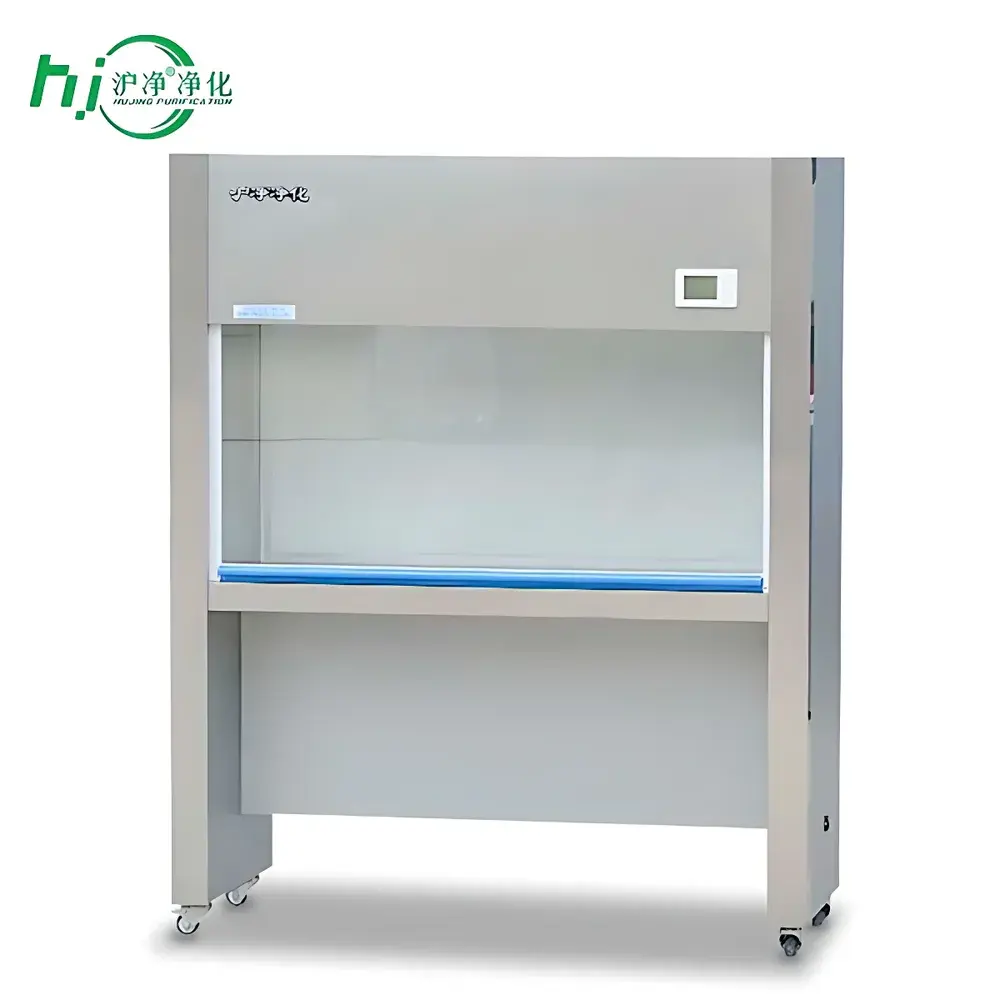
Hujing Purification SW-CJ-2G Dual-Operator Single-Face Horizontal Laminar Flow Clean Bench
| Brand | Hujing Purification (HJ) |
|---|---|
| Origin | Shanghai, China |
| Manufacturer Type | Direct Manufacturer |
| Country of Origin | China |
| Model | SW-CJ-2G |
| Price | USD 820 (FOB Shanghai) |
| Cleanliness Class | ISO Class 5 (equivalent to Fed. Std. 209E Class 100 @ ≥0.5 µm) |
| Microbial Contamination | ≤0.5 CFU/plate·hour (90 mm Petri dish) |
| Average Air Velocity | 0.25–0.45 m/s (dual-speed control) |
| Noise Level | ≤62 dB(A) |
| Vibration Half-Peak | ≤5 µm (X/Y/Z axes) |
| Illuminance | ≥300 lx |
| Power Supply | AC 220 V, 50 Hz, Single Phase |
| Max. Power Consumption | 600 W |
| Net Weight | 150 kg |
| Work Area Dimensions (W×D×H) | 1140 × 400 × 515 mm |
| Overall Dimensions (W×D×H) | 1300 × 550 × 1600 mm |
| HEPA Filter Spec. | 1135 × 600 × 38 mm (1 unit) |
| Fluorescent Lamp | 30 W × 1 |
| UV Lamp | 30 W × 1 |
| Construction | Cold-rolled steel cabinet with epoxy-painted finish |
| work surface | SUS304 brushed stainless steel |
| Airflow Configuration | Horizontal unidirectional laminar flow (single-face, dual-operator) |
Overview
The Hujing Purification SW-CJ-2G is a dual-operator, single-face horizontal laminar flow clean bench engineered for ISO Class 5 (Fed. Std. 209E Class 100) environments. It operates on the principle of horizontal unidirectional airflow: ambient air is drawn through a pre-filter, pressurized by a centrifugal blower into a plenum chamber, and then passes through a certified HEPA filter (≥99.99% efficiency at 0.3 µm). The resulting particle-free airstream exits uniformly across the full width of the work surface at controlled velocity (0.25–0.45 m/s), forming a protective laminar curtain that sweeps contaminants away from the operator and sample zone. Unlike vertical flow hoods, this configuration minimizes turbulence-induced cross-contamination during non-sterile manipulations and is widely adopted in pharmaceutical QC labs, cell culture support areas, electronics assembly, and precision optics handling where operator exposure to UV or chemical vapors must be minimized.
Key Features
- Horizontally oriented laminar airflow design optimized for dual-user operation on a single workface — ideal for collaborative benchwork without compromising containment integrity.
- Full-height, counterbalanced sash system enabling precise, tool-free vertical positioning — ensures consistent airflow profile across variable working heights.
- Robust enclosure fabricated from cold-rolled steel with electrostatic epoxy coating; work surface constructed from 1.2 mm thick SUS304 brushed stainless steel — resistant to corrosion, non-porous, and compliant with ISO 14644-1 surface cleanliness requirements.
- Dual-lamp system with interlocked fluorescent (30 W) and UV-C germicidal (30 W, 254 nm) lamps — activation of UV lamp automatically disables fluorescent illumination and cuts power to the blower, meeting IEC 60335-1 safety interlock standards.
- Microprocessor-based digital controller with LCD interface offering three preset airflow speeds (low/medium/high), real-time velocity indication, and system status monitoring (filter life estimation, lamp runtime, fault logging).
- Integrated pre-filter (G4 grade) upstream of the HEPA module — reduces particulate loading on the final filter, extending service life and maintaining stable pressure drop per ISO 16890 guidelines.
Sample Compatibility & Compliance
The SW-CJ-2G supports open-container handling of non-hazardous biological reagents, sterile media preparations, microelectronic components, and optical substrates. It is not suitable for volatile organic solvents, infectious agents requiring BSL-2 containment, or radioactive materials. The unit complies with GB/T 25225–2010 (Chinese national standard for laminar flow clean benches), meets electromagnetic compatibility (EMC) requirements per GB 4824–2019 (Class B), and adheres to electrical safety specifications under GB 4706.1–2005 (IEC 60335-1 equivalent). While not certified to NSF/ANSI 49 or EN 12469, its performance parameters align with ISO 14644-1:2015 Class 5 operational benchmarks when installed in a background environment of ISO Class 8 (100,000-grade) or better.
Software & Data Management
This clean bench operates as a standalone hardware platform with no embedded network connectivity or cloud-based software. All operational parameters are managed locally via the front-panel LCD interface. The controller logs cumulative runtime for UV and fluorescent lamps, tracks estimated HEPA filter depletion based on total airflow hours and differential pressure trends (via optional external manometer input), and stores up to 10 system fault codes with timestamps. Audit trail functionality is limited to manual logbook entries; for GLP/GMP-regulated environments, users must implement external documentation protocols per 21 CFR Part 11 requirements — including handwritten or electronic records of daily pre-use verification (air velocity mapping, UV intensity measurement, surface microbiological swab testing).
Applications
- Preparation of sterile culture media and buffer solutions in academic and industrial microbiology laboratories.
- Handling of sensitive photonic components, semiconductor wafers, and thin-film deposition substrates where static charge and airborne molecular contamination must be mitigated.
- Non-aseptic assembly of diagnostic assay kits, packaging of reference standards, and weighing of high-purity reference materials (e.g., USP-grade chemicals).
- Support workspace adjacent to biosafety cabinets for instrument calibration, pipette tip loading, and secondary packaging operations.
- Teaching laboratories requiring cost-effective, low-maintenance laminar flow infrastructure for undergraduate biotechnology and materials science curricula.
FAQ
What is the recommended maintenance schedule for the pre-filter and HEPA filter?
Pre-filters should be cleaned every 3–6 months depending on ambient dust load; HEPA filters require replacement approximately every 18 months under continuous operation, or sooner if terminal velocity falls below 0.25 m/s after pre-filter cleaning and fan voltage adjustment.
Can this unit be used for handling pathogenic organisms?
No. The SW-CJ-2G provides personnel and product protection only — it lacks inward airflow and negative pressure containment. Pathogen work requires certified Class II biological safety cabinets per NSF/ANSI 49.
Is UV irradiation validated for surface decontamination?
UV-C output is sufficient for routine surface disinfection of stainless steel surfaces prior to operation, but validation per ISO 15858 is required for critical applications; users must verify intensity (>40 µW/cm² at 1 m) with a calibrated radiometer before each use.
Does the unit include certification documentation for ISO Class 5 compliance?
Factory-installed units ship with a Certificate of Conformance stating nominal HEPA filtration efficiency and dimensional specifications. Formal ISO 14644-1 classification requires on-site testing by an accredited third-party provider following ISO 14644-3 protocols.
What electrical infrastructure is required for installation?
A dedicated grounded AC 220 V / 50 Hz circuit with minimum 10 A capacity and Type C circuit breaker is required. Voltage fluctuations exceeding ±10% may affect blower motor longevity and velocity stability.



