
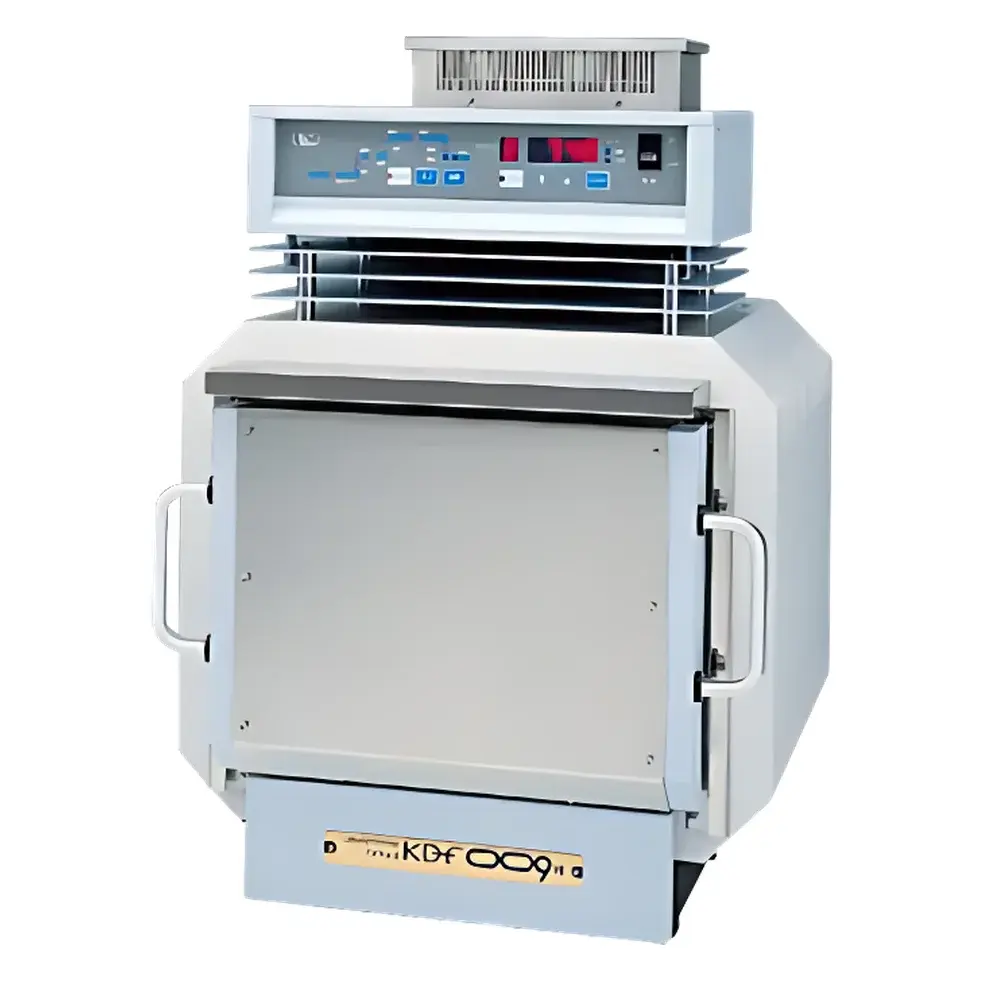
KDF KDF-009G / KDF-009GS Advanced Programmable Muffle Furnace
| Brand | KDF |
|---|---|
| Origin | Japan |
| Model | KDF-009G / KDF-009GS |
| Instrument Type | Box-Type Muffle Furnace |
| Max Operating Temperature | 1230 °C |
| Max Power Consumption | 4000 W |
| Heating Rate | Adjustable from 0.1 to 30 °C/min (in 1 °C increments) |
| Internal Chamber Dimensions | 250 (W) × 180 (H) × 280 (D) mm |
| External Dimensions | 470 (W) × 600 (H) × 485 (D) mm |
| Weight | 51 kg |
| Heating Element Material | Kanthal® A1 Alloy |
| Temperature Sensor | Type R Thermocouple |
| Programmable Steps | Up to 10 independent multi-segment programs |
| Timer Range | 0–99 h 59 min |
| Ambient Atmosphere Options | Air (KDF-009G) or Controlled Gas (N₂, Ar, etc. |
| Safety Monitoring | Overtemperature, heater open-circuit, thermocouple break, memory corruption, and system fault detection |
Overview
The KDF KDF-009G and KDF-009GS are high-reliability, front-loading box-type muffle furnaces engineered for precision thermal processing in research laboratories, materials science facilities, and quality control environments. Designed and manufactured in Japan, these units operate on the principle of radiant heat transfer within an insulated refractory chamber, isolating samples from direct contact with heating elements and combustion byproducts—ensuring consistent, contamination-free thermal treatment. The KDF-009G model is optimized for atmospheric air firing, while the KDF-009GS variant integrates a gas inlet system compatible with inert (e.g., N₂, Ar) or reducing atmospheres, enabling controlled oxidation state management during sintering, ashing, calcination, or annealing. With a maximum operating temperature of 1230 °C and a usable working range up to 1100 °C, the furnace supports ISO/IEC 17025-compliant thermal validation protocols and aligns with ASTM E1142 (Standard Practice for Calibration of High-Temperature Furnaces) when paired with traceable thermocouple verification.
Key Features
- Robust ceramic fiber insulation and Kanthal® A1 alloy heating elements ensure long-term thermal stability and resistance to oxidation at elevated temperatures.
- Front-hinged door with integrated work surface functionality—enables safe handling of hot crucibles or casting rings without requiring external staging.
- 10-user-programmable multi-segment thermal profiles, each supporting up to three ramp-soak steps with independent rate (0.1–30 °C/min), target temperature (0–1230 °C), and dwell time (0–99 h 59 min) settings.
- Type R thermocouple feedback loop with digital PID control delivers repeatable thermal performance; factory-calibrated per JIS C 1602 and NIST-traceable reference standards.
- Comprehensive fault diagnostics including heater open-circuit detection, thermocouple break monitoring, overtemperature cutoff (>1250 °C), and EEPROM integrity verification.
- Compact footprint (470 × 600 × 485 mm) with generous internal volume (250 × 180 × 280 mm)—optimized for batch processing of standard porcelain, alumina, or platinum crucibles (up to ø100 mm × 120 mm height).
Sample Compatibility & Compliance
The KDF-009G/009GS accommodates a broad spectrum of sample forms—including powders, granules, pressed pellets, thin films, and small metallic components—within its fully enclosed muffle chamber. Its gas-tight design (KDF-009GS) permits operation under low-flow (<500 mL/min) inert or reactive atmospheres, meeting requirements for ASTM C1171 (ash content determination), ISO 1171 (determination of ash in coal and coke), and USP heavy metals testing. All electrical and thermal safety functions comply with IEC 61010-1:2010 (Safety Requirements for Electrical Equipment for Measurement, Control, and Laboratory Use) and meet CE marking directives for electromagnetic compatibility (EMC) and low-voltage equipment. Optional exhaust integration (e.g., ES9 odor removal unit) supports GLP-aligned fume management in regulated analytical workflows.
Software & Data Management
While the KDF-009G/009GS operates via an intuitive front-panel interface with LED display and rotary encoder navigation, it supports optional RS-485 serial communication (Modbus RTU protocol) for integration into centralized lab automation systems. When connected to validated data acquisition software, the furnace enables full audit trail generation—including timestamped setpoint changes, actual temperature logs, program execution status, and alarm event records—supporting compliance with FDA 21 CFR Part 11 requirements for electronic records and signatures. All parameter configurations are retained in non-volatile memory, eliminating reprogramming after power interruption.
Applications
- Thermal gravimetric analysis (TGA) pre-conditioning and residue quantification in pharmaceutical excipients and polymer formulations.
- High-temperature ashing of biological tissues, foodstuffs, and environmental filter media per AOAC 942.05 and EPA Method 1631E.
- Sintering of ceramic green bodies and metal oxide precursors in materials development labs.
- Heat treatment of calibration standards (e.g., Pt-Rh thermocouples, Zn/Al reference cells) prior to metrological use.
- Controlled-atmosphere annealing of semiconductor substrates and thin-film electrodes in cleanroom-adjacent settings.
FAQ
What atmosphere options are supported by the KDF-009GS model?
The KDF-009GS accepts continuous low-pressure flow of inert gases (N₂, Ar) or reducing mixtures (e.g., 5% H₂ in N₂) via standardized 6 mm OD stainless steel tubing connections; gas flow must be externally regulated and monitored.
Is the furnace compatible with GLP or GMP documentation requirements?
Yes—when used with validated data logging hardware and compliant software, the system supports full traceability, user access control, and electronic signature functionality per 21 CFR Part 11 Annex 11 guidelines.
Can the unit be calibrated in-house using standard reference materials?
Yes—the Type R thermocouple input allows verification against NIST-traceable fixed-point cells (e.g., Al, Zn, Ag) or calibrated portable thermometers; calibration intervals should follow ISO/IEC 17025 Clause 6.5.2 recommendations.
What maintenance is required to sustain thermal accuracy over time?
Annual inspection of ceramic fiber lining integrity, thermocouple tip condition, and door gasket compression is recommended; Kanthal® elements typically exceed 5,000 hours of operation at ≤1100 °C.
Does the furnace support remote start/stop or real-time temperature monitoring?
Via optional RS-485 Modbus interface and third-party SCADA or LabVIEW integration—enabling remote command execution and live temperature streaming at 1-second resolution.
Related Products



