
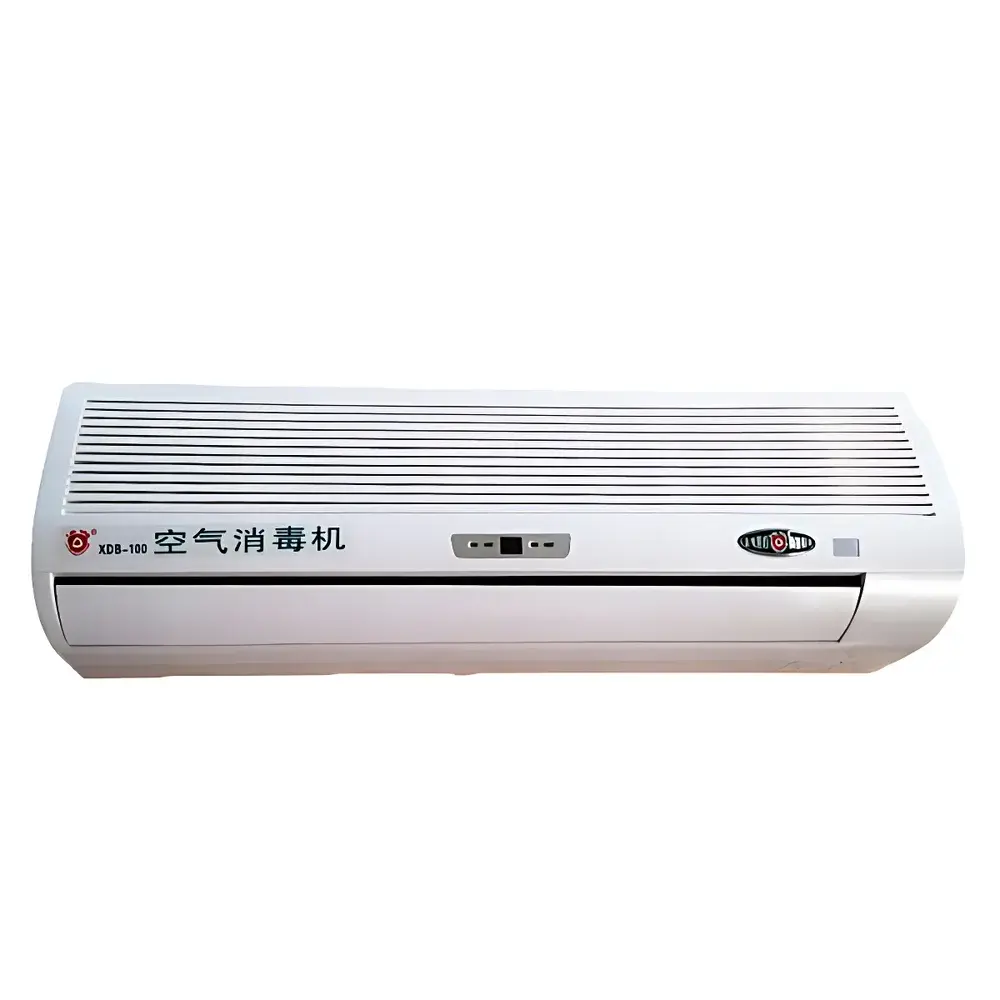
Hujing ZJQ-40 Wall-Mounted Dual-Mode Air Disinfection Unit
| Brand | Hujing Purification (HJ) |
|---|---|
| Origin | Shanghai, China |
| Manufacturer Type | OEM/ODM Manufacturer |
| Country of Origin | China |
| Model | ZJQ-40 |
| Price | USD 185 (FOB Shanghai) |
| Disinfection Modes | Dynamic (UV-C + Filtration + Negative Ions) & Static (Ozone) |
| Rated Ozone Output | 2000 mg/h |
| UV Lamp Power | 36 W |
| UV Irradiance | ≥10,000 µW/cm² |
| Total Power Consumption | 80 W |
| Noise Level | ≤50 dB(A) |
| Operating Temperature | 5–40 °C |
| Dimensions (W×H×D) | 640×225×115 mm |
| Weight | 8.2 kg |
| Safety Class | Class I, Type B |
| Compliance | GB 28235–2020, WS/T 367–2012, YY/T 1697–2020 |
Overview
The Hujing ZJQ-40 Wall-Mounted Dual-Mode Air Disinfection Unit is an engineered solution for continuous and intermittent microbial control in controlled environments where personnel occupancy and operational safety must be balanced with rigorous disinfection efficacy. Unlike single-mode air treatment systems, the ZJQ-40 integrates two physicochemically distinct disinfection modalities—dynamic mode (operational with occupants present) and static mode (unoccupied, ozone-based)—within a compact, wall-integrated architecture. Its core mechanism combines germicidal ultraviolet irradiation (254 nm UV-C), electrostatic particulate capture, activated carbon adsorption, and programmable ozone generation—all coordinated through an embedded microcontroller with real-time fault diagnostics. Designed specifically for laboratories, cleanrooms, clinical support areas, and GMP-adjacent facilities, the unit meets national Chinese standards for air disinfection performance (GB 28235–2020, WS/T 367–2012) and aligns with international best practices for non-thermal airborne pathogen reduction in low-to-moderate risk settings.
Key Features
- Two independent, user-selectable disinfection protocols: dynamic mode (UV-C + HEPA-grade filtration + negative ion emission) for occupied spaces; static mode (controlled ozone release at ≥20 mg/m³ for ≥30 min) for unoccupied surface decontamination.
- Germicidal UV-C lamp array delivering ≥10,000 µW/cm² irradiance at 1 m distance—validated per WS/T 367–2012 for ≥90% natural flora reduction on airborne and surface microorganisms.
- High-efficiency ozone generation via dielectric-barrier discharge (DBD) tube: stable output of 2000 mg/h, optimized for rapid decay post-cycle (t½ < 30 min in typical indoor ventilation conditions).
- Multi-stage air treatment train: pre-filter + medium-efficiency particulate filter (MERV 8 equivalent), electrostatic precipitator (ESP), granular activated carbon (GAC) bed, and negative ion emitter—reducing PM2.5, VOCs, and odorous compounds concurrently with microbial load.
- Comprehensive self-diagnostic system: real-time monitoring and audible/visual alerts for UV lamp failure, ozone generator malfunction, fan stall, and cumulative runtime logging (non-volatile memory retention).
- Wall-mount design (640 × 225 × 115 mm) minimizes floor footprint and enables strategic placement near HVAC returns or high-traffic entry zones without obstructing workflow.
Sample Compatibility & Compliance
The ZJQ-40 is validated for use in ambient indoor air (5–40 °C, RH ≤80%) across enclosed volumes up to 40 m³ under dynamic operation and up to 60 m³ under static ozone cycles. It complies with GB 28235–2020 (“Ultraviolet Disinfection Equipment for Air”) and YY/T 1697–2020 (“Ozone Generators for Medical Use”), including mandatory electrical safety (Class I, Type B), ozone residual limits (<0.1 ppm post-ventilation), and UV leakage thresholds (<1 µW/cm² at 5 cm). While not FDA-cleared or CE-marked for medical device use, its technical documentation supports integration into GLP-compliant environmental monitoring programs when deployed as a supplementary engineering control—not as primary sterilization equipment. It is not intended for use in ISO Class 5 or higher cleanrooms without supplemental validation.
Software & Data Management
The unit operates via a tactile membrane keypad with LCD status display and supports fully autonomous scheduling: up to 8 programmable daily cycles (on/off times, mode selection, duration). All operational logs—including total UV exposure time, ozone activation count, fault events, and cumulative runtime—are stored in onboard EEPROM and accessible via front-panel navigation. No proprietary software, cloud connectivity, or remote interface is provided; data export requires manual review only. Audit trails meet basic GLP record-keeping requirements (WS/T 367–2012 §5.4.2) but do not fulfill FDA 21 CFR Part 11 electronic signature or audit trail specifications.
Applications
- Pre-analytical sample handling zones: reducing airborne bioburden in specimen receipt, centrifugation, and aliquoting areas.
- QC/QA laboratories: maintaining background microbial levels in stability chambers, media prep rooms, and instrument calibration spaces.
- Pharmaceutical ancillary areas: disinfecting packaging inspection booths, warehouse staging zones, and staff changing rooms where full HVAC integration is impractical.
- Research animal holding rooms: supplemental air treatment during cage change cycles, adhering to AAALAC-recommended environmental hygiene thresholds.
- Biobanking support spaces: minimizing aerosolized contamination risk near cryo-storage entry vestibules and data entry stations.
FAQ
Can the ZJQ-40 be used continuously in occupied laboratory workspaces?
Yes—only in dynamic mode, which excludes ozone generation and relies solely on UV-C irradiation (with shielded lamp housing), electrostatic filtration, and negative ion emission. UV-C exposure remains below occupational safety limits (ACGIH TLV: 6 mJ/cm² per 8 h) when installed per manufacturer’s mounting guidelines.
Does the unit comply with ISO 14644 or EU GMP Annex 1 requirements?
No. It is not classified as a cleanroom air handling device and lacks particle counting, pressure differential monitoring, or HEPA certification. It may serve as a secondary mitigation tool but cannot substitute for certified HVAC filtration or laminar flow systems.
What maintenance intervals are recommended for optimal performance?
Pre-filters require cleaning every 7 days in high-dust environments; GAC and ESP components should be replaced every 6 months; UV lamps must be replaced annually or after 8,000 hours—whichever occurs first—to maintain ≥90% rated irradiance.
Is ozone residue monitoring required after static mode operation?
Yes. Users must verify ozone concentration falls below 0.1 ppm (OSHA PEL) using a calibrated ozone meter before re-entry. Ventilation time varies by room volume and airflow rate; minimum 30-minute mechanical exhaust is advised.
Can the ZJQ-40 be integrated into a building management system (BMS)?
No. It has no digital communication ports (e.g., Modbus, BACnet) or dry-contact outputs. Control remains local-only via front-panel interface.



