
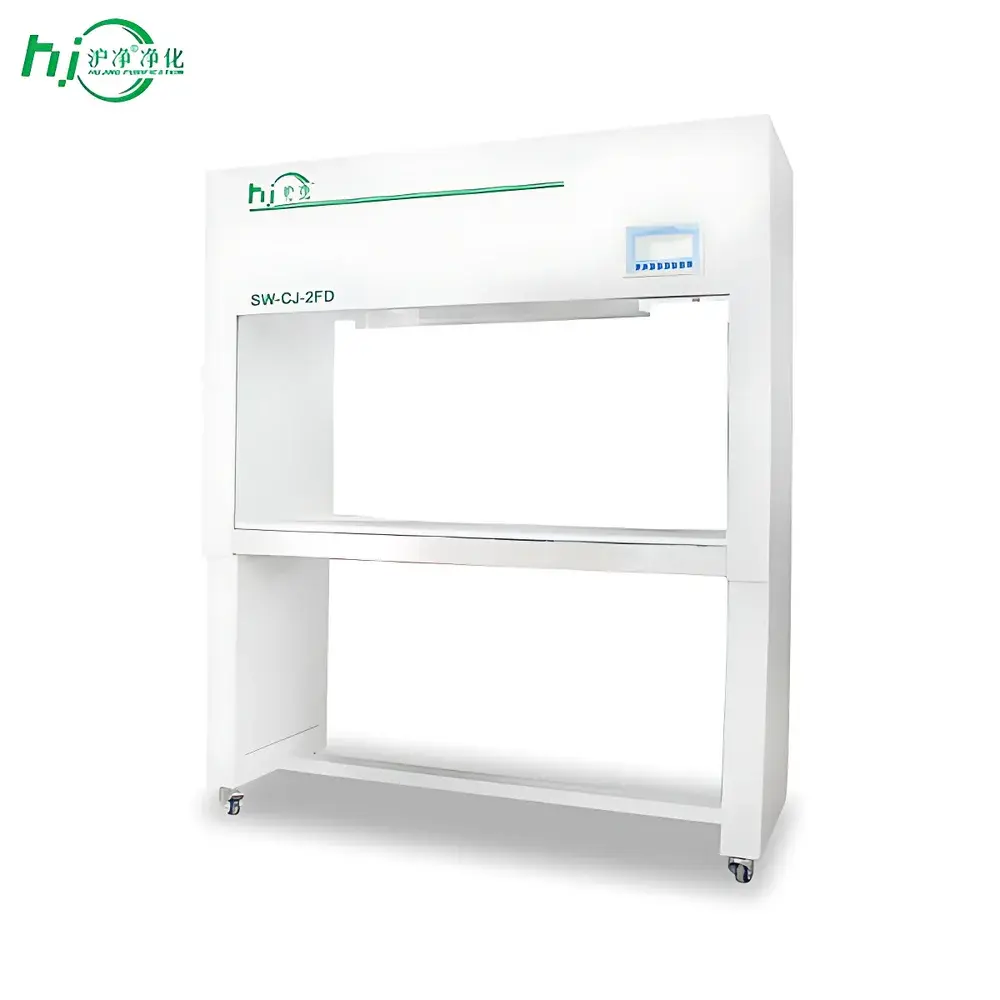
Hujing SWCJ-2FD Vertical Laminar Flow Clean Bench
| Brand | Hujing Purification (HJ) |
|---|---|
| Origin | Shanghai, China |
| Manufacturer Type | Direct Manufacturer |
| Product Category | Domestic |
| Model | SWCJ-2FD |
| Instrument Type | Vertical Flow Clean Bench |
| Cleanliness Class | ISO Class 5 (100 @ ≥0.5 µm, Fed. Std. 209E) |
| Noise Level | ≤62 dB(A) |
| User Capacity | Dual-Operator, Single-Face |
| Airflow Pattern | Vertical Downflow |
| Pre-filter | Integrated Panel-Type G4 |
| HEPA Filter | 1355 × 555 × 50 mm, H14 (EN 1822), ≥99.995% @ 0.3 µm |
| Average Face Velocity | 0.25–0.45 m/s |
| Illumination | ≥300 lx (fluorescent lamp, 20 W) |
| UV Lamp | 36 W, Timer-Controlled, Safety Interlocked with Lighting Circuit |
| Vibration | ≤5 µm (peak-to-peak, X/Y/Z) |
| Power Supply | AC 220 V / 50 Hz |
| Max. Power Consumption | 640 W |
| Net Weight | 140 kg |
| Work Area Dimensions (W×D×H) | 1370 × 650 × 580 mm |
| External Dimensions (W×D×H) | 1530 × 690 × 1600 mm |
Overview
The Hujing SWCJ-2FD Vertical Laminar Flow Clean Bench is an ISO Class 5-certified (equivalent to Federal Standard 209E Class 100) laboratory containment system engineered for personnel-protected, particle-controlled operations in microbiological, pharmaceutical, and cell culture applications. It operates on the principle of vertical unidirectional airflow: ambient air is drawn through a pre-filter (G4 grade), conditioned, and then passed through an H14-grade HEPA filter (EN 1822 compliant, ≥99.995% efficiency at 0.3 µm). The resulting laminar downflow—maintained within 0.25–0.45 m/s across the work surface—creates a sterile, low-turbulence environment that minimizes cross-contamination and protects samples from airborne particulates ≥0.5 µm. Unlike biological safety cabinets, the SWCJ-2FD does not recirculate air nor provide operator protection against hazardous aerosols; it is designed exclusively for non-hazardous, clean-process workflows where sample integrity—not personnel containment—is the primary objective.
Key Features
- Robust all-steel construction: Cold-rolled carbon steel frame with electrostatic powder coating; work surface fabricated from brushed 304 stainless steel (corrosion-resistant, non-porous, compliant with ISO 14644-1 surface cleanliness requirements)
- Vertical laminar flow architecture with quasi-closed work chamber: Optimized downward airflow profile forms a stable descending air curtain at the front opening, effectively isolating the work zone from ambient room air infiltration
- Integrated safety interlock system: UV germicidal lamp (36 W) and fluorescent lighting are electrically interlocked—UV activation is disabled when the sash is open or lighting is active, preventing accidental UV exposure
- Digital LCD control panel: Provides real-time monitoring and adjustment of UV timer (0–99 min), lighting control, and fan speed calibration; supports repeatable startup sequences for GLP-aligned SOP execution
- Modular filtration design: Removable G4 pre-filter extends HEPA service life by capturing coarse particulates; HEPA filter housed in a sealed, gasketed aluminum frame for leak-free installation and ISO 14644-3-compliant integrity testing
- Ergonomic dual-operator configuration: 1370 mm wide work area accommodates two technicians operating side-by-side on a single-face access plane, with optimized sash height and depth (650 mm) for arm insertion without turbulence disruption
Sample Compatibility & Compliance
The SWCJ-2FD is validated for use in non-hazardous aseptic procedures including media preparation, microbial plating, plant tissue culture, and reagent dispensing. Its ISO Class 5 performance has been verified per ISO 14644-1:2015 Annex B (particle counting methodology) and Fed. Std. 209E (discontinued but still referenced in legacy pharma specifications). Microbiological validation per ISO 14698-1 confirms ≤0.5 colony-forming units per 90-mm Petri dish per hour under dynamic operation. The unit complies with IEC 61000-6-3 (EMC emissions) and IEC 61000-6-1 (immunity); electrical safety conforms to GB 4793.1–2019 (equivalent to IEC 61010-1). While not certified to NSF/ANSI 49 or EN 12469, its design aligns with Good Manufacturing Practice (GMP) Annex 1 expectations for Grade A environments when installed in controlled background rooms (ISO Class 7 or better).
Software & Data Management
The SWCJ-2FD features embedded firmware—not PC-based software—with non-volatile memory storing operational logs including UV runtime, total fan hours, and manual override events. All control inputs and status outputs (e.g., filter saturation warning, door-open detection) are timestamped and retain audit trail capability for internal quality documentation. No external connectivity (USB/Ethernet/Wi-Fi) is provided, eliminating cybersecurity risks and supporting 21 CFR Part 11 compliance in environments requiring “closed system” validation. Calibration records—including face velocity mapping per ISO 14644-3—and filter integrity test reports (via DOP/PAO scanning) must be maintained manually as part of facility qualification (IQ/OQ/PQ).
Applications
- Aseptic transfer of bacterial, fungal, and mammalian cell cultures in academic and industrial labs
- Preparation of sterile culture media, buffers, and diluents under cGMP-aligned workflows
- Handling of sensitive diagnostic reagents and oligonucleotide solutions where particulate-induced degradation is a concern
- Electronics prototyping requiring particulate-free soldering or micro-assembly of optical components
- Seed germination studies and plant propagation protocols governed by ISO 21568 (plant biotechnology)
- Support function in ISO Class 7 cleanrooms serving as localized Grade A workstations for high-value sample manipulation
FAQ
What is the recommended room classification for optimal SWCJ-2FD performance?
The unit requires installation in a minimum ISO Class 7 (Fed. Std. 209E Class 10,000) environment to maintain consistent ISO Class 5 output; higher background particle loads accelerate pre-filter loading and reduce HEPA service intervals.
Can the HEPA filter be replaced in-house, and what certification is required post-replacement?
Yes—filter replacement is tool-free and follows EN 1822-defined procedures. Post-installation, a full filter integrity test (e.g., DOP/PAO scan per ISO 14644-3) and face velocity uniformity mapping must be performed by qualified personnel before requalification.
Does the SWCJ-2FD meet FDA or EU GMP Annex 1 requirements for Grade A zones?
It satisfies the technical performance criteria (airflow velocity, particle count, microbial limits) specified in Annex 1 §4.39–4.42 for localized critical zones, provided it is installed, qualified, and operated within a validated cleanroom infrastructure.
Is UV irradiation time programmable, and does the system log UV usage?
Yes—the digital timer allows preset durations from 1 to 99 minutes; however, no cumulative UV-hour logging is retained beyond session-based reset, necessitating external maintenance tracking per ISO 13485 clause 7.5.3.1.
What maintenance schedule is recommended for the pre-filter and HEPA filter?
G4 pre-filter: Replace every 3–6 months depending on ambient dust load; HEPA filter: Typically 3–5 years under continuous operation in ISO Class 7 rooms, verified annually via integrity testing and pressure drop monitoring.



