
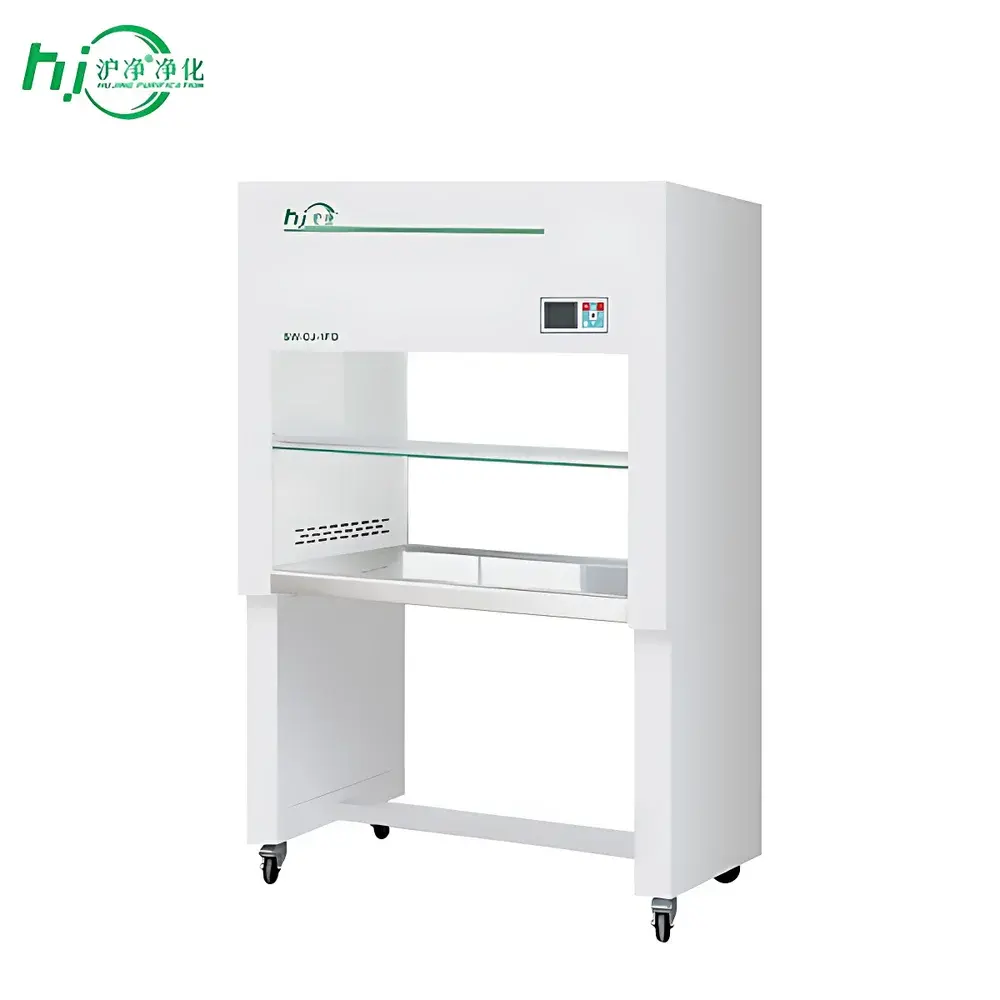
HJ SW-CJ-1FD Vertical Laminar Flow Clean Bench
| Brand | HJ Purification |
|---|---|
| Origin | Shanghai, China |
| Manufacturer Type | Direct Manufacturer |
| Product Category | Domestic |
| Model | SW-CJ-1FD |
| Price Range | USD 700–1,400 (FOB) |
| Instrument Type | Vertical Laminar Flow Clean Bench |
| Cleanliness Class | ISO Class 5 (equivalent to Federal Standard 209E Class 100 @ ≥0.5 µm) |
| Noise Level | ≤62 dB(A) |
| User Capacity | Single Operator |
| Airflow Pattern | Vertical Downflow |
| Pre-filter | Polyester Panel Filter |
| HEPA Filter | 865 × 555 × 50 mm, H14 grade (EN 1822), single unit |
| Average Air Velocity | 0.25–0.45 m/s |
| Microbial Contamination | ≤0.5 CFU/plate·hour (90 mm Petri dish) |
| Vibration | ≤5 µm (peak-to-peak, X/Y/Z axes) |
| Illumination | ≥300 lux |
| Power Supply | AC 220 V / 50 Hz |
| Max. Power Consumption | 490 W |
| Net Weight | 90 kg |
| Working Area Dimensions (W×D×H) | 880 × 650 × 580 mm |
| Overall Dimensions (W×D×H) | 1040 × 690 × 1600 mm |
| Lighting | 12 W fluorescent lamp × 1 |
| UV Lamp | 20 W germicidal lamp × 1 |
Overview
The HJ SW-CJ-1FD Vertical Laminar Flow Clean Bench is an ISO Class 5-certified laboratory containment device engineered for unidirectional, particle-free airflow in low-risk aseptic applications. Unlike biological safety cabinets, this clean bench provides personnel and environmental protection only indirectly—its primary function is to safeguard samples from airborne particulate and microbial contamination during non-hazardous procedures such as media preparation, plate pouring, component assembly, and sterile packaging. Air is drawn through a pre-filter to capture coarse particulates, then passes through an H14-grade HEPA filter (EN 1822 compliant) delivering ≥99.995% efficiency at 0.3 µm. The filtered air exits vertically downward across the work surface at a controlled velocity of 0.25–0.45 m/s, forming a continuous laminar curtain that isolates the working area from ambient room air. Designed per Federal Standard 209E and aligned with ISO 14644-1 requirements, it maintains ≤0.5 colony-forming units per 90 mm Petri dish per hour under standard test conditions.
Key Features
- Vertically oriented laminar airflow architecture with adjustable sash window for ergonomic access and operator flexibility
- Structural frame fabricated from cold-rolled steel with electrostatic powder coating; work surface constructed from brushed 304 stainless steel for corrosion resistance, chemical compatibility, and ease of decontamination
- Interlocked lighting and UV irradiation system: UV lamp (20 W, 254 nm) automatically de-energizes when fluorescent lamp (12 W) is activated—and vice versa—to prevent accidental exposure and ensure operational safety
- Digital LCD control panel with programmable UV timer (0–60 min), real-time airflow status indicator, and manual override functions
- Optimized aerodynamic design featuring a near-closed front aperture and downward-facing flow profile to minimize turbulence and maintain stable downflow integrity across the entire work zone
- Dual-stage filtration: washable polyester pre-filter extends service life of the main H14 HEPA filter and reduces long-term maintenance frequency
Sample Compatibility & Compliance
The SW-CJ-1FD is intended for use with non-volatile, non-toxic, non-aerosol-generating materials. It supports routine microbiological workflows including agar plate handling, cell culture passaging (non-pathogenic lines), pharmaceutical component staging, and electronics assembly where particulate control is critical. It complies with ISO 14644-1:2015 (Class 5), US Federal Standard 209E (Class 100), and meets general laboratory infrastructure requirements under CLSI M29-A4 and EU GMP Annex 1 (for Grade A background environments). Note: This unit is not certified for biosafety level 2 or higher agents, nor does it provide protection against chemical vapors or radionuclides. Installation requires placement in ISO Class 7 or cleaner ambient space with minimal cross-drafts.
Software & Data Management
This clean bench operates as a standalone mechanical system without embedded software or network connectivity. All controls are local and analog/digital hybrid—no firmware, no data logging, and no remote interface. However, its design supports integration into GLP/GMP-compliant facilities via external validation protocols. Users may document operational parameters (e.g., UV cycle logs, filter replacement dates, airflow verification reports) using paper-based or LIMS-linked SOP templates. Routine certification—including airflow uniformity mapping, filter integrity testing (via DOP/PAO scan), and particle count validation—should be performed per ISO 14644-3 and conducted annually or after filter replacement. The unit includes mounting points and documentation support for IQ/OQ/PQ execution.
Applications
- Preparation of microbiological growth media and sterile diluents in academic and clinical labs
- Aseptic transfer of non-pathogenic bacterial or yeast cultures in teaching and R&D settings
- Assembly and inspection of precision optical or microelectronic components requiring particulate-free handling
- Pharmaceutical secondary packaging operations where ISO Class 5 air quality is mandated by internal quality standards
- Botanical extract formulation and analytical sample staging prior to HPLC or GC injection
- Quality control activities for medical device manufacturers operating under ISO 13485
FAQ
Is the SW-CJ-1FD suitable for handling BSL-2 organisms?
No. This is a clean bench—not a biosafety cabinet—and offers no personnel or environmental protection against aerosols or splashes. BSL-2 work requires a Class II Type A2 or B2 biological safety cabinet.
What is the recommended HEPA filter replacement interval?
Under typical usage (6–8 hrs/day, ISO Class 7 environment), replace the H14 filter every 18–24 months—or sooner if manometer differential pressure exceeds 250 Pa or airflow velocity falls below 0.25 m/s.
Can this unit be installed in a non-ISO classified room?
Yes, but performance and longevity will degrade significantly. Optimal operation requires ambient air cleanliness no worse than ISO Class 7 (10,000); uncontrolled environments increase pre-filter loading and HEPA fouling rates.
Does the unit include calibration certificates or factory test reports?
Standard delivery includes a Certificate of Conformance and basic installation checklist. Optional third-party airflow and particle certification reports are available upon request at additional cost.
Is the UV lamp ozone-free?
Yes. The 20 W low-pressure mercury lamp emits primarily at 254 nm and produces negligible ozone under normal operating conditions.



