Shanghai Hujing BM-100 Airborne Microbial Sampler Calibrator
| Brand | Shanghai Hujing (HJ) |
|---|---|
| Origin | Shanghai, China |
| Manufacturer Type | Direct Manufacturer |
| Country of Origin | PRC |
| Model | BM-100 |
| Flow Accuracy | ±1% FS |
| Flow Range | 0–200 L/min |
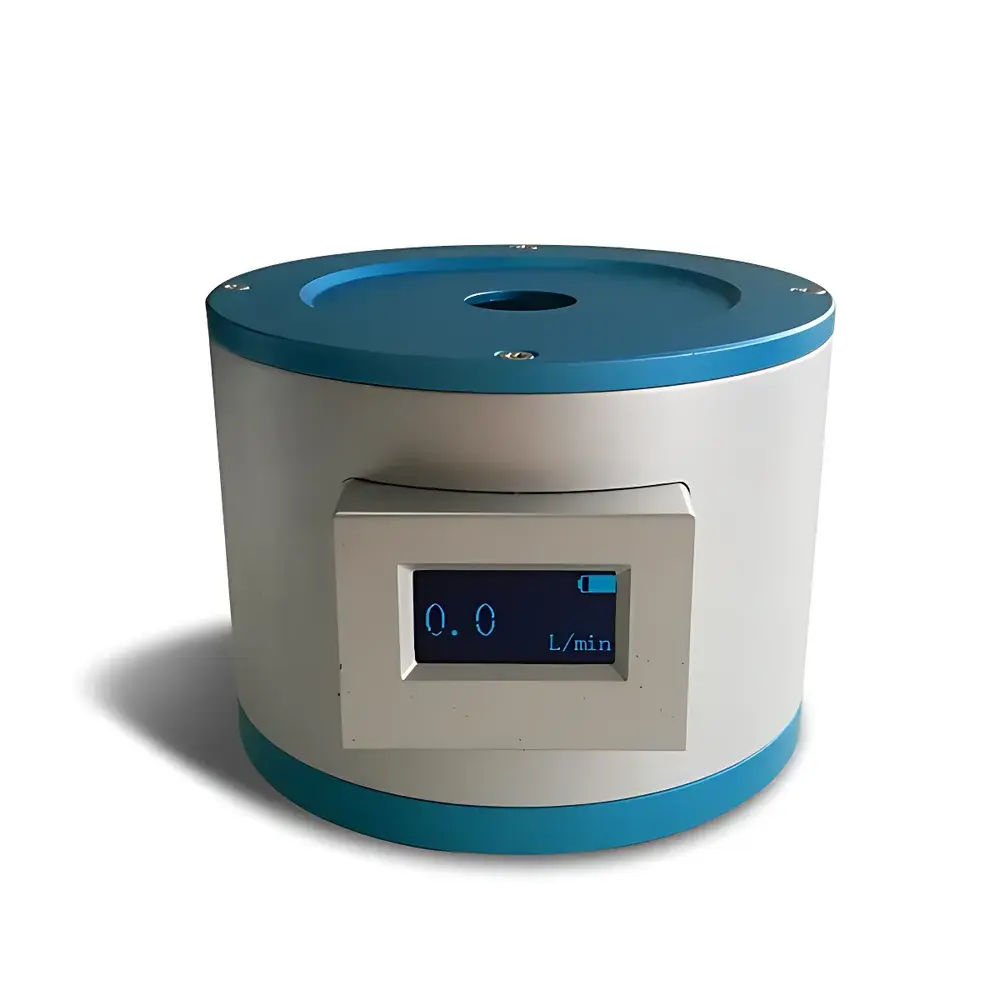
| Dimensions | Ø110 mm × 87 mm |
| Weight | 0.85 kg |
| Power Supply | 7.4 V Li-ion battery (3000 mAh) |
| Charger Input | 8.4 V DC, 1 A |
| Display Update Rate | 1 Hz |
| Operating Interface | Single-button activation |
| Compliance | Designed for ISO 14698-1, ISO 14644-1, and EU GMP Annex 1 environmental monitoring workflows |
Overview
The Shanghai Hujing BM-100 Airborne Microbial Sampler Calibrator is a portable, high-accuracy flow verification instrument engineered specifically for routine calibration and performance validation of membrane-based (micro-orifice) active air samplers used in controlled environments. It operates on the principle of thermal mass flow measurement—employing a calibrated hot-wire anemometric sensor array to determine volumetric airflow without introducing backpressure or flow resistance into the sampling train. This non-intrusive design ensures that calibration measurements reflect true operational conditions, eliminating flow deviation artifacts commonly observed with restrictive inline calibrators. The BM-100 is intended for use in cleanroom qualification, pharmaceutical manufacturing facilities, hospital isolation rooms, and biosafety laboratories where regulatory adherence to ISO 14698-1 (Biocontamination control), ISO 14644-1 (Air cleanliness classification), and EU GMP Annex 1 (Manufacture of sterile medicinal products) is mandatory. Its compact form factor and battery-powered operation enable field-deployable verification across multiple sampling locations without dependency on fixed infrastructure.
Key Features
- Thermal mass flow sensing technology with ±1% full-scale accuracy—traceable to national metrological standards
- Zero-pressure-drop calibration methodology preserves native sampler performance during verification
- Real-time flow display updated at 1 Hz, enabling dynamic observation of flow stability during startup and steady-state operation
- Single-button interface with auto-wake and auto-shutdown logic minimizes operator training requirements
- Integrated 7.4 V lithium-ion battery (3000 mAh capacity) supports >8 hours of continuous operation per charge
- Compact cylindrical housing (Ø110 mm × 87 mm; 0.85 kg) optimized for handheld use and integration into mobile cleanroom audit kits
- No external power supply required during calibration—eliminates grounding risks and electrical interference in sensitive environments
Sample Compatibility & Compliance
The BM-100 is compatible with all standard micro-orifice airborne microbial samplers utilizing 100 mm or 142 mm Petri dish formats—including but not limited to variants from Merck Millipore (AirPort™), Thermo Fisher Scientific (Microbial Air Sampler MAS-100), BioMérieux (MAS-100 NT), and domestic Chinese manufacturers compliant with YY/T 0998-2015. Calibration results are documented in accordance with ALCOA+ data integrity principles: attributable, legible, contemporaneous, original, accurate, complete, consistent, enduring, and available. While the BM-100 itself does not generate electronic records with audit trails, its analog output and real-time display support manual entry into validated paper-based or LIMS-integrated calibration logs meeting FDA 21 CFR Part 11 and EU Annex 11 expectations when paired with appropriate procedural controls.
Software & Data Management
The BM-100 operates as a standalone hardware calibrator with no embedded firmware-based data logging or USB/Bluetooth connectivity. All measurement data must be manually recorded by qualified personnel in accordance with site-specific Standard Operating Procedures (SOPs). For digital integration, users may pair the BM-100 with external tablet-based calibration management systems via visual readout capture (e.g., using time-stamped video or still-image documentation). Such workflows are routinely accepted during MHRA, FDA, and EMA inspections when supported by documented change control, user access restrictions, and periodic accuracy verification against NIST-traceable reference standards.
Applications
- Pre- and post-sampling verification of volumetric flow rate for ISO 14698-1 bioaerosol monitoring campaigns
- Periodic performance qualification (PQ) of active air samplers during cleanroom re-certification
- Root-cause analysis of low colony recovery—distinguishing between microbiological viability issues and mechanical flow drift
- Supporting risk-based environmental monitoring (REMM) strategies under ICH Q9 and Q10 frameworks
- Training and competency assessment for QC microbiology technicians in GMP-regulated settings
- Field validation of portable samplers deployed in HVAC commissioning and containment testing
FAQ
Does the BM-100 require annual recalibration?
Yes. To maintain traceability and measurement confidence, it is recommended that the BM-100 undergoes annual calibration against a NIST-traceable primary standard flow meter in an accredited laboratory.
Can the BM-100 be used to calibrate impaction-type samplers?
No. The BM-100 is validated exclusively for micro-orifice membrane samplers. Impaction-based devices (e.g., Andersen cascade impactors) require separate velocity profile and particle collection efficiency validation per ISO 14644-3 Annex B.
Is the battery replaceable by the end user?
The lithium-ion cell is field-replaceable using standard Torx tools; however, replacement must be performed by authorized service personnel to preserve IP rating and metrological integrity.
What environmental conditions affect BM-100 accuracy?
Operation outside 15–30°C ambient temperature or >80% RH may induce thermal drift; users should allow 15-minute thermal stabilization before critical measurements.
Does the BM-100 meet FDA 21 CFR Part 11 requirements?
As a non-data-logging analog instrument, the BM-100 complies with Part 11’s “system suitability” clause when incorporated into a broader validated calibration process—including defined roles, documented procedures, and independent review of manual entries.