
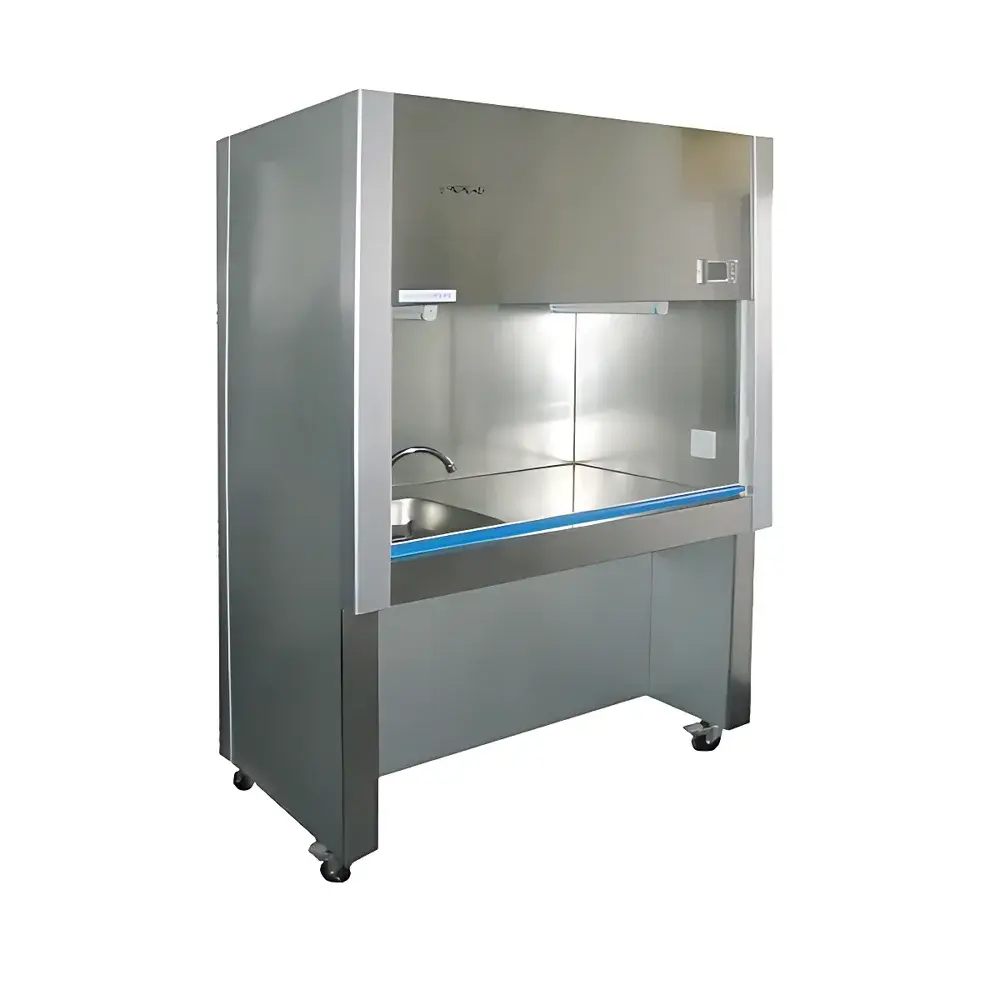
HJ SW-TFG-18 Steel-and-Wood Single-Face Laboratory Fume Hood
| Brand | HJ Purification |
|---|---|
| Origin | Zhejiang, China |
| Manufacturer Type | Direct Manufacturer |
| Country of Origin | China |
| Model | SW-TFG-18 |
| Housing Material | Steel-and-Wood Construction |
| Configuration | Single-Face Operation |
| Face Velocity Range | 0.25–0.45 m/s (adjustable) |
| Minimum Water Supply Pressure | >0.5 bar |
| Electrical Supply | AC 220 V, 50 Hz |
| Max. Power Consumption | 800 W |
| Net Weight | <350 kg |
| Work Area Dimensions (W×D×H) | 1600 × 695 × 580 mm |
| Overall Dimensions (W×D×H) | 1755 × 760 × 1950 mm |
| Exhaust Duct | Ø160 mm, 1 m straight + elbow |
| Lighting | 2 × 20 W fluorescent lamps |
| Control Interface | Digital LCD panel with dual-speed fan control (low/high) |
| Work Surface | Full SUS304 brushed stainless steel or optional PP lining |
| Integrated Features | Five-port GFCI outlet, quick-release water valve, adjustable sash window, built-in stainless steel sink (optional), sealed high-density fire-retardant MDF frame with stainless steel/PP cladding |
| Compliance | Designed to meet ISO 10974:2018 structural safety guidelines and ASHRAE 110–2016 performance testing protocols for laboratory fume hoods |
Overview
The HJ SW-TFG-18 is a single-face, steel-and-wood constructed laboratory fume hood engineered for reliable containment of hazardous vapors, aerosols, and particulates generated during routine chemical handling, synthesis, and analytical procedures. It operates on the principle of negative-pressure airflow management: ambient air is drawn inward across the sash opening at a controlled face velocity (0.25–0.45 m/s), passes through the work area where contaminants are captured, and is exhausted via a dedicated ducted system. This dynamic containment strategy conforms to internationally recognized performance benchmarks defined in ASHRAE Standard 110–2016 and supports compliance with ISO 10974:2018 for structural integrity and operational safety in non-ducted and ducted fume hood installations. The unit integrates mechanical, electrical, plumbing, and ventilation subsystems into a unified platform—enabling plug-and-play deployment without requiring external integration engineering.
Key Features
- Robust structural frame fabricated from five-layer fire-retardant high-density MDF, clad with either electropolished SUS304 stainless steel or chemically resistant polypropylene (PP) lining—ensuring long-term dimensional stability and corrosion resistance.
- Adjustable vertical sash window with tempered safety glass, enabling precise control over airflow dynamics and operator exposure risk during variable workflow conditions.
- Dual-speed digital LCD controller providing real-time monitoring and selection between low- and high-velocity exhaust modes—optimized for energy efficiency during standby and maximum capture velocity during active use.
- Integrated utility infrastructure: two 20 W fluorescent lamps (CE-certified), one GFCI-protected five-port power outlet (IEC 60320 C13/C14 compatible), quick-action water valve, and optional stainless steel sink with drain assembly—all pre-wired and pre-plumbed within the work surface cavity.
- Factory-assembled Ø160 mm rigid PVC exhaust duct (1 m straight section + 90° elbow) included as standard—designed for direct connection to building exhaust risers or centralized HVAC plenums.
- Face velocity calibrated and verified per ASHRAE 110 tracer gas test methodology; full documentation provided for GLP/GMP audit readiness.
Sample Compatibility & Compliance
The SW-TFG-18 accommodates standard bench-scale glassware (up to 2 L round-bottom flasks, condenser assemblies, separatory funnels) and modular instrumentation such as pH meters, burettes, and small-scale distillation setups. Its work area depth (695 mm) ensures adequate clearance behind apparatus while maintaining effective containment. All internal surfaces comply with ISO 15190:2020 requirements for laboratory safety equipment material compatibility. Optional PP lining extends suitability for strong acids (e.g., concentrated HNO₃, HF), halogenated solvents, and oxidizing agents. The unit meets CE marking requirements for electromagnetic compatibility (EMC Directive 2014/30/EU) and low-voltage safety (LVD Directive 2014/35/EU). While not certified to UL 1805 or EN 14175 by default, it is fully configurable to satisfy site-specific validation protocols under ISO/IEC 17025-accredited laboratory quality systems.
Software & Data Management
This fume hood operates as a standalone mechanical device with no embedded firmware or network connectivity. However, its digital LCD interface logs cumulative runtime hours and records fan speed selections—data accessible via front-panel query. For laboratories implementing centralized monitoring (e.g., BMS or LabVantage), analog 4–20 mA output signals (optional add-on) can be configured to relay face velocity, sash position, and fault status to supervisory SCADA platforms. Audit trails—including date/time stamps of mode changes—are retained locally for ≥12 months and exportable via USB interface (firmware upgrade kit required). All operational parameters align with FDA 21 CFR Part 11 data integrity principles when paired with validated electronic record systems.
Applications
- General chemistry teaching labs requiring ANSI/AIHA Z9.5-compliant ventilation for undergraduate instruction in titration, extraction, and reflux techniques.
- QC/QA laboratories performing raw material identification, solvent recovery, or stability-indicating assays involving volatile organic compounds (VOCs).
- Pharmaceutical R&D environments conducting early-stage API synthesis where intermittent low-to-moderate hazard exposure occurs.
- Environmental testing facilities processing soil/water extracts using acid digestion or Soxhlet extraction methods.
- Veterinary diagnostic labs handling formalin-fixed tissue specimens or disinfectant formulations containing glutaraldehyde or quaternary ammonium compounds.
FAQ
Is the SW-TFG-18 suitable for perchloric acid digestion?
No—this model lacks the wash-down capability, inert metal ducting, and explosion-proof motor required for perchloric acid applications. A dedicated perchloric acid hood with stainless steel interior and chilled-water scrubber is recommended.
Can the unit be retrofitted with variable air volume (VAV) control?
Yes—external VAV actuators and differential pressure sensors may be interfaced via the optional 4–20 mA I/O module; factory calibration and commissioning support available upon request.
What maintenance intervals are specified for fan and filter components?
The centrifugal exhaust fan requires biannual inspection for belt tension and bearing lubrication; no filters are installed in this ducted configuration—maintenance focuses on sash track cleaning, gasket integrity verification, and velocity recalibration every six months.
Does the unit include certification documentation for installation validation?
Yes—each shipment includes ASHRAE 110 test report (performed at factory), dimensional compliance certificate, electrical safety test record, and material traceability documentation for all SUS304 components.
Is remote monitoring supported out-of-the-box?
No—remote access requires integration with third-party building management software; HJ provides Modbus RTU protocol specifications and pinout diagrams for seamless interoperability.



