
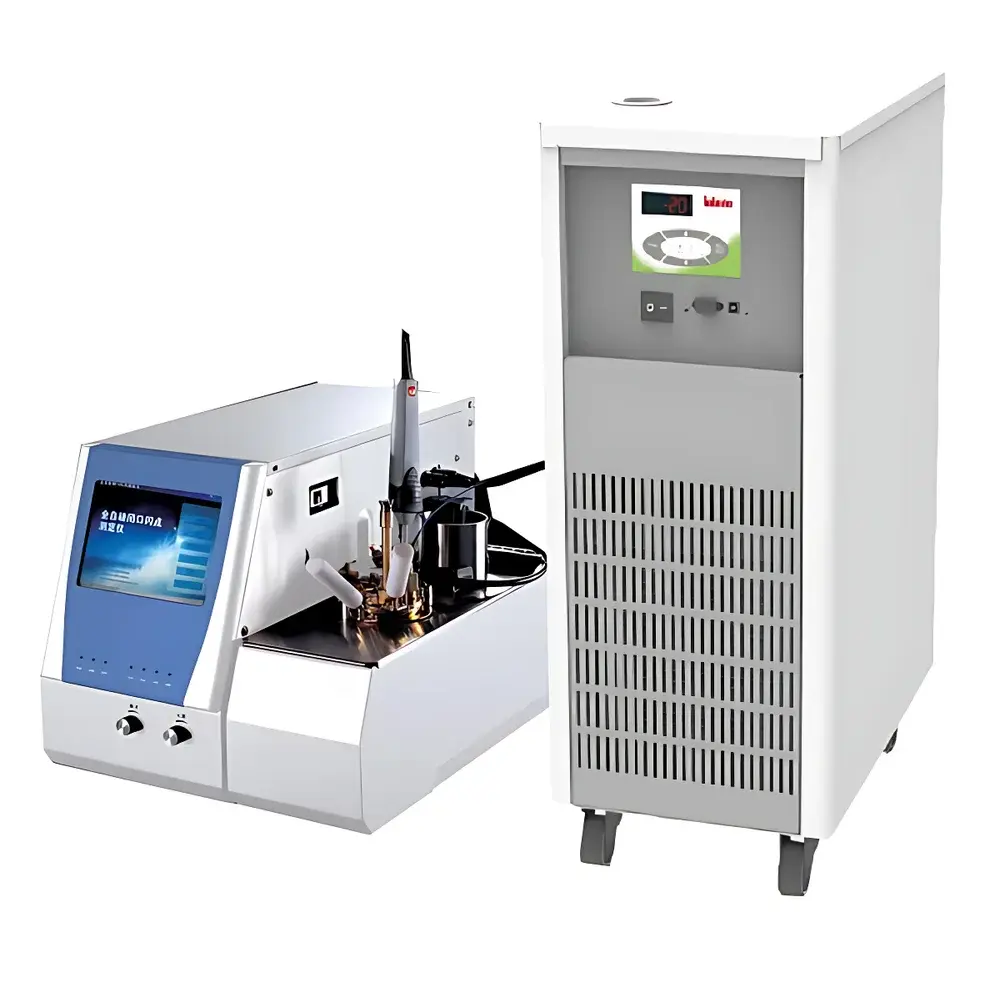
Karrie EFP410 Automatic Abel Closed-Cup Flash Point Tester
| Brand | Karrie |
|---|---|
| Model | EFP410 |
| Origin | Shenzhen, China |
| Detection Method | Abel Closed-Cup Method |
| Applicable Standards | GB/T 21789, ISO 13736 |
| Temperature Range | −30 °C to +80 °C (with external chiller) |
| Temperature Sensor | PT100 Platinum Resistance Thermometer |
| Display | 6.4″ TFT LCD (24-bit true color, touch-enabled) |
| Cooling | Compressor-based recirculating chiller |
| Heating Rate | 1 °C/min (programmable & verifiable) |
| Stirring Speed | 0.5 r/s (30 rpm) |
| Ignition Options | Electronic spark or gas flame |
| Power Supply | AC 220 V ±10%, 50 Hz |
| Total Power Consumption | ≤650 W (main unit) |
| Weight | 25 kg |
| Environmental Operating Conditions | 10–40 °C ambient, RH ≤80% |
Overview
The Karrie EFP410 Automatic Abel Closed-Cup Flash Point Tester is a precision-engineered instrument designed for the standardized determination of flash point in petroleum products and other flammable liquids within the temperature range of −30 °C to +80 °C. It operates strictly in accordance with the principles and procedural requirements defined in GB/T 21789 and ISO 13736 — both of which specify the Abel closed-cup method for low-flash-point materials. Unlike open-cup techniques, the Abel method employs a sealed test cup with controlled vapor accumulation and timed ignition, ensuring high reproducibility under stringent thermal and mechanical conditions. The instrument integrates thermodynamic control, real-time sensor feedback, and fail-safe thermal management to deliver compliance-ready results suitable for quality control laboratories, refinery QC departments, and regulatory testing facilities operating under ISO/IEC 17025-accredited workflows.
Key Features
- Dual-layer control architecture: A dedicated microcontroller handles real-time heating control and sensor acquisition (PT100, flash detection), while an industrial-grade embedded PC (256 MB RAM, 4 GB flash storage) runs Windows CE 5.0 for system coordination, data logging, and UI rendering — ensuring deterministic timing and immunity to host-level OS vulnerabilities.
- True-color 6.4″ TFT touchscreen display with graphical temperature ramp visualization; supports on-screen curve zoom, numeric rate readout, and dual-unit (°C/°F) toggling.
- Modular mechanical design: Independent mounting of the gold-plated brass test cup assembly, flash sensor, and PT100 probe enables field-replaceable component service without recalibration.
- Redundant ignition options: User-selectable electronic spark or butane gas flame ignition — both validated to yield statistically equivalent flash point outcomes per ASTM D3278 and ISO 13736 interlaboratory studies.
- Comprehensive self-diagnostic suite: Automated pre-test verification of flash sensor continuity, PT100 calibration offset, ignition circuit integrity, stirrer motor function, thermal fuse status, and chiller communication — with audible alarm and on-screen fault code (e.g., “Flash Sensor Open Circuit”) upon failure.
- Triple-stage thermal safety protocol: Audible/visual alert at user-configurable warning threshold; automatic test suspension and forced-air cooling activation at absolute cutoff (400 °C) or user-defined stop temperature.
- Barometric pressure compensation algorithm compliant with ISO 3405 Annex B, enabling traceable correction of observed flash point to standard atmospheric pressure (101.3 kPa).
Sample Compatibility & Compliance
The EFP410 is validated for use with diesel fuels, kerosene, naphthas, solvent blends, biodiesel intermediates, and other low-viscosity hydrocarbon liquids exhibiting flash points between −30 °C and +70 °C. Its closed-cup geometry minimizes vapor loss and suppresses convective interference, making it especially suitable for volatile, low-boiling fractions where Pensky-Martens or Cleveland open-cup methods introduce significant uncertainty. All hardware components — including the gold-plated cup assembly and Japanese-sourced gearmotor — meet material compatibility requirements for repeated exposure to aromatic and chlorinated solvents. The instrument supports audit-ready operation under GLP and GMP environments via timestamped, user-logged test records and optional LIMS integration through RS-232 or Ethernet (RJ-45). While not FDA 21 CFR Part 11-certified out-of-the-box, its data export functionality (CSV via USB) and immutable local storage (≥10,000 test records) facilitate validation by end-user QA teams.
Software & Data Management
The embedded Windows CE 5.0 interface provides full English-language operation (localizable to other languages via firmware update). Test parameters — including target temperature, ramp rate, ignition delay, and atmospheric pressure — are configurable per ASTM D93 and ISO 13736 Annex A. Results are stored with metadata: date/time stamp, operator ID, sample ID, ambient conditions, and raw sensor traces. Data export is supported via USB mass storage mode (no driver required) or direct printing via LPT port to networked laser printers. Optional firmware upgrades and calibration certificate import are performed over USB. All stored records include SHA-256 hash integrity verification to prevent tampering — a prerequisite for ISO/IEC 17025 Clause 7.7.2 documentation control.
Applications
- Refinery off-gas condensate and light naphtha flash point verification prior to storage or transport
- Quality release testing of aviation turbine fuel (Jet A-1) per DEF STAN 91-91 and ASTM D1655
- Batch certification of bioethanol-blended gasoline (E10/E15) in accordance with EN 228
- Regulatory compliance testing for UN Transport Class 3 flammability classification (UN Manual of Tests and Criteria, Part III, Section 32.3)
- R&D screening of novel synthetic lubricants and functional fluids during formulation development
FAQ
Does the EFP410 comply with ASTM D3278?
Yes — although optimized for GB/T 21789 and ISO 13736, its thermal ramp fidelity, cup geometry, and ignition timing meet the essential performance criteria of ASTM D3278 for low-flash liquids.
Can the instrument operate without the external chiller?
No — the −30 °C lower limit requires active refrigeration; the integrated compressor chiller is mandatory for sub-ambient testing.
Is third-party calibration support available?
Yes — Karrie provides NIST-traceable calibration services and issues ISO/IEC 17025-compliant certificates upon request.
What maintenance intervals are recommended?
Annual verification of PT100 linearity and flash sensor sensitivity is advised; cup cleaning with anhydrous ethanol after each test series is required to prevent residue buildup.
How is atmospheric pressure measured for correction?
Users manually input local barometric pressure (kPa or mmHg) at test initiation; the instrument applies the ISO 3405 correction polynomial in real time.





