
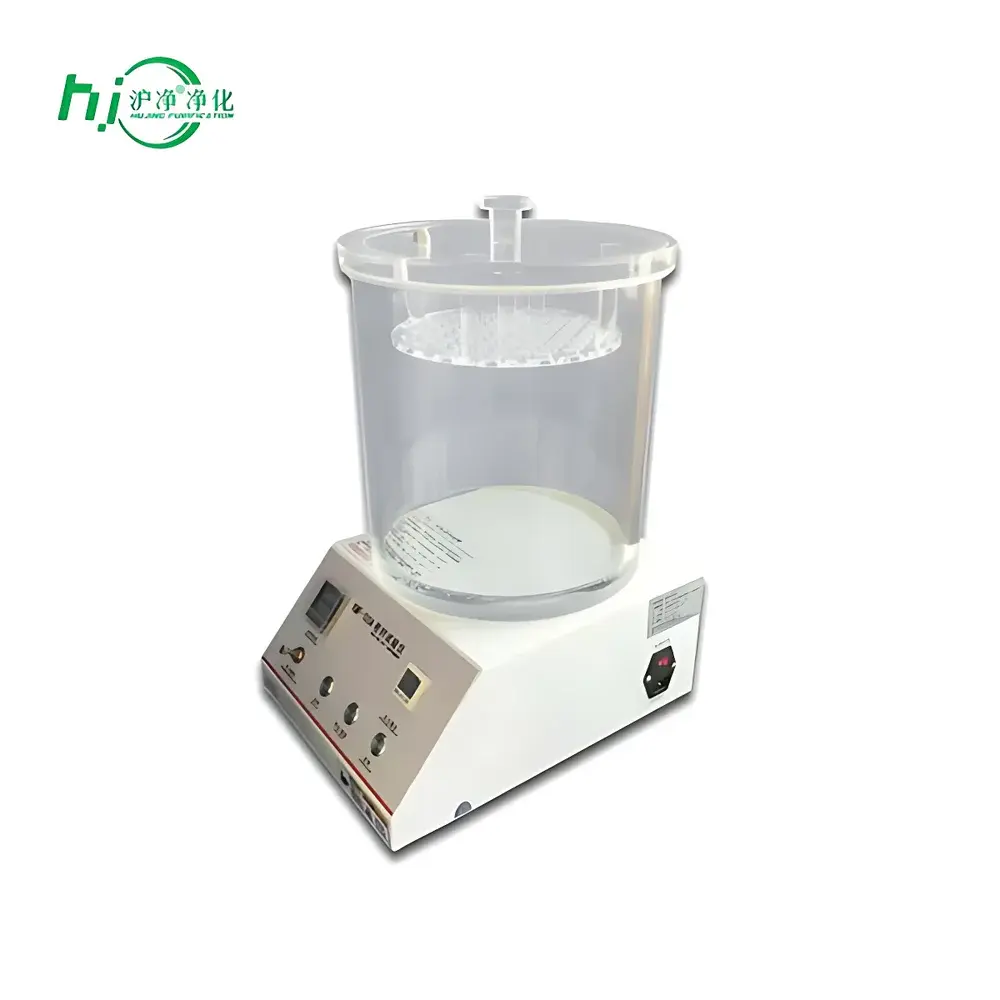
HJ Wit-900 Packaging Integrity Tester
| Brand | HJ Purification |
|---|---|
| Origin | Shanghai, China |
| Manufacturer Type | Direct Manufacturer |
| Country of Origin | China |
| Model | Wit-900 |
| Pricing | Available Upon Request |
| Vacuum Range | 0 to –90 kPa |
| Accuracy Class | Class 1 |
| Standard Vacuum Chamber Dimensions | Φ270 mm × 160 mm (H) |
| Optional Chamber Sizes | Φ270 mm × 260 mm (H), Φ270 mm × 300 mm (H), Φ370 mm × 260 mm (H), Φ470 mm × 260 mm (H) |
| Air Supply Pressure | 0.7 MPa |
| Air Inlet Fitting | Φ6 mm Polyurethane Tubing |
| Overall Dimensions | 300 mm (L) × 380 mm (W) × 500 mm (H) |
| Power Supply | AC 220 V, 50 Hz |
| Net Weight | 15 kg |
| Compliance Standards | GB/T 15171, ASTM D3078 |
Overview
The HJ Wit-900 Packaging Integrity Tester is an automated, high-reproducibility vacuum decay-based leak detection system engineered for quantitative and qualitative assessment of package seal integrity across regulated and industrial manufacturing environments. It operates on the principle of controlled negative pressure application within a sealed test chamber—submerging or suspending the sample under vacuum to induce differential pressure across its barrier structure. Seal failure is detected either by visual observation of air bubble emission (per ASTM D3078 “Bubble Emission Test”) or by dimensional response analysis: expansion under vacuum followed by recovery kinetics upon pressure release (per GB/T 15171). This dual-mode methodology enables reliable discrimination between gross leaks (>100 µm equivalent orifice), micro-leaks (1–100 µm), and marginal seal defects that may compromise shelf life, sterility, or product stability. The instrument is not a qualitative pass/fail indicator alone; it delivers traceable, time-stamped, pressure-profiled test records suitable for audit-ready documentation in GMP, GLP, and ISO 13485 contexts.
Key Features
- Microprocessor-controlled vacuum generation with digital presetting of target vacuum level (0 to –90 kPa) and dwell duration—ensuring method consistency across operators and shifts.
- Automated vacuum maintenance via real-time pressure feedback and precision pneumatic replenishment, sustaining user-defined vacuum conditions within ±1 kPa tolerance during test hold phase.
- Integrated automatic venting and reverse-air purge function at test conclusion, preventing residual vacuum lock and enabling rapid sample removal without manual intervention.
- High-stability pneumatic components sourced from globally recognized suppliers, validated for >50,000 operational cycles and compatible with cleanroom-grade compressed air (ISO 8573-1 Class 2).
- Backlit LCD interface with intuitive PVC membrane keypad—supporting multilingual menu navigation (English default), parameter recall, and real-time vacuum curve visualization.
- Modular vacuum chamber architecture with five standard and customizable dimension options (including extended height and diameter variants), accommodating flexible packaging formats from single-dose blister cards to large-volume pouches and rigid containers.
Sample Compatibility & Compliance
The Wit-900 accommodates a broad spectrum of primary and secondary packaging configurations: thermoformed aluminum-plastic blisters, heat-sealed PE/PP laminated pouches, HDPE/PET bottles, collapsible tubes, sterile barrier systems (SBS), Tyvek®-lidded trays, and CO₂-flushed flexible packs. Its design conforms to critical regulatory frameworks governing packaging validation—including USP “Packaging Integrity Evaluation”, FDA Guidance for Industry on Container Closure Systems, and Annex 1 (2022) requirements for sterile product packaging. All test protocols are fully traceable and support 21 CFR Part 11-compliant electronic signatures when paired with validated laboratory information management system (LIMS) integration. Calibration certificates and IQ/OQ documentation packages are available upon request to support equipment qualification per GAMP 5 guidelines.
Software & Data Management
While the base unit operates as a standalone instrument with embedded firmware, optional PC-based software provides enhanced data governance capabilities: automated report generation (PDF/CSV), trend analysis of vacuum decay rates over time, batch-level statistical process control (SPC) charting, and secure role-based user access control. Audit trails record all parameter modifications, test initiations, and result approvals—including timestamps, operator IDs, and IP addresses where networked. Data export complies with ALCOA+ principles (Attributable, Legible, Contemporaneous, Original, Accurate, Complete, Consistent, Enduring, Available), ensuring readiness for regulatory inspection.
Applications
- Pharmaceutical: Validation of sterile barrier integrity for vials, syringes, and blister packs prior to sterilization and release.
- Medical Devices: Leak testing of peel-open pouches containing Class II/III devices under ISO 11607-1.
- Foods & Beverages: Detection of compromised seals in retort pouches, vacuum-packed meats, and modified-atmosphere (MAP) trays.
- Consumer Health: QC screening of tamper-evident closures, child-resistant packaging, and moisture-sensitive desiccant sachets.
- Electronics: Verification of hermeticity in moisture-barrier packaging for PCBs, sensors, and MEMS components.
FAQ
What standards does the Wit-900 comply with?
It meets GB/T 15171 (Chinese national standard for soft package seal testing) and ASTM D3078 (U.S. standard for bubble emission leak detection), and supports method development aligned with USP , ISO 11607, and ISO 20957.
Can the Wit-900 detect CO₂-specific leakage?
Yes—the instrument detects any gas-phase leakage regardless of composition; for CO₂-flushed packages, it verifies structural integrity of the seal against internal pressurization loss, though it does not quantify CO₂ concentration.
Is calibration traceable to national standards?
Vacuum sensor calibration is performed using NIST-traceable reference manometers; full calibration certificates with uncertainty budgets are provided upon request.
Does the system support IQ/OQ protocol execution?
Yes—HJ provides vendor-qualified IQ/OQ templates and on-site qualification support for GMP-regulated facilities.
What maintenance is required for long-term reliability?
Routine checks include filter replacement every 6 months, O-ring inspection per 1,000 cycles, and annual verification of vacuum pump oil and pressure transducer drift.





