
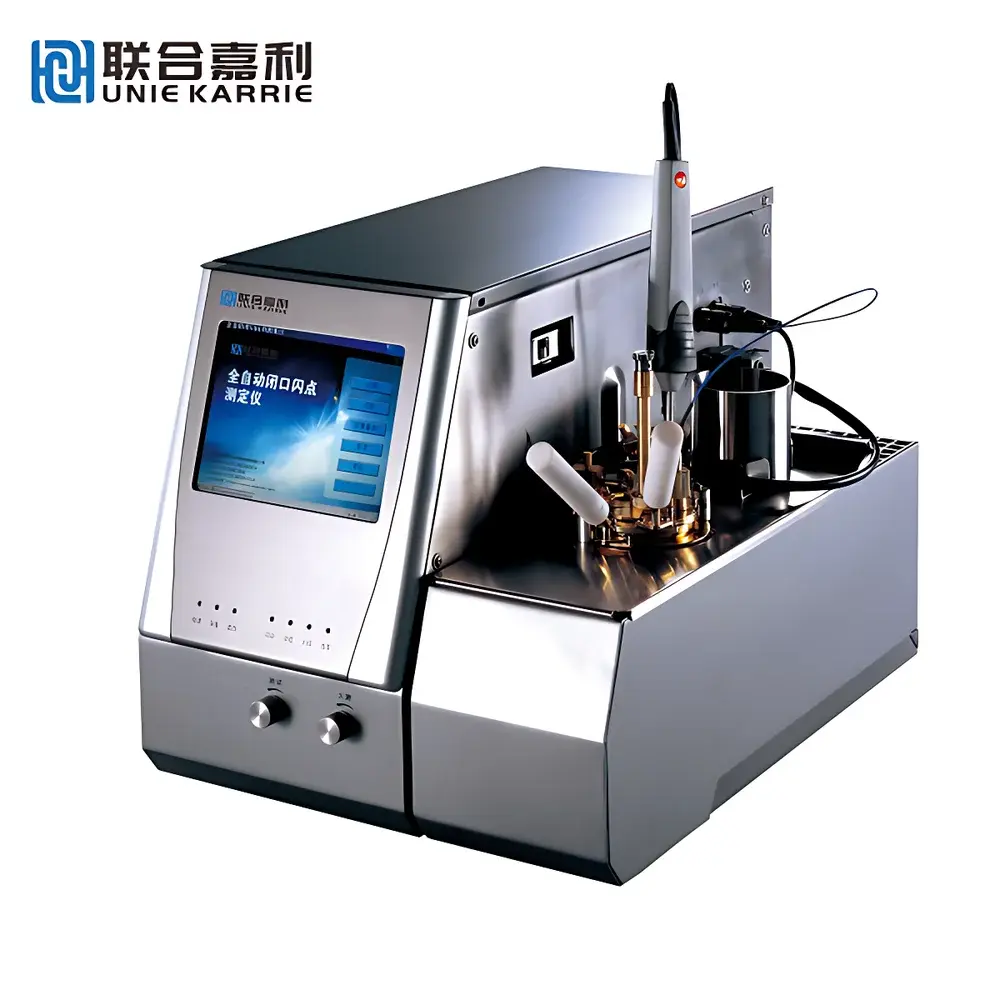
Karrie EFP110 Automated Closed-Cup Flash Point Tester
| Brand | Karrie |
|---|---|
| Model | EFP110 |
| Measurement Method | Closed-Cup (ASTM D93 / ISO 2719 / GB/T 261) |
| Temperature Range | Ambient to 400 °C |
| Power Supply | AC 220 V, 50 Hz |
| Heating Power | 630 W |
| Total Power Consumption | 750 W |
| Operating Temperature | 0–40 °C |
| Storage Temperature | −20–50 °C |
| Safety Cut-off Temperatures | Pre-Alarm at EFP+10 °C, Alarm & Continue at EFP+20 °C, Auto-Termination at 400 °C |
| Ignition Modes | Electronic or Gas Ignition |
| Display | 6.4″ Color TFT LCD (640×480) with Touch Interface |
| Dimensions (W×D×H) | 478×319×322 mm |
| Weight | 25 kg |
| Compliance | ASTM D93, ISO 2719, GB/T 261 |
| Data Interfaces | RS-232, USB 2.0, RJ-45 (Ethernet), LPT |
| OS | Windows CE 5.0 |
| Internal Storage | 4 GB Flash + 256 MB RAM |
Overview
The Karrie EFP110 Automated Closed-Cup Flash Point Tester is an industrial-grade analytical instrument engineered for precise, repeatable flash point determination of petroleum products, lubricants, solvents, and other flammable liquids according to internationally recognized closed-cup methodologies. It operates on the principle of controlled heating under sealed conditions, where vapors above the sample are periodically exposed to an ignition source until the lowest temperature at which vapor ignition occurs is identified — the flash point. This measurement is critical for safety classification (e.g., UN transport categories), quality control in refining and blending operations, regulatory compliance (OSHA, DOT, ATEX), and material specification verification. The EFP110 implements dynamic thermal ramping with real-time feedback control, ensuring strict adherence to standardized heating rates (1–1.6 °C/min for low-flash samples; 5–6 °C/min for higher-boiling fractions), as mandated by ASTM D93, ISO 2719, and GB/T 261.
Key Features
- Dual-Controller Architecture: Combines a dedicated microcontroller for real-time thermal regulation and sensor acquisition with an embedded industrial PC (256 MB RAM, 4 GB flash storage) running Windows CE 5.0 — delivering deterministic response, high data integrity, and immunity to common desktop OS vulnerabilities.
- True-Color Touch Interface: 6.4″ TFT LCD (640×480 resolution) with capacitive touch support enables intuitive navigation, graphical temperature ramp visualization, and simultaneous numeric/curve display of heating profiles.
- Redundant Ignition System: User-selectable electronic spark or gas flame ignition, both calibrated to deliver consistent energy input without biasing results — validated across matrixes including diesel, jet fuel, transformer oil, and biodiesel blends.
- Modular Sensor Design: Independent mounting of the flash sensor, Pt100 temperature probe, and cup lid assembly allows field-replaceable component service without system recalibration or downtime.
- Certified Metrology Components: German-sourced Pt100 RTD sensors and Japanese precision mechanical drive assemblies ensure long-term stability, ±0.1 °C thermal accuracy, and robust stirring performance under continuous duty cycles.
- Comprehensive Self-Diagnostic Routine: On power-up, the system verifies flash sensor continuity, thermistor resistance, ignition circuit integrity, thermal fuse status, stirrer actuation, and cooling fan readiness — reporting faults via audible alert and on-screen diagnostic code.
- Multi-Level Thermal Protection: Three-tiered overtemperature management: pre-alarm at EFP+10 °C, operational alarm at EFP+20 °C, and automatic test termination plus forced-air cooling at 400 °C — meeting IEC 61010-1 requirements for laboratory electrical safety.
Sample Compatibility & Compliance
The EFP110 accommodates standard ASTM D93 test cups (dual-purpose brass cup with gold-plated interior surface for oxidation resistance and thermal uniformity) and supports viscous and low-volatility samples up to 400 °C. Its closed-cup design eliminates ambient vapor dispersion, making it suitable for testing hazardous materials in routine QC labs, refinery process control environments, and third-party certification laboratories. The instrument complies fully with ASTM D93 (Pensky-Martens closed-cup method), ISO 2719, and Chinese national standard GB/T 261. All firmware and calibration protocols are traceable to NIST-certified reference standards. Data audit trails, user access logs, and electronic signature support align with GLP and GMP documentation requirements per FDA 21 CFR Part 11 when configured with network authentication and encrypted storage.
Software & Data Management
Embedded Windows CE 5.0 provides a familiar, menu-driven interface with full multilingual capability (English default; optional Chinese localization). Test parameters, operator ID, atmospheric pressure (manually entered or auto-compensated via optional barometric module), and environmental conditions are recorded with each result. Over 10,000 test records can be stored locally and retrieved via flexible filters — including date range, sample ID, operator name, or custom metadata tags. Export options include CSV via USB mass storage, direct printing via parallel port (LPT) to laser printers, and structured XML transmission over TCP/IP to LIMS or enterprise QA databases using standard RS-232/USB/Ethernet protocols. Firmware updates and result backups are performed securely through authenticated USB sessions.
Applications
- Refinery distillate cut verification (naphtha, kerosene, diesel)
- Transformer oil and turbine oil condition monitoring per IEEE C57.106 and ASTM D877/D1816
- Aviation fuel (Jet A-1, JP-5) flash point surveillance per DEF STAN 91-87 and ASTM D1655
- Blending stock qualification in petrochemical manufacturing
- Regulatory submission testing for SDS (Safety Data Sheet) preparation
- Research & development of bio-based lubricants and synthetic esters
- Third-party conformity assessment for ISO/IEC 17025-accredited laboratories
FAQ
What standards does the EFP110 comply with?
ASTM D93, ISO 2719, and GB/T 261 — all implemented with hardware-enforced ramp rate control and certified thermal sensors.
Can the instrument correct for atmospheric pressure?
Yes — manual entry or external barometric sensor integration enables automatic flash point correction per ASTM D93 Annex A1.
Is remote operation supported?
Yes — Ethernet (RJ-45) and RS-232 interfaces allow integration into centralized lab networks, SCADA systems, or automated test sequences via Modbus RTU or custom TCP commands.
How is calibration verified?
Using certified reference materials (CRM) such as n-decane (flash point 46 °C) and tetralin (flash point 101 °C); built-in diagnostics validate sensor linearity and ignition timing prior to each test sequence.
What maintenance is required?
Routine cleaning of the gold-plated cup and lid, annual verification of Pt100 sensor drift, and periodic inspection of stirrer coupling integrity — no consumables beyond standard fuses and ignition wires.




